

TweetFeed
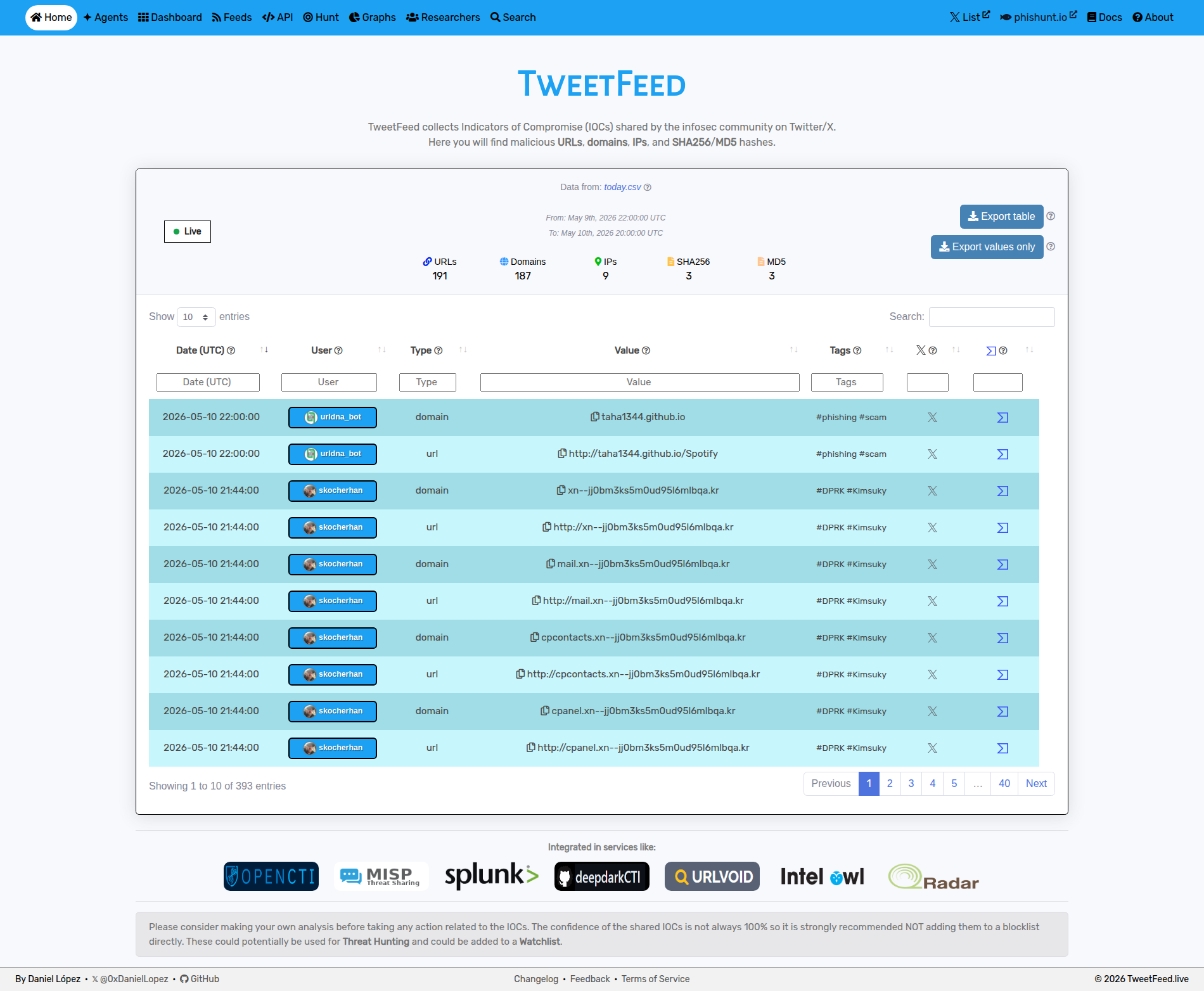
TweetFeed collects Indicators of Compromise (IOCs) shared by the infosec community at Twitter. Here you will find malicious URLs, domains, IPs, and SHA256/MD5 hashes.
**TweetFeed** is a TweetFeed collects Indicators of Compromise (IOCs) shared by the infosec community at Twitter. Here you will find malicious URLs, domains, IPs, and SHA256/MD5 hashes. The project is first published in 2021. Key topics include: blueteam, malware, malware-detection, malware-research, osint.
</div>
☰ Content
- Data collected
- Programmatic access
- Some statistics
- How it works
- Use TweetFeed in your stack
- Agent-ready surface
- License
- Author
- Disclaimer
Everything in the dynamic blocks below (date, type counters, top tags, top reporters, output example) is regenerated by the pipeline every 15 minutes. Hand-written sections are stable.
:heart: Support the project
If you like the project, please consider:
- Giving it a star :star:
- Invite to a coffee :coffee:
:page_facing_up: Data collected
<div align="center"> <h3>CSV feeds</h3> <table> <thead> </thead> <tbody> <tr> <th colspan=4>2026-06-27 08:00:22 (UTC)</th> </tr> <tr> <th>Today</th> <th>Last 7 days</th> <th>Last 30 days</th> <th>Last 365 days</th> </tr> <tr> <td>:clipboard: <a href="https://github.com/0xDanielLopez/TweetFeed/blob/master/today.csv">Today</a> (<a href="https://raw.githubusercontent.com/0xDanielLopez/TweetFeed/master/today.csv">raw</a>)</td> <td>:clipboard: <a href="https://github.com/0xDanielLopez/TweetFeed/blob/master/week.csv">Week</a> (<a href="https://raw.githubusercontent.com/0xDanielLopez/TweetFeed/master/week.csv">raw</a>)</td> <td>:clipboard: <a href="https://github.com/0xDanielLopez/TweetFeed/blob/master/month.csv">Month</a> (<a href="https://raw.githubusercontent.com/0xDanielLopez/TweetFeed/master/month.csv">raw</a>)</td> <td>:clipboard: <a href="https://github.com/0xDanielLopez/TweetFeed/blob/master/year.csv">Year</a> (<a href="https://raw.githubusercontent.com/0xDanielLopez/TweetFeed/master/year.csv">raw</a>)</td> </tr> </tbody> </table> <h3>Other formats</h3> <table> <thead> <tr> <th>Format</th> <th>URL</th> <th>Notes</th> </tr> </thead> <tbody> <tr> <td><b>RSS 2.0</b></td> <td><a href="https://raw.githubusercontent.com/0xDanielLopez/TweetFeed/master/rss.xml">rss.xml</a></td> <td>Today's IOCs (regenerated every 15 min)</td> </tr> <tr> <td><b>MISP</b></td> <td><a href="https://raw.githubusercontent.com/0xDanielLopez/TweetFeed/master/misp/manifest.json">misp/manifest.json</a></td> <td>4 events (today / week / month / year). Add as a feed in MISP via <i>Sync Actions → Feeds → Add</i>.</td> </tr> <tr> <td><b>STIX 2.1</b></td> <td><a href="https://raw.githubusercontent.com/0xDanielLopez/TweetFeed/master/stix/manifest.json">stix/manifest.json</a></td> <td>Bundles for today / week / month</td> </tr> </tbody> </table> </div> <div align="center"> <h3>Output example</h3> <p><b>CSV schema</b></p> <pre><code>date, user, type, value, tags, tweet_url</code></pre><sub>Live samples: <a href="https://github.com/0xDanielLopez/TweetFeed/blob/master/today.csv">today.csv</a></sub>
</div>:gear: Programmatic access
<div align="center"> <table> <thead> <tr> <th>Surface</th> <th>URL</th> <th>Use case</th> </tr> </thead> <tbody> <tr> <td><b>REST API</b></td> <td><a href="https://api.tweetfeed.live/v1">api.tweetfeed.live</a></td> <td>JSON, no auth, CORS enabled. <code>/v1/{today,week,month,year}[/{type}[/{tag}]]</code></td> </tr> <tr> <td><b>MCP server</b></td> <td><a href="https://mcp.tweetfeed.live">mcp.tweetfeed.live</a></td> <td>JSON-RPC 2.0 endpoint exposing 8 tools (<code>query_iocs</code>, <code>check_url</code>, <code>check_ip</code>, <code>check_hash</code>, <code>list_recent_iocs</code>, <code>get_tag_info</code>, <code>get_trending</code>, <code>enrich_ioc</code>) for Claude / AI agents</td> </tr> </tbody> </table>See <a href="https://tweetfeed.live/agents/">tweetfeed.live/agents/</a> for the copy-paste MCP config and full tool reference.
</div>:bar_chart: Some statistics
<div align="center"> <h3>Types</h3>| Type | Today | Week | Month | Year |
|---|---|---|---|---|
| :link: URLs | 3 | 463 | 5404 | 54831 |
| :globe_with_meridians: Domains | 3 | 374 | 4732 | 39305 |
| :triangular_flag_on_post: IPs | 0 | 106 | 683 | 13124 |
| :1234: SHA256 | 3 | 112 | 589 | 1874 |
| :1234: MD5 | 0 | 40 | 177 | 2612 |
<div align="center"> <h3>Top 10 tags <sub>(by year activity, refreshed every 15 min)</sub></h3> <!-- TAG_TABLE_START -->
| Tag | Today | Week | Month | Year |
|---|---|---|---|---|
| #phishing | 6 | 465 | 2968 | 36526 |
| #C2 | 0 | 34 | 336 | 18309 |
| #Kimsuky | 0 | 4 | 4918 | 12988 |
| #DPRK | 0 | 0 | 4900 | 11333 |
| #scam | 0 | 11 | 526 | 6764 |
| #CobaltStrike | 0 | 2 | 13 | 4771 |
| #malware | 0 | 51 | 310 | 2471 |
| #Interactsh | 0 | 0 | 0 | 1792 |
| #APT | 0 | 32 | 198 | 1705 |
| #Remcos | 0 | 1 | 30 | 1423 |
The full catalog of 120 tags with per-tag landing pages and CSV exports lives at tweetfeed.live/tags/.
</div><div align="center"> <h3>Top Reporters (today)</h3> <!-- TOP_REPORTERS_START -->
| Number | User | IOCs |
|---|---|---|
| #1 | Q8CyberTi | 4 |
| #2 | bomccss | 3 |
| #3 | masaomi346 | 2 |
| #4 | - | 0 |
| #5 | - | 0 |
| #6 | - | 0 |
| #7 | - | 0 |
| #8 | - | 0 |
| #9 | - | 0 |
| #10 | - | 0 |
:question: How it works?
Search tweets that contain certain tags or that are posted by certain infosec people.
Tags being searched
(case-insensitive matching, top 10 by year activity, refreshed every 15 min)
<!-- TAGS_LIST_START -->#phishing, #C2, #Kimsuky, #DPRK, #scam, #CobaltStrike, #malware,
#Interactsh, #APT, #Remcos
The full list of 120 tags lives at tweetfeed.live/tags/.
Also search Tweets posted by
(these are trusted folks that sometimes don't use tags)
<big><pre>
TweetFeed list
</pre></big>
:mag: Use TweetFeed in your stack
TweetFeed publishes the same data in CSV / JSON / RSS / MISP / STIX so you can wire it into whichever SIEM, EDR, or TIP you already run. Examples below default to year.csv (1-year window); swap to month.csv / week.csv / today.csv to keep the dataset smaller.
1. Match SHA256 hashes against the yearly feed
kustolet MaxAge = ago(30d); let SHA256_whitelist = pack_array( 'XXX' // Some SHA256 hash you want to whitelist. ); let TweetFeed = materialize ( (externaldata(report:string) [@"https://raw.githubusercontent.com/0xDanielLopez/TweetFeed/master/year.csv"] with (format = "txt")) | extend report = parse_csv(report) | extend Type = tostring(report[2]) | where Type == 'sha256' | extend SHA256 = tostring(report[3]) | where SHA256 !in(SHA256_whitelist) | extend Tag = tostring(report[4]) | extend Tweet = tostring(report[5]) | project SHA256, Tag, Tweet ); union ( TweetFeed | join ( DeviceProcessEvents | where Timestamp > MaxAge ) on SHA256 ), ( TweetFeed | join ( DeviceFileEvents | where Timestamp > MaxAge ) on SHA256 ), ( TweetFeed | join ( DeviceImageLoadEvents | where Timestamp > MaxAge ) on SHA256 ) | project Timestamp, DeviceName, FileName, FolderPath, SHA256, Tag, Tweet
2. Match IP addresses against the monthly feed
kustolet MaxAge = ago(30d); let IPaddress_whitelist = pack_array( 'XXX' // Some IP address you want to whitelist. ); let TweetFeed = materialize ( (externaldata(report:string) [@"https://raw.githubusercontent.com/0xDanielLopez/TweetFeed/master/month.csv"] with (format = "txt")) | extend report = parse_csv(report) | extend Type = tostring(report[2]) | where Type == 'ip' | extend RemoteIP = tostring(report[3]) | where RemoteIP !in(IPaddress_whitelist) | where not(ipv4_is_private(RemoteIP)) | extend Tag = tostring(report[4]) | extend Tweet = tostring(report[5]) | project RemoteIP, Tag, Tweet ); union ( TweetFeed | join ( DeviceNetworkEvents | where Timestamp > MaxAge ) on RemoteIP ) | project Timestamp, DeviceName, RemoteIP, Tag, Tweet
3. Match URLs and domains against the weekly feed
kustolet MaxAge = ago(30d); let domain_whitelist = pack_array( 'XXX' // Some URL/Domain you want to whitelist. ); let TweetFeed = materialize ( (externaldata(report:string) [@"https://raw.githubusercontent.com/0xDanielLopez/TweetFeed/master/week.csv"] with (format = "txt")) | extend report = parse_csv(report) | extend Type = tostring(report[2]) | where Type in('url','domain') | extend RemoteUrl = tostring(report[3]) | where RemoteUrl !in(domain_whitelist) | extend Tag = tostring(report[4]) | extend Tweet = tostring(report[5]) | project RemoteUrl, Tag, Tweet ); union ( TweetFeed | join ( DeviceNetworkEvents | where Timestamp > MaxAge ) on RemoteUrl ) | project Timestamp, DeviceName, RemoteUrl, Tag, Tweet
The same KQL works in Microsoft Sentinel if you replace DeviceProcessEvents / DeviceNetworkEvents with the equivalent Sentinel tables (SecurityEvent, CommonSecurityLog, etc.).
Schedule a recurring CSV import via the Add-on Builder or the inputs.conf REST modular input. Then:
splindex=firewall earliest=-30d | join dest_ip [ | inputlookup tweetfeed_iocs.csv | where Type="ip" | rename Value AS dest_ip | fields dest_ip, Tags, Tweet ] | stats count by src_ip, dest_ip, Tags
For proxy / DNS logs vs. URLs and domains:
splindex=proxy sourcetype=zscaler earliest=-7d | join url [ | inputlookup tweetfeed_iocs.csv | where Type IN ("url","domain") | rename Value AS url | fields url, Tags, Tweet ] | table _time, src, dest, url, Tags, Tweet
For process-execution hashes:
</details> <details> <summary><b>Elastic Security / OpenSearch</b> <sub>(Filebeat <code>threatintel</code> module + indicator-match rule)</sub></summary> <br>splindex=endpoint sourcetype=Sysmon EventCode=1 earliest=-30d | eval hash=lower(Hashes) | join hash [ | inputlookup tweetfeed_iocs.csv | where Type IN ("sha256","md5") | rename Value AS hash | fields hash, Tags, Tweet ] | table _time, host, Image, hash, Tags, Tweet
Add the MISP feed to your filebeat.yml:
yaml- module: threatintel misp: enabled: true var.url: "https://raw.githubusercontent.com/0xDanielLopez/TweetFeed/master/misp/manifest.json" var.interval: 15m
Then create an indicator-match rule mapping your data to the threat fields:
| Source field | Threat field |
|---|---|
destination.ip | threat.indicator.ip |
url.full | threat.indicator.url.full |
dns.question.name | threat.indicator.url.domain |
file.hash.sha256 | threat.indicator.file.hash.sha256 |
file.hash.md5 | threat.indicator.file.hash.md5 |
Tags + tweet URLs are preserved as enrichment fields on each match (threat.indicator.description, threat.indicator.reference).
For OpenSearch the same approach works via the Security Analytics threat intel framework using the STIX bundles at stix/manifest.json.
| TIP | How to add TweetFeed |
|---|---|
| MISP | Sync Actions → Feeds → Add with URL https://raw.githubusercontent.com/0xDanielLopez/TweetFeed/master/misp/manifest.json (4 events: today / week / month / year, regenerated every 15 min). |
| OpenCTI | Use the official tweetfeed connector. |
| TheHive 5 | Import the STIX bundles at https://raw.githubusercontent.com/0xDanielLopez/TweetFeed/master/stix/manifest.json via the MISP-Hive connector or directly through the API. |
Pull today's phishing URLs:
bashcurl -s 'https://api.tweetfeed.live/v1/today/phishing/url' | jq -r '.[].value'
Cross-check a hash against the year window:
bashHASH=XXX # any SHA256 you want to look up curl -s 'https://raw.githubusercontent.com/0xDanielLopez/TweetFeed/master/year.csv' \ | awk -F, -v h="$HASH" '$3=="sha256" && $4==h'
Pandas one-liner — top 20 IPs reported in the last year:
pythonimport pandas as pd df = pd.read_csv('https://raw.githubusercontent.com/0xDanielLopez/TweetFeed/master/year.csv', names=['date','user','type','value','tags','tweet']) print(df[df.type == 'ip'].groupby('value').size().sort_values(ascending=False).head(20))
For interactive querying via Claude / AI agents, see Programmatic access above (the MCP server exposes the same data with built-in query helpers).
</details>:robot: Agent-ready surface
TweetFeed is built for consumption by AI agents and LLM-based tooling:
/.well-known/agent-skills/index.json- skill discovery (RFC v0.2.0)/.well-known/mcp/server-card.json- MCP server card (SEP-1649 draft)/llms.txt- llms.txt index/agents/- human-readable overview with copy-paste MCP config
Plug the MCP endpoint above into Claude Desktop / Claude Code / any MCP-aware client to query feeds in natural language.
:balance_scale: License
The data feeds (CSV, JSON, RSS, MISP, STIX) and the public API responses are released under CC0 1.0 Universal - no rights reserved, reuse freely, no attribution required.
A primer on how to put this data to work in detection workflows lives at tweetfeed.live/docs/.
:bust_in_silhouette: Author
:pushpin: Disclaimer
Please note that all the data is collected from Twitter/X and sorted/served here as it is on best effort.
I have tried to tune as much as possible the searches trying to collect only valuable info. However please consider making your own analysis before taking any action related to these IOCs.
Anyway feel free to reach me out or to provide any kind of feedback regarding any contribution or suggestion.
<hr><b>By the community, for the community.</b>
Related Repositories

chaitin/SafeLine
SafeLine is a self-hosted WAF(Web Application Firewall) / reverse proxy to protect your web apps from attacks and exploits.

laramies/theHarvester
E-mails, subdomains and names Harvester - OSINT

GTFOBins/GTFOBins.github.io
GTFOBins is a curated list of Unix-like executables that can be used to bypass local security restrictions in misconfigured systems.

LOLBAS-Project/LOLBAS
Living Off The Land Binaries And Scripts - (LOLBins and LOLScripts)

yaklang/yakit
Cyber Security ALL-IN-ONE Platform

ihebski/DefaultCreds-cheat-sheet
One place for all the default credentials to assist the Blue/Red teamers identifying devices with default password 🛡️