

Forge film
Multi-model DAG-driven parallel AI film generation — parallel speedup scales with scene independence; Generate film scenes simultaneously instead of one by one; "把影视生成的执行图从拓扑序变成关键路径最优调度" ; 唯一把场景叙事依赖建模为 DAG、以 CPM 算法驱动并行调度的影视生成引擎
**forge film** is a Multi-model DAG-driven parallel AI film generation — parallel speedup scales with scene independence; Generate film scenes simultaneously instead of one by one; "把影视生成的执行图从拓扑序变成关键路径最优调度" ; 唯一把场景叙事依赖建模为 DAG、以 CPM 算法驱动并行调度的影视生成引擎 The project is written primarily in Python, distributed under the MIT License license, first published in 2026. Key topics include: ai, ai-cinematography, ai-filmmaking, ai-video-generation, cpm.
🎬 Forge
One story, multiple AI models, zero manual stitching.


Making a multi-scene AI film means logging into Kling, CogVideoX, Seedance separately — downloading frames, color-correcting between models, stitching manually. An 8-scene short can eat half a day.
Forge automates the entire pipeline. You write a story. Forge compiles it into a scene graph, routes each scene to the right model, runs them in parallel, keeps visual continuity across model boundaries, and outputs a single final.mp4.
What Forge does
🧭 Story → DAG — GPT-4o (or Claude / DeepSeek) compiles your story into a dependency graph. Scenes with no dependencies run in parallel.
⚡ CPM parallel scheduling — Critical Path Method finds the longest dependency chain and prioritizes it. N workers run simultaneously, not one by one.
🎯 Scene-type routing — dialogue → Kling, landscapes → CogVideoX (free, local), action → Kling. Fully configurable in forge.yaml.
🎨 Cross-model continuity — when scene B (CogVideoX) follows scene A (Kling), Forge extracts A's last frame, applies histogram color matching, and passes it as the i2v seed. No jarring cuts.
🎬 Final assembly — once all scenes are generated, clips are concatenated in a single ffmpeg pass. Normalized resolution and frame rate. Outputs final.mp4.
End-to-end walkthrough
Given this story (examples/detective.txt):
A weary private detective takes on a missing-person case. His client is an anxious middle-aged woman whose husband vanished without a trace three days ago.
The detective searches the husband's office and finds an unsent letter and a basement key.
Meanwhile, a mysterious man begins tailing the detective through the streets.
The detective locates the basement and discovers a secret ledger the missing husband had hidden away.
The mysterious man suddenly appears — a confrontation erupts.
The detective delivers the secret ledger to the police, and the truth finally comes to light.
Forge compiles it into a DAG and schedules:
forge plan examples/detective.txt --scenes 6

Plan: 6 scenes
DAG: {'S1': ['S2', 'S3'], 'S2': ['S4'], 'S3': ['S5'], 'S4': ['S6'], 'S5': ['S6'], 'S6': []}

Routing:
  S1  dialogue    → kling_light
  S2  action      → kling_heavy
  S3  landscape   → cogvideo
  S4  action      → kling_heavy
  S5  dialogue    → kling_light
  S6  dialogue    → kling_light

Critical path: S1 → S2 → S4 → S6  (longest chain)
Estimated time: 20 min parallel  vs  30 min serial
Then runs:
forge run examples/detective.txt --workers 4

[00:00] S1 started  (kling_light)
[00:00] S3 started  (cogvideo)       ← parallel
[05:00] S1 done  → S2 unlocked
[05:00] S2 started  (kling_heavy)
[07:00] S3 done  → S3→S2 color calibration applied
[10:00] S2 done  → S4 unlocked
[10:00] S4 started  (kling_heavy)
...
[20:00] S6 done  → assembling final.mp4

Done. Output: ./output/final.mp4
Parallel scheduling
Forge uses the Critical Path Method (CPM) to find the longest dependency chain in your scene DAG and prioritizes those scenes first. Scenes with no blocking dependencies start immediately.
In the example above: S1→S2→S4→S6 is the critical path. With 4 workers, S1 and S3 launch simultaneously at t=0. The total wall time drops from 30 min (serial) to 20 min.
Speedup scales with scene independence — a story where half the scenes are parallel will run roughly 2× faster.
mermaidgantt title Without Forge — 6 scenes × 5 min = 30 min dateFormat mm axisFormat %M min section Sequential S1 :s1, 00, 5m S2 :s2, after s1, 5m S3 :s3, after s2, 5m S4 :s4, after s3, 5m S5 :s5, after s4, 5m S6 :s6, after s5, 5m
mermaidgantt title With Forge (CPM) — critical path = 15 min dateFormat mm axisFormat %M min section Worker 1 S1 (Kling) :s1, 00, 5m S3 (CogVideoX) :s3, after s1, 5m S5 (Seedance) :s5, after s3, 5m section Worker 2 S2 (Kling) :s2, 00, 5m S4 (CogVideoX) :s4, after s2, 5m S6 (Seedance) :s6, after s4, 5m
Cross-model continuity
Kling, CogVideoX, and Seedance have different color profiles, exposure levels, and visual styles. Cutting directly between them produces jarring transitions.
When scene B depends on scene A and they use different backends, Forge automatically:
- Extracts the last frame of scene A
- Applies histogram color matching to align the color distribution
- Passes the corrected frame as the i2v (image-to-video) seed for scene B
The result: visual continuity across model boundaries without manual color grading.
mermaidflowchart LR A["Scene A\nKling"] -->|"last frame"| B["ColorCalibrator\nhistogram match"] B -->|"seed image"| C["Scene B\nCogVideoX"] C -->|"last frame"| D["ColorCalibrator\nhistogram match"] D -->|"seed image"| E["Scene C\nSeedance"] style B fill:#f0a500,color:#000 style D fill:#f0a500,color:#000
🚀 Quickstart
[!NOTE]
No API keys? Use--backend mockfor a full end-to-end run with zero external dependencies.
Requirements: Python 3.11+ · ffmpeg · GPU optional (CogVideoX local needs CUDA 12+)
bashgit clone https://github.com/F-R-L/forge-film cd forge-film pip install -e . cp .env.example .env
bash# Run with mock backend — no API keys needed forge run examples/detective.txt --backend mock --workers 4 # Multi-model orchestration forge run examples/multi_backend_demo.txt --workers 4 # Inspect DAG and routing without generating video forge plan examples/detective.txt --scenes 6 # Launch Web UI forge webui
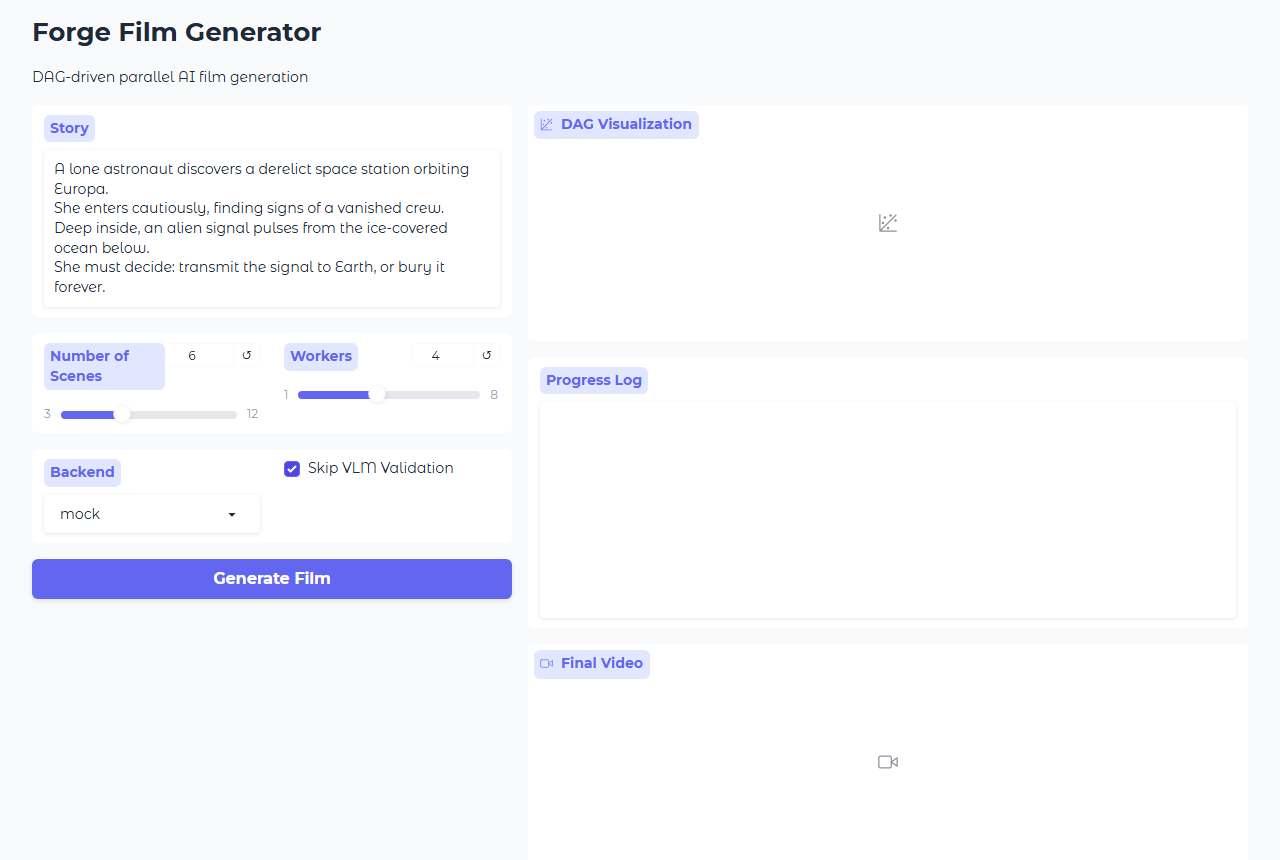
Web UI — Run forge webui to launch the Gradio interface locally.
As a library
pythonfrom forge.config import ForgeConfig from forge.compiler.vision_compiler import VisionCompiler from forge.scheduler.scheduler import ForgeScheduler cfg = ForgeConfig("forge.yaml") compiler = VisionCompiler(cfg.build_llm_provider()) plan = await compiler.compile(story_text, num_scenes=6) scheduler = ForgeScheduler(plan, generate_fn, num_workers=cfg.workers) results, failed = await scheduler.run(asset_map, output_dir="./output")
⚙️ Configuration
forge.yaml — all fields optional, falls back to environment variables and defaults.
yamlllm: provider: openai # openai | anthropic | deepseek model: gpt-4o imagegen: provider: mock # mock | openai | flux routing: dialogue: kling_light # Kling v1 — lip sync & character consistency action: kling_heavy # Kling v1.5 Pro — motion quality landscape: cogvideo # CogVideoX local — free default: mock scheduler: workers: 4
bash# .env OPENAI_API_KEY=sk-... KLING_API_KEY=... KLING_API_SECRET=...
| Key | Options | Default |
|---|---|---|
llm.provider | openai | anthropic | deepseek | openai |
imagegen.provider | openai | flux | mock | mock |
validator.provider | openai | anthropic | mock | mock |
routing.dialogue | any backend name | kling_light |
routing.landscape | any backend name | cogvideo |
scheduler.workers | int | 4 |
🆚 How Forge compares
| Forge | OpusClip Agent | Seedance Multi-shot | FilmAgent | |
|---|---|---|---|---|
| Open source | ✅ MIT | ❌ Closed SaaS | ❌ | ✅ Research prototype |
| Local deployment | ✅ | ❌ | ❌ | Partial |
| Multi-model mixing | ✅ | ✅ not configurable | ❌ single model | ❌ 3D virtual space |
| Cross-model color calibration | ✅ | Unknown | N/A | N/A |
| Pluggable backends | ✅ | ❌ | ❌ | ❌ |
| Data privacy | ✅ stays local | ❌ third-party | ❌ | Partial |
🎬 Supported backends
| Backend | Type | Best for | Cost |
|---|---|---|---|
kling_light | API (Kling v1) | Dialogue, character consistency, lip sync | Per-second |
kling_heavy | API (Kling v1.5 Pro) | Action, complex motion, longer clips | Per-second (higher) |
cogvideo | Local (CogVideoX-2b) | Landscapes, transitions, atmospheric shots | Free (GPU) |
seedance | API (Seedance) | Fast motion, sports, dynamic scenes | Per-second |
wan | Local (Wan 2.x) | General purpose, good quality/cost ratio | Free (GPU) |
mock | Local (no-op) | Testing, CI, development | Free |
All backends implement the same BasePipeline interface — adding a new one takes ~50 lines.
❓ FAQ
Do I need a GPU?
No. All cloud backends (Kling, Seedance) are API-based. A GPU is only needed if you use the local CogVideoX or Wan backends.
Can I use only one video model?
Yes. Set all routing keys to the same backend in forge.yaml, or pass --backend kling_light on the CLI.
How does Forge handle API failures?
Each scene retries up to scheduler.max_retries times (default: 2) with exponential backoff. Failed scenes are returned in the failed dict so you can inspect or re-run them.
What video formats does the assembler output?
H.264 MP4 by default via ffmpeg. Resolution and frame rate are normalized across all input clips before concatenation.
Can I plug in my own video model?
Yes — subclass BasePipeline in forge/generation/base.py, implement generate(), and register it in the router. No changes needed elsewhere.
🏗️ Architecture
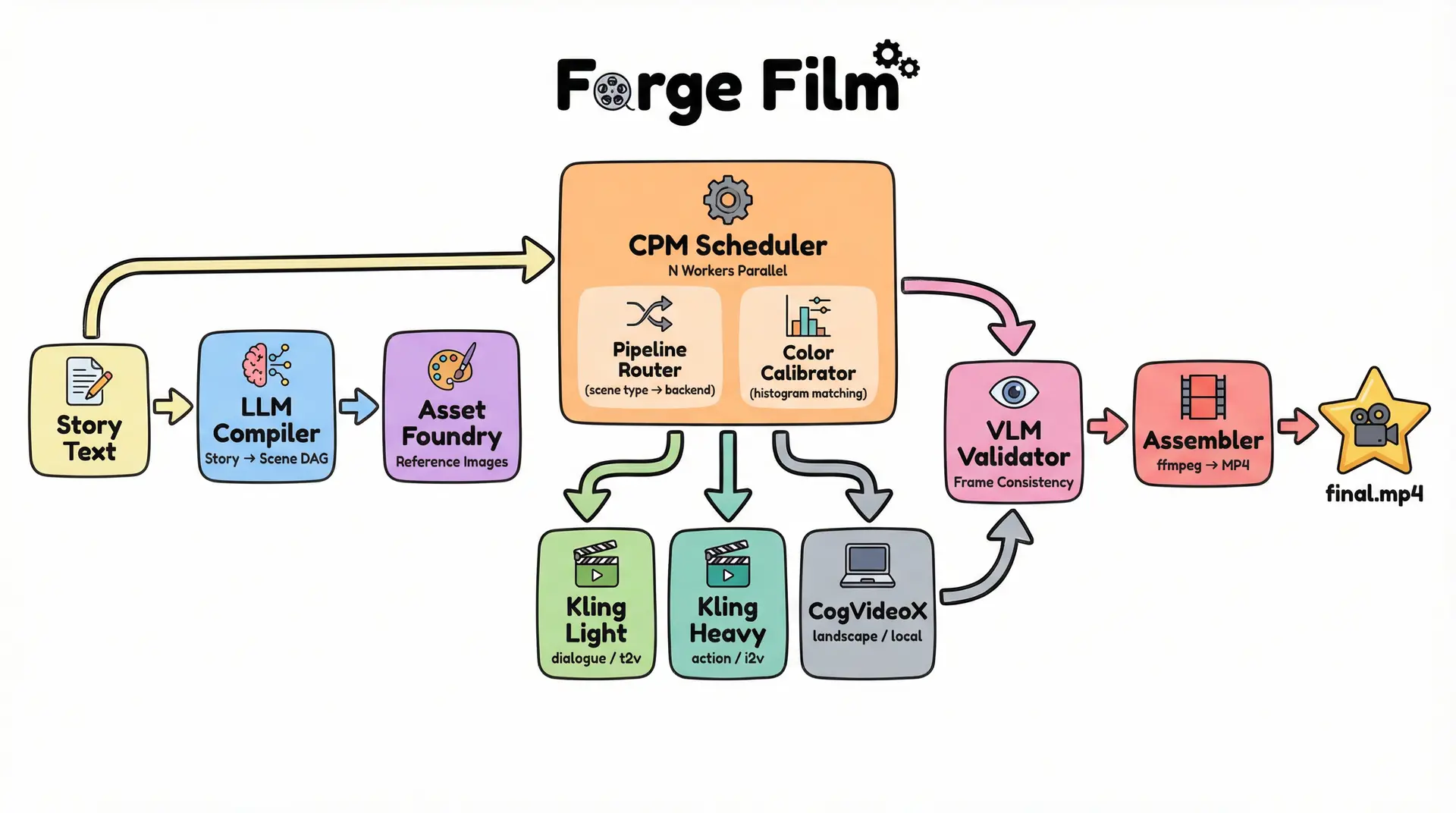
forge.yaml
    │
    ├── VisionCompiler   story → ProductionPlan (scenes + DAG)
    ├── AssetFoundry     reference images per character / location
    ├── ForgeScheduler   CPM critical path · N workers · retries
    │       ├── PipelineRouter    scene_type → kling / cogvideo / seedance
    │       └── ColorCalibrator   last-frame histogram match for i2v
    ├── VLM Validator    optional frame consistency check
    └── StreamAssembler  ffmpeg concat → final.mp4
📁 Project structure
forge/
  compiler/      # Story → DAG (LLM-driven)
  providers/     # LLM / ImageGen / VLM abstractions
  scheduler/     # DAG topology + CPM scheduling
  generation/    # Video backend pipelines
  continuity/    # Cross-model color calibration
  assets/        # Reference image generation + cache
  validation/    # VLM frame consistency check
  assembler/     # Streaming video concatenation
  cli.py
  webui/
forge.yaml
examples/
tests/         # 20 tests, no API keys needed
benchmarks/
🗺️ Roadmap
- Multi-model semantic routing by scene type
- Cross-model color calibration (histogram matching)
- Pluggable LLM / ImageGen / VLM providers
- CPM scheduling with backend-aware duration estimates
- forge.yaml unified config
- Gradio Web UI
- CogVideoX local backend
- Seedance backend
- Wan 2.x backend
- GPU-accelerated local video assembly
- Story template library
- Real benchmark results with Kling API
🤝 Contributing
PRs and issues welcome — see CONTRIBUTING.md.
📄 License
MIT — see LICENSE
Contributors
Showing top 1 contributor by commit count.

Related Repositories

openclaw/openclaw
Your own personal AI assistant. Any OS. Any Platform. The lobster way. 🦞

obra/superpowers
An agentic skills framework & software development methodology that works.

NousResearch/hermes-agent
The agent that grows with you

n8n-io/n8n
Fair-code workflow automation platform with native AI capabilities. Combine visual building with custom code, self-host or cloud, 400+ integrations.

Significant-Gravitas/AutoGPT
AutoGPT is the vision of accessible AI for everyone, to use and to build on. Our mission is to provide the tools, so that you can focus on what matters.

f/prompts.chat
f.k.a. Awesome ChatGPT Prompts. Share, discover, and collect prompts from the community. Free and open source — self-host for your organization with complete privacy.