

DeepRecommender
Deep learning for recommender systems
This is not an official NVIDIA product. It is a research project described in: "Training Deep AutoEncoders for Collaborative Filtering"(https://arxiv.org/abs/1708.01715) The project is written primarily in Python, distributed under the MIT License license, first published in 2017. It has gained significant community traction with 1,705 stars and 342 forks on GitHub. Key topics include: collaborative-filtering, deep-autoencoders, deep-learning, gpu, recommendation-engine.
Deep AutoEncoders for Collaborative Filtering
This is not an official NVIDIA product. It is a research project described in: "Training Deep AutoEncoders for Collaborative Filtering"(https://arxiv.org/abs/1708.01715)
The model
The model is based on deep AutoEncoders.
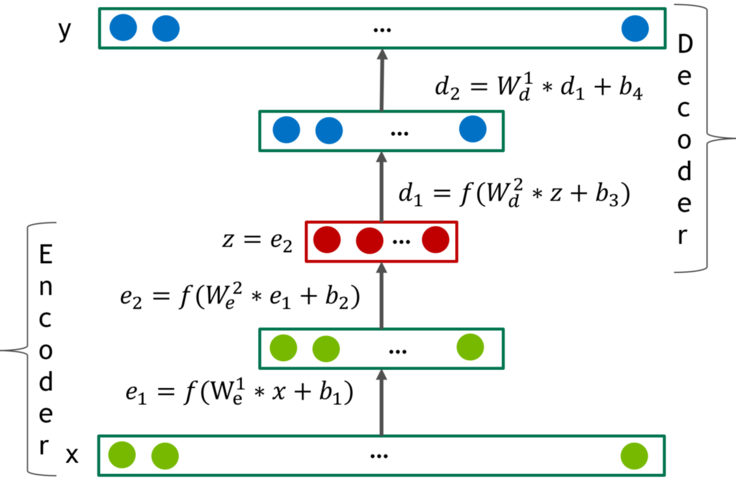
Requirements
- Python 3.6
- Pytorch:
pipenv install - CUDA (recommended version >= 8.0)
Training using mixed precision with Tensor Cores
- You would need NVIDIA Volta-based GPU
- Checkout mixed precision branch
- For theory on mixed precision training see Mixed Precision Training paper
Getting Started
Run unittests first
The code is intended to run on GPU. Last test can take a minute or two.
$ python -m unittest test/data_layer_tests.py
$ python -m unittest test/test_model.py
Tutorial
Checkout this tutorial by miguelgfierro.
Get the data
Note: Run all these commands within your DeepRecommender folder
- Download from here into your
DeepRecommenderfolder
$ tar -xvf nf_prize_dataset.tar.gz
$ tar -xf download/training_set.tar
$ python ./data_utils/netflix_data_convert.py training_set Netflix
Data stats
| Dataset | Netflix 3 months | Netflix 6 months | Netflix 1 year | Netflix full |
|---|---|---|---|---|
| Ratings train | 13,675,402 | 29,179,009 | 41,451,832 | 98,074,901 |
| Users train | 311,315 | 390,795 | 345,855 | 477,412 |
| Items train | 17,736 | 17,757 | 16,907 | 17,768 |
| Time range train | 2005-09-01 to 2005-11-31 | 2005-06-01 to 2005-11-31 | 2004-06-01 to 2005-05-31 | 1999-12-01 to 2005-11-31 |
| -------- | ---------------- | ----------- | ------------ | |
| Ratings test | 2,082,559 | 2,175,535 | 3,888,684 | 2,250,481 |
| Users test | 160,906 | 169,541 | 197,951 | 173,482 |
| Items test | 17,261 | 17,290 | 16,506 | 17,305 |
| Time range test | 2005-12-01 to 2005-12-31 | 2005-12-01 to 2005-12-31 | 2005-06-01 to 2005-06-31 | 2005-12-01 to 2005-12-31 |
Train the model
In this example, the model will be trained for 12 epochs. In paper we train for 102.
python run.py --gpu_ids 0 \
--path_to_train_data Netflix/NF_TRAIN \
--path_to_eval_data Netflix/NF_VALID \
--hidden_layers 512,512,1024 \
--non_linearity_type selu \
--batch_size 128 \
--logdir model_save \
--drop_prob 0.8 \
--optimizer momentum \
--lr 0.005 \
--weight_decay 0 \
--aug_step 1 \
--noise_prob 0 \
--num_epochs 12 \
--summary_frequency 1000
Note that you can run Tensorboard in parallel
$ tensorboard --logdir=model_save
Run inference on the Test set
python infer.py \
--path_to_train_data Netflix/NF_TRAIN \
--path_to_eval_data Netflix/NF_TEST \
--hidden_layers 512,512,1024 \
--non_linearity_type selu \
--save_path model_save/model.epoch_11 \
--drop_prob 0.8 \
--predictions_path preds.txt
Compute Test RMSE
python compute_RMSE.py --path_to_predictions=preds.txt
After 12 epochs you should get RMSE around 0.927. Train longer to get below 0.92
Results
It should be possible to achieve the following results. Iterative output re-feeding should be applied
once during each iteration.
(exact numbers will vary due to randomization)
| DataSet | RMSE | Model Architecture |
|---|---|---|
| Netflix 3 months | 0.9373 | n,128,256,256,dp(0.65),256,128,n |
| Netflix 6 months | 0.9207 | n,256,256,512,dp(0.8),256,256,n |
| Netflix 1 year | 0.9225 | n,256,256,512,dp(0.8),256,256,n |
| Netflix full | 0.9099 | n,512,512,1024,dp(0.8),512,512,n |
Contributors
Showing top 8 contributors by commit count.



Related Repositories

gorse-io/gorse
AI powered open source recommender system engine supports classical/LLM rankers and multimodal content via embedding

hongleizhang/RSPapers
RSTutorials: A Curated List of Must-read Papers on Recommender System.

RUCAIBox/RecBole
A unified, comprehensive and efficient recommendation library

benfred/implicit
Fast Python Collaborative Filtering for Implicit Feedback Datasets

guoguibing/librec
LibRec: A Leading Java Library for Recommender Systems, see

robi56/Deep-Learning-for-Recommendation-Systems
This repository contains Deep Learning based articles , paper and repositories for Recommender Systems