

Data tamer
C++ library for Fearless Timeseries Logging
**DataTamer** is a library to log/trace numerical variables over time and takes periodic "snapshots" of their values, to later visualize them as **timeseries**. The project is written primarily in C++, distributed under the MIT License license, first published in 2023. Key topics include: logging, plotjuggler, real-time, timeseries-data, tracing.




DataTamer is a library to log/trace numerical variables over time and
takes periodic "snapshots" of their values, to later visualize them as timeseries.
It works great with PlotJuggler,
the timeseries visualization tool (note: you will need PlotJuggler 3.8.2 or later).
DataTamer is "fearless data logger" because you can record hundreds or thousands of variables:
even 1 million points per second should have a fairly small CPU overhead.
Since all the values are aggregated in a single "snapshot", it is usually meant to
record data in a periodic loop (a very frequent use case, in robotics applications).
Kudos to pal_statistics, for inspiring this project.
How it works
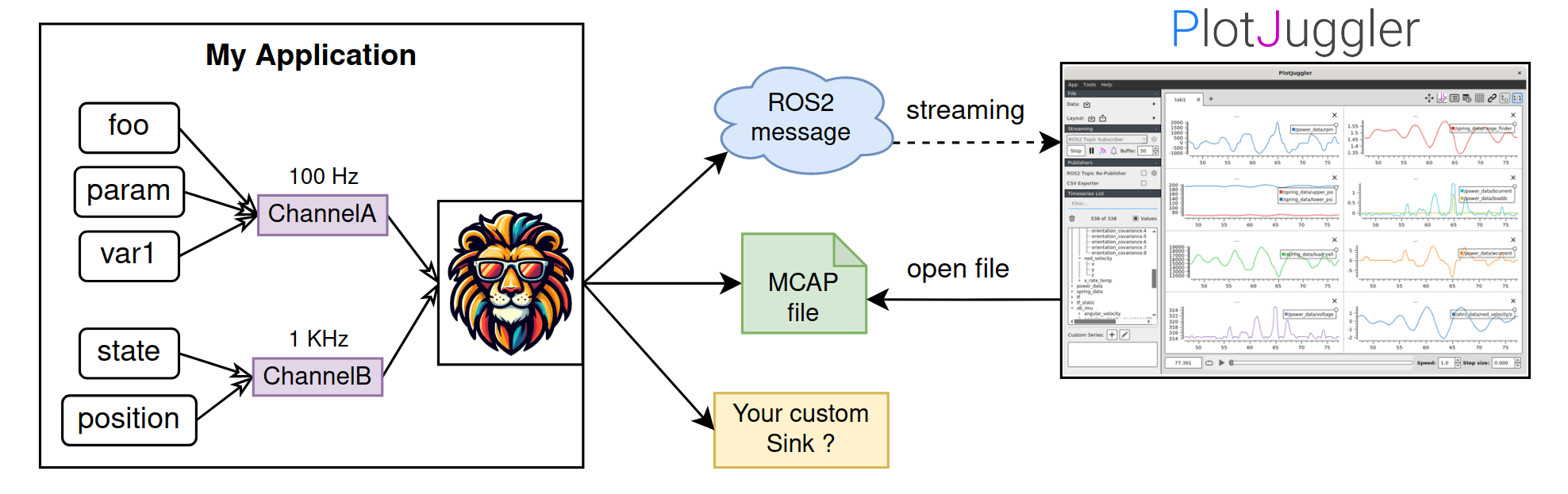
DataTamer can be used to monitor multiple variables in your applications.
Channels are used to take "snapshots" of a subset of variables at a given time.
If you want to record at different frequencies, you can use different channels.
DataTamer will forward the collected data to 1 or multiple sinks;
a sink may save the information immediately in a file (currently, we support MCAP)
or publish it using an inter-process communication, for instance, a ROS2 publisher.
You can easily create your own, specialized sinks.
Use PlotJuggler to
visualize your logs offline or in real-time.
Features
- Serialization schema is created at run-time: no need to do code generation.
- Suitable for real-time applications: very low latency (on the side of the callee).
- Multi-sink architecture: recorded data can be forwarded to multiple "backends".
- Very low serialization overhead, in the order of 1 bit per traced value.
- The user can enable/disable traced variables at run-time.
Limitations
- Traced variables can not be added (registered) once the recording starts (first
takeSnapshot). - Focused on periodic recording. Not the best option for sporadic, asynchronous events.
- If you use
DataTamer::registerValueyou must be careful about the lifetime of the
object. If you prefer a safer RAII interface, useDataTamer::createLoggedValueinstead.
Examples
Basic example
cpp#include "data_tamer/data_tamer.hpp" #include "data_tamer/sinks/mcap_sink.hpp" int main() { // Multiple channels can use this sink. Data will be saved in mylog.mcap auto mcap_sink = std::make_shared<DataTamer::MCAPSink>("mylog.mcap"); // Create a channel and attach a sink. A channel can have multiple sinks auto channel = DataTamer::LogChannel::create("my_channel"); channel->addDataSink(mcap_sink); // You can register any arithmetic value. You are responsible for their lifetime! double value_real = 3.14; int value_int = 42; auto id1 = channel->registerValue("value_real", &value_real); auto id2 = channel->registerValue("value_int", &value_int); // If you prefer to use RAII, use this method instead // logged_real will unregister itself when it goes out of scope. auto logged_real = channel->createLoggedValue<float>("my_real"); // Store the current value of all the registered values channel->takeSnapshot(); // You can disable (i.e., stop recording) a value like this channel->setEnabled(id1, false); // or, in the case of a LoggedValue logged_real->setEnabled(false); // The next snapshot will contain only [value_int], i.e. [id2], // since the other two were disabled channel->takeSnapshot(); }
How to register custom types
Containers such as std::vector and std::array are supported out of the box.
You can also register a custom type, as shown in the example below.
cpp#include "data_tamer/data_tamer.hpp" #include "data_tamer/sinks/mcap_sink.hpp" #include "data_tamer/custom_types.hpp" // This is your custom type namespace MyNamespace { struct Point3D { double x; double y; double z; }; } // end namespace MyNamespace // You must implement the function TypeDefinition in the same namespace as Point3D namespace MyNamespace { template <typename AddField> std::string_view TypeDefinition(Point3D& point, AddField& add) { add("x", &point.x); add("y", &point.y); add("z", &point.z); return "Point3D"; } } // end namespace MyNamespace int main() { auto channel = DataTamer::LogChannel::create("my_channel"); channel->addDataSink(std::make_shared<DataTamer::MCAPSink>("mylog.mcap")); // Array/vectors are supported natively std::vector<double> values = {1, 2, 3, 4}; channel->registerValue("values", &values); // Requires the implementation of DataTamer::TypeDefinition<Point3D> Point3D position = {0.1, -0.2, 0.3}; channel->registerValue("position", &position); // save the data as usual ... channel->takeSnapshot(); }
Compilation
Compiling with ROS2
Just use colcon :)
Compiling with Conan (not ROS2 support)
Note that the ROS2 publisher will NOT be built when using this method.
Assuming conan 2.x installed. From the source directory.
Release:
conan install . -s compiler.cppstd=gnu17 --build=missing -s build_type=Release
cmake -S . -B build/Release -DCMAKE_BUILD_TYPE=Release \
      -DCMAKE_TOOLCHAIN_FILE="build/Release/generators/conan_toolchain.cmake"
cmake --build build/Release --parallel
Debug:
conan install . -s compiler.cppstd=gnu17 --build=missing -s build_type=Debug
cmake -S . -B build/Debug -DCMAKE_BUILD_TYPE=Debug \
      -DCMAKE_TOOLCHAIN_FILE="build/Debug/generators/conan_toolchain.cmake"
cmake --build build/Debug --parallel
How to deserialize data recorded with DataTamer
I will write more extensively about the serialization format used by DataTamer, but for the time being I
created a single header file without external dependencies that you can just copy into your project:
data_tamer_parser.hpp
You can see how it is used in this example: mcap_reader
Contributors
Showing top 12 contributors by commit count.





Related Repositories

gabime/spdlog
Fast C++ logging library.

grafana/loki
Like Prometheus, but for logs.

sirupsen/logrus
Structured, pluggable logging for Go.

apache/skywalking
APM, Application Performance Monitoring System

uber-go/zap
Blazing fast, structured, leveled logging in Go.

Delgan/loguru
Python logging made (stupidly) simple