Loop
Composable unidirectional data flow with ReactiveSwift.
Unidirectional Reactive Architecture. This is a [ReactiveSwift](https://github.com/ReactiveCocoa/ReactiveSwift) counterpart of [RxFeedback](https://github.com/kzaher/RxFeedback). The project is written primarily in Swift, distributed under the Other license, first published in 2020. Key topics include: ios, rac, reactivecocoa, reactiveswift, swift.

Unidirectional Reactive Architecture. This is a ReactiveSwift counterpart of RxFeedback.
Documentation
Motivation
Requirements for iOS apps have become huge. Our code has to manage a lot of state e.g. server responses, cached data, UI state, routing etc. Some may say that Reactive Programming can help us a lot but, in the wrong hands, it can do even more harm to your code base.
The goal of this library is to provide a simple and intuitive approach to designing reactive state machines.
Core Concepts
State
State is the single source of truth. It represents a state of your system and is usually a plain Swift type (which doesn't contain any ReactiveSwift primitives). Your state is immutable. The only way to transition from one State to another is to emit an Event.
swiftstruct Results<T: JSONSerializable> { let page: Int let totalResults: Int let totalPages: Int let results: [T] static func empty() -> Results<T> { return Results<T>(page: 0, totalResults: 0, totalPages: 0, results: []) } } struct Context { var batch: Results<Movie> var movies: [Movie] static var empty: Context { return Context(batch: Results.empty(), movies: []) } } enum State { case initial case paging(context: Context) case loadedPage(context: Context) case refreshing(context: Context) case refreshed(context: Context) case error(error: NSError, context: Context) case retry(context: Context) }
Event
Represents all possible events that can happen in your system which can cause a transition to a new State.
swiftenum Event { case startLoadingNextPage case response(Results<Movie>) case failed(NSError) case retry }
Reducer
A Reducer is a pure function with a signature of (State, Event) -> State. While Event represents an action that results in a State change, it's actually not what causes the change. An Event is just that, a representation of the intention to transition from one state to another. What actually causes the State to change, the embodiment of the corresponding Event, is a Reducer. A Reducer is the only place where a State can be changed.
swiftstatic func reduce(state: State, event: Event) -> State { switch event { case .startLoadingNextPage: return .paging(context: state.context) case .response(let batch): var copy = state.context copy.batch = batch copy.movies += batch.results return .loadedPage(context: copy) case .failed(let error): return .error(error: error, context: state.context) case .retry: return .retry(context: state.context) } }
Feedback
While State represents where the system is at a given time, Event represents a trigger for state change, and a Reducer is the pure function that changes the state depending on current state and type of event received, there is not as of yet any type to emit events given a particular current state. That's the job of the Feedback. It's essentially a "processing engine", listening to changes in the current State and emitting the corresponding next events to take place. It's represented by a pure function with a signature of Signal<State, NoError> -> Signal<Event, NoError>. Feedbacks don't directly mutate states. Instead, they only emit events which then cause states to change in reducers.
swiftpublic struct Feedback<State, Event> { public let events: (Scheduler, Signal<State, NoError>) -> Signal<Event, NoError> } func loadNextFeedback(for nearBottomSignal: Signal<Void, NoError>) -> Feedback<State, Event> { return Feedback(predicate: { !$0.paging }) { _ in return nearBottomSignal .map { Event.startLoadingNextPage } } } func pagingFeedback() -> Feedback<State, Event> { return Feedback<State, Event>(skippingRepeated: { $0.nextPage }) { (nextPage) -> SignalProducer<Event, NoError> in return URLSession.shared.fetchMovies(page: nextPage) .map(Event.response) .flatMapError { (error) -> SignalProducer<Event, NoError> in return SignalProducer(value: Event.failed(error)) } } } func retryFeedback(for retrySignal: Signal<Void, NoError>) -> Feedback<State, Event> { return Feedback<State, Event>(skippingRepeated: { $0.lastError }) { _ -> Signal<Event, NoError> in return retrySignal.map { Event.retry } } } func retryPagingFeedback() -> Feedback<State, Event> { return Feedback<State, Event>(skippingRepeated: { $0.retryPage }) { (nextPage) -> SignalProducer<Event, NoError> in return URLSession.shared.fetchMovies(page: nextPage) .map(Event.response) .flatMapError { (error) -> SignalProducer<Event, NoError> in return SignalProducer(value: Event.failed(error)) } } }
The Flow
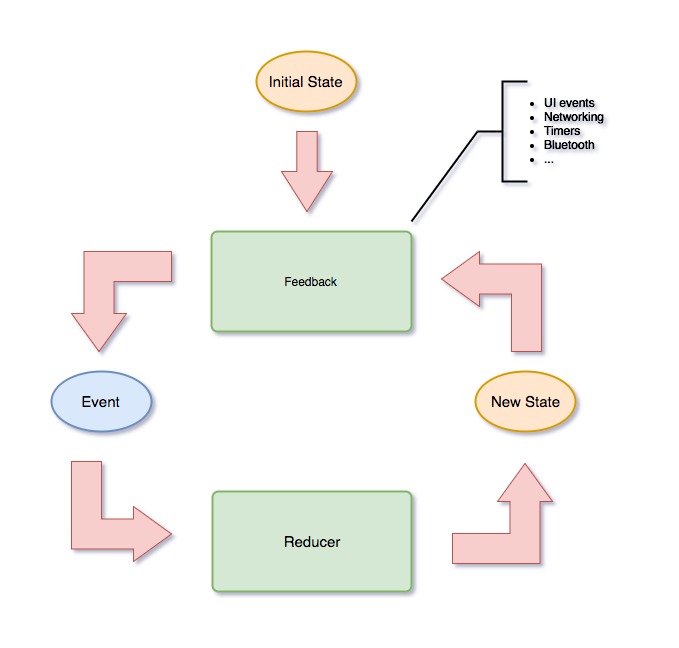
- As you can see from the diagram above we always start with an initial state.
- Every change to the
Statewill be then delivered to allFeedbackloops that were added to the system. Feedbackthen decides whether any action should be performed with a subset of theState(e.g calling API, observe UI events) by dispatching anEvent, or ignoring it by returningSignalProducer.empty.- Dispatched
Eventthen goes to theReducerwhich applies it and returns a new value of theState. - And then cycle starts all over (see 2).
Example
swiftlet increment = Feedback<Int, Event> { _ in return self.plusButton.reactive .controlEvents(.touchUpInside) .map { _ in Event.increment } } let decrement = Feedback<Int, Event> { _ in return self.minusButton.reactive .controlEvents(.touchUpInside) .map { _ in Event.decrement } } let system = SignalProducer<Int, NoError>.system(initial: 0, reduce: { (count, event) -> Int in switch event { case .increment: return count + 1 case .decrement: return count - 1 } }, feedbacks: [increment, decrement]) label.reactive.text <~ system.map(String.init)

Advantages
TODO
Acknowledgements
This is a community fork of the ReactiveFeedback project (with the MIT license) from Babylon Health.
Contributors
Showing top 12 contributors by commit count.