

JMemoryBuddy
JMemoryBuddy provides an API to unit-test your code for memory leaks. It also provides an API to monitor a running JVM for memory leaks. It is used for internal projects at Sandec, especially for [JPro](https://www.jpro.one/). We've made it public, so everyone can fix and test their code for memory leaks in a **professional** way. The project is written primarily in Java, distributed under the Apache License 2.0 license, first published in 2019. Key topics include: java, javafx, memory-leaks, unittest.
JMemoryBuddy


JMemoryBuddy provides an API to unit-test your code for memory leaks.
It also provides an API to monitor a running JVM for memory leaks.
It is used for internal projects at Sandec, especially for JPro.
We've made it public, so everyone can fix and test their code for memory leaks in a professional way.
Together we can fix all memory leaks in the world. :-)
Dependency
The library is published at MavenCentral
Maven
<dependency>
  <groupId>one.jpro</groupId>
  <artifactId>jmemorybuddy</artifactId>
  <version>0.5.6</version>
  <scope>test</scope>
</dependency>
Gradle
dependencies {
    compile "one.jpro:jmemorybuddy:0.5.6"
}
How to use:
Write unit tests for memory leaks!
The method JMemoryBuddy.memoryTest is the usual way to test for leaks with JMemoryBuddy.
A typicial test might look like the following:
@Test
public void simpleTest() {
    JMemoryBuddy.memoryTest(checker -> {
        A referenced = new A();
        checker.setAsReferenced(referenced);
        A notReferenced = new A();
        checker.assertCollectable(notReferenced); // notReferenced should be collectable
        checker.assertNotCollectable(referenced); // referenced should not be collectable
    });
}
The lambda provided to the memory test method is executed only once. The provided argument named "checker" provides an API to declare how the memory semantic should be.
| Method | |
|---|---|
| assertCollectable(ref) | After executing the lambda, the provided ref must be collectable. Otherwise, an exception is thrown. |
| assertNotCollectable(ref) | After executing the lambda, the provided ref must be not collectable. Otherwise, an exception is thrown. |
| setAsReferenced(ref) | The provided reference won't be collected, until memoryTest finishes all it's tests. |
Other utility methods:
You can also use the method assertCollectable and assertNotCollectable to check whether a single WeakReference can be collected, but usually, the memoryTest method is prefered because it results in more elegant tests.
Analyzing the heap dump:
On a failed leak check JMemoryBuddy reads back the heap dump and prints the strong-reference path from a GC root to each not-collected object directly in the test output — usually enough to find the cause without opening any tool:
JMemoryBuddy — path to GC root for leak: PageDoc @58a903060:
  GC root [Java frame] DataRepository
    ↓ DataRepository.listeners
  ...
  PageDoc   ← leaked
Disable with -Djmemorybuddy.printPath=false. For a deeper look, open the dump in your preferred tool — all watched instances are referenced by a TrackedWeakReference, so you can search for that class name:
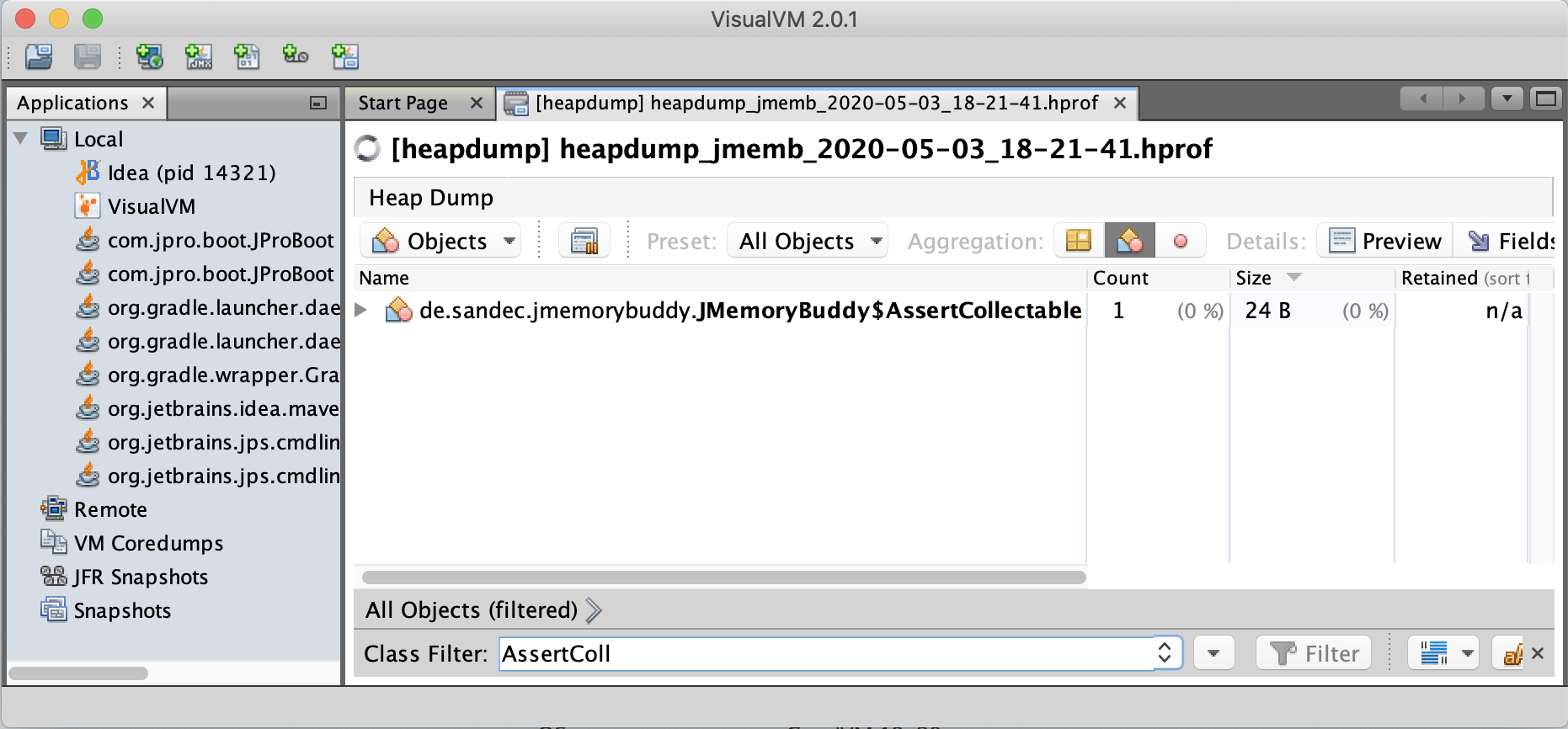
Configure JMemoryBuddy
You can configure VisualVM with SystemProperties:
| Tables | Effect | Default |
|---|---|---|
| -Djmemorybuddy.createHeapDump | Should a heap dump created on failure? | true |
| -Djmemorybuddy.printPath | Print the path from a GC root to each not-collected object on failure. | true |
| -Djmemorybuddy.maxObjects | Skip the path analysis when the dump has more objects than this (avoids heavy in-process analysis). | 8000000 |
| -Djmemorybuddy.output | The folder where the heap dump gets saved. | if target exists, then "target" otherwise "build" |
The following values usually shouldn't be changed but might be useful to make tests more stable or reduce the time required.
| Tables | Effect | Default |
|---|---|---|
| -Djmemorybuddy.steps | Maximum number of times we check whether something is collectable. You probably shouldn't change it. | 10 |
| -Djmemorybuddy.testDuration | Maximum time in ms used to check whether something is collectable. You probably shouldn't change it. | 1000 |
| -Djmemorybuddy.garbageAmount | How much garbage is created to stimulate the garbage collector | 999999 |
Monitor running systems:
Mark references, where you know they can be collected:
JMemoryBuddyLive.markCollectable("description",reference);
Afterwards you can create a report during runtime with details about leaks.
System.gc();
JMemoryBuddyLive.getReport();
or search for AssertCollectableLive in a HeapDump.
If the referent of an AssertCollectableLive is reachable, then you have a memory leak.
It's especially interesting to see which leaks happen, if an application runs for severy hours, days, weeks or months.
FAQ - Why is no one else writing unit-tests for memory leaks?
There are various reasons for this. By spec the command System.gc() doesn't have to do anything,
This makes it hard and undeterministic to test for collectability. Nevertheless, JMemoryBuddy makes testing for memory leaks reliably!. Currently, all known cases reliable and don't cause false-negative test results.
- What can i do about SoftReferences? It's hard to check whether they are strongly reachable.
You can use the following JVM arugment: -XX:SoftRefLRUPolicyMSPerMB=0. With this argument, SoftReferences behave like WeakReferences.
- I'm getting Leaking references during development, but not during production. What could be the reason?
A common reason might be various debuging features of you IDE. If you use the debugger, the garbage collector doesn't work reliably anymore.
Real test samples:
- controlsfx - A simple test for a isolated JavaFX Components.
- CSSFX (1, 2) - Various tests to make sure that a listener based code base doesn't have unwanted changes to the memory semantics.
- JavaFX - PR for JavaFX itself to simplify some of the existing tests for memory leaks.
Projects using JMemoryBuddy:
- jpro.one - aka JavaFX for the web
- controlsfx - A very often used Library for JavaFX
- CSSFX - Every JavaFX Developer should use this library
- Your project?
internal developer
publish local:
./gradlew publishToMavenLocal
publish to sonatype:
./gradlew publishToSonatype closeAndReleaseStagingRepository
Contributors
Showing top 4 contributors by commit count.


