

DMLR
[CVPR2026] Official codebase for the paper "Reasoning Within the Mind: Dynamic Multimodal Interleaving in Latent Space"
This repository implements **DMLR** (Dynamic Multimodal Interleaving Latent Reasoning), a method for improving vision-language model reasoning through latent space optimization. The system uses reinforcement learning to optimize "thought tokens" that enhance the model's reasoning capabilities on multimodal tasks. The project is written primarily in Python, distributed under the MIT License license, first published in 2025. Key topics include: interleaved-multimodal, latent-reasoning, multimodal-latent-reasoning, multimodal-reasoning, test-time-optimization.
Reasoning Within the Mind: Dynamic Multimodal Interleaving in Latent Space


This repository implements DMLR (Dynamic Multimodal Interleaving Latent Reasoning), a method for improving vision-language model reasoning through latent space optimization. The system uses reinforcement learning to optimize "thought tokens" that enhance the model's reasoning capabilities on multimodal tasks.
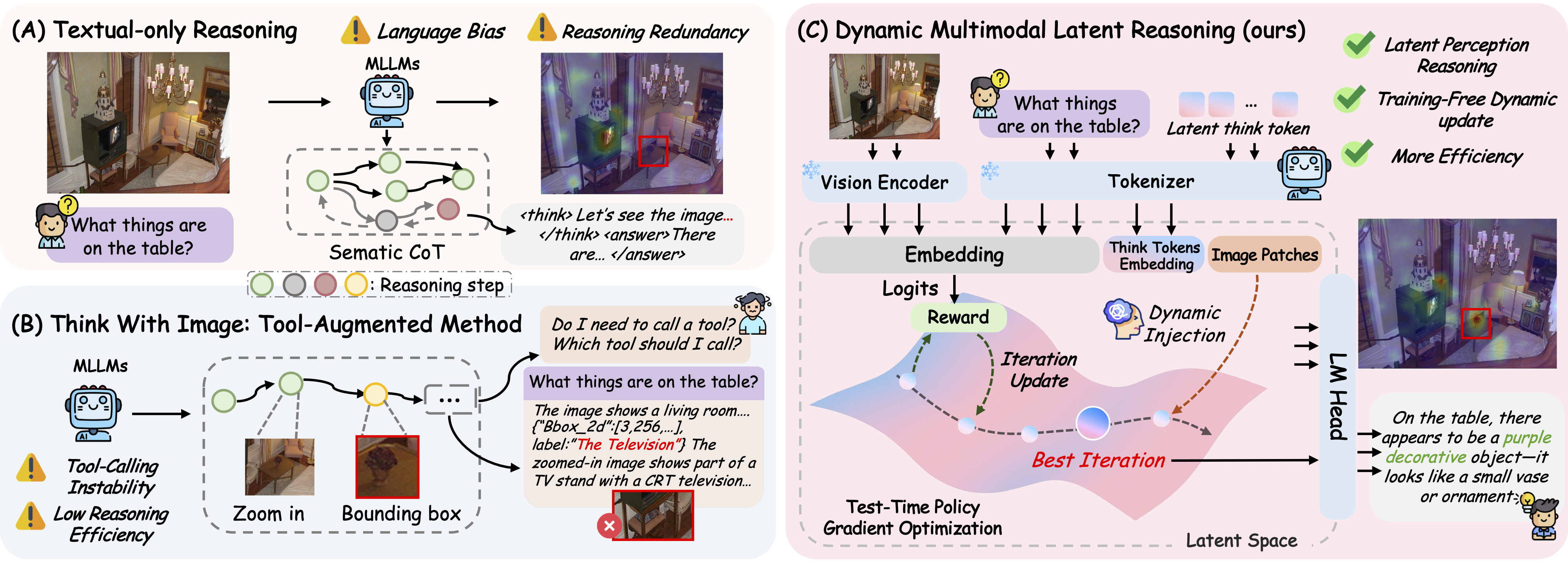
Comparison between DMLR and two reasoning paradigms. (A) Text-only reasoning: relies solely on explicit CoT, often causing visual grounding errors and redundant steps. (B) Think-with-Image reasoning: depends on external perception tools, leading to unstable tool calls and extra overhead. (C) DMLR (ours): refines latent think tokens in the latent space through confidence-guided optimization and dynamically injects visual information, achieving self-improving reasoning without additional training while maintaining high efficiency.
Setup
- Clone the repository:
bashgit clone <repository-url> cd DMLR
- Install dependencies (using
uvorpip):
bash# Using uv (recommended) uv pip install -r requirements.txt # Or using pip pip install -r requirements.txt
- Set up Hugging Face token (if needed for private models):
bashexport HUGGING_FACE_TOKEN=your_token_here
- Configure LLM verifier (for answer verification):
Create a.envfile in the project root with the following content:
bashOPENAI_API_KEY=your_api_key_here OPENAI_API_BASE_URL=https://api.openai.com/v1 MODEL_TYPE=gpt-4.1-2025-04-14
Quick Start
Basic Usage
Run inference using the provided script:
bashbash script/run.sh
Custom Configuration
You can modify script/run.sh or run directly with Python:
bashuv run python main.py \ --dataset data/scienceqa.json \ --model_name_or_path Qwen/Qwen2.5-VL-7B-Instruct \ --output_dir ./output \ --device cuda \ --start_data_idx 0 \ --end_data_idx 100 \ --max_new_tokens 2048 \ --max_num_steps 15 \ --num_thought_tokens 2 \ --sigma 25.0 \ --lr 0.01
Configuration
Key Parameters
Dataset & Model
--dataset: Path to dataset JSON file or dataset name--model_name_or_path: Hugging Face model identifier (default:Qwen/Qwen2.5-VL-7B-Instruct)--output_dir: Directory to save results--start_data_idx: Starting index for evaluation (default: 0)--end_data_idx: Ending index for evaluation (default: 100)
Optimization
--num_thought_tokens: Number of thought tokens to optimize (default: 8)--max_num_steps: Maximum RL optimization steps (default: 20)--lr: Learning rate for optimization (default: 0.005)--sigma: Noise scale for exploration (default: 20.0)--sigma_decay: Decay factor for sigma (default: 0.95)--reward_threshold: Reward threshold to stop early (default: -1)
Visual Features
--num_selected_patches: Max image patches per thought token--initial_patch_count: Initial number of patches to insert--patch_increment: Additional patches when best reward improves--visual_insert_stride: Insert visual tokens every N thought tokens--visual_injection_start_step: Start visual injection from this RL step--visual_injection_interval: Perform injection every N RL steps--visual_only: Use visual features to initialize thought tokens
Inference
--max_new_tokens: Maximum tokens to generate (default: 2048)--num_workers: Number of worker processes (default: 1)--worker_device_round_robin: Distribute workers across GPUs--min_pixels: Minimum image pixels (default: 128)--max_pixels: Maximum image pixels (default: 256)
Verification
--use_llm_verify: Use LLM to verify solution equivalence--verify_only: Re-verify existing results without re-running inference
Datasets
The project supports multiple vision-language datasets. Place your dataset JSON files in the data/ directory. Expected format:
json[ { "prompt": "Question text", "solution": "Answer", "image_path": "path/to/image.jpg", "idx": 0 } ]
Output
Results are saved in the specified output_dir:
results.json: Complete evaluation results with:- Model predictions
- Ground truth answers
- Correctness judgments
- Best reward values and steps
- Configuration parameters
Results JSON Structure
json{ "model": "Qwen/Qwen2.5-VL-7B-Instruct", "dataset": "data/scienceqa.json", "accuracy": 0.75, "correct": 75, "total": 100, "config": {...}, "args": {...}, "entries": [ { "data_idx": 0, "question": "...", "model_output": "...", "answer": "...", "ground_truth": "...", "is_correct": true, "best_reward": 0.85, "best_reward_step": 5, "stop_reason": "eos_token" } ] }
Project Structure
DMLR/
├── main.py                 # Main entry point
├── DMLR/
│   ├── data.py            # Dataset loading
│   ├── inference.py       # Core inference logic
│   ├── reward.py          # Reward model implementation
│   ├── prompts.py         # Prompt templates
│   ├── verifier.py        # Answer verification
│   ├── utils.py           # Utility functions
│   └── logger.py          # Logging setup
├── data/                  # Dataset files
├── script/
│   └── run.sh            # Example run script
└── Readme.md             # This file
Citation
If you use this code in your research, please cite:
bibtex@misc{liu2025reasoningminddynamicmultimodal, title={Reasoning Within the Mind: Dynamic Multimodal Interleaving in Latent Space}, author={Chengzhi Liu and Yuzhe Yang and Yue Fan and Qingyue Wei and Sheng Liu and Xin Eric Wang}, year={2025}, eprint={2512.12623}, archivePrefix={arXiv}, primaryClass={cs.CV}, url={https://arxiv.org/abs/2512.12623}, }
Contributors
Showing top 3 contributors by commit count.


