

Skscope
skscope: Sparse-Constrained OPtimization via itErative-solvers
``skscope`` aims to make sparsity-constrained optimization (SCO) accessible to **everyone** because SCO holds immense potential across various domains, including machine learning, statistics, and signal processing. By providing a user-friendly interface, ``skscope`` empowers individuals from diverse backgrounds to harness the power of SCO and unlock its broad range of applications (see examples exhibited below). The project is written primarily in Python, distributed under the MIT License license, first published in 2022. Key topics include: auto-differentiation, compressive-sensing, jax, non-convex-optimization, nonlinear-optimization.

skscope: Fast Sparse-Constraint Optimization






What is skscope?
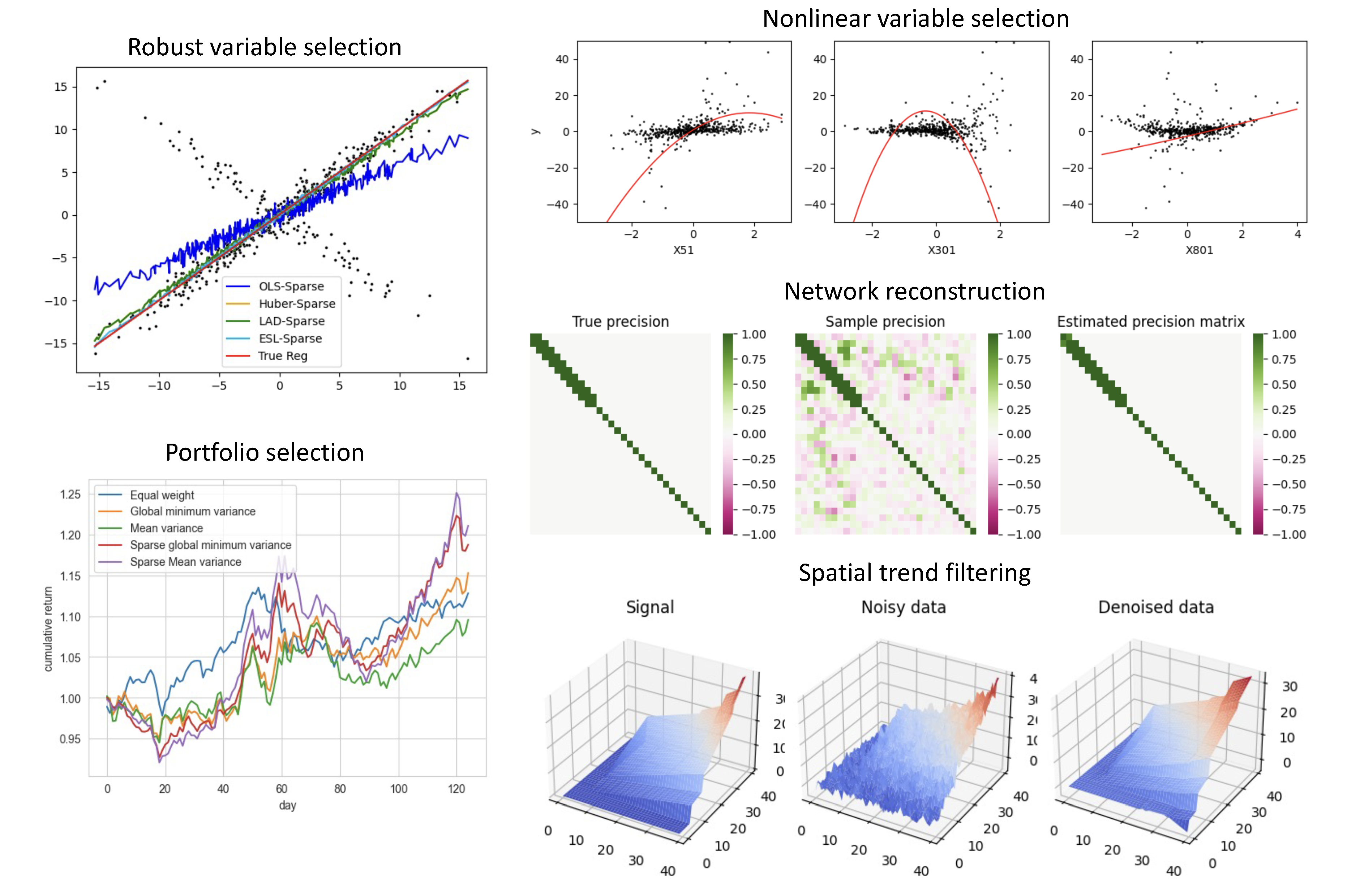
skscope aims to make sparsity-constrained optimization (SCO) accessible to everyone because SCO holds immense potential across various domains, including machine learning, statistics, and signal processing. By providing a user-friendly interface, skscope empowers individuals from diverse backgrounds to harness the power of SCO and unlock its broad range of applications (see examples exhibited below).
Installation
The recommended option for most users:
bashpip install skscope
For Linux or Mac users, an alternative is
bashconda install skscope
If you want to work with the latest development version, the further installation instructions help you install from source.
Quick examples
Here's a quick example showcasing how you can use three simple steps to perform feature selection via the skscope:
pythonfrom skscope import ScopeSolver from sklearn.datasets import make_regression import jax.numpy as jnp ## generate data x, y, coef = make_regression(n_features=10, n_informative=3, coef=True) ## 1. define loss function def ols_loss(para): return jnp.sum(jnp.square(y - x @ para)) ## 2. initialize the solver where 10 parameters in total and three of which are sparse solver = ScopeSolver(10, 3) ## 3. use the solver to optimized the objective params = solver.solve(ols_loss)
Below's another example illustrates that you can modify the objective function to address another totally different problem.
<p align="center"> <img src="docs/source/userguide/figure/tf.png" width="300"/> </p>pythonimport numpy as np import jax.numpy as jnp import matplotlib.pyplot as plt from skscope import ScopeSolver ## generate data np.random.seed(2023) x = np.cumsum(np.random.randn(500)) # random walk with normal increment ## 1. define loss function def tf_objective(params): return jnp.sum(jnp.square(x - jnp.cumsum(params))) ## 2. initialize the solver where 10 parameters in total and three of which are sparse solver = ScopeSolver(len(x), 10) ## 3. use the solver to optimized the objective params = solver.solve(tf_objective) tf_x = jnp.cumsum(params) plt.plot(x, label='observation', linewidth=0.8) plt.plot(tf_x, label='filtering trend') plt.legend(); plt.show()
The above Figure shows that the solution of ScopeSolver now captures the main trend of the observed random work. Again, 4 lines of code help us attain the solution.
Example gallery
Since skscope can easily be applied to diverse objective functions, we can definitely leverage it to develop various machine learning methods that is driven by SCO. In our example gallery, we supply 25 comprehensive statistical/machine learning examples to illustrate the versatility of skscope.
Why skscope is versatile?
The high versatility of skscope in effectively addressing SCO problems are derived from two key factors: theoretical concepts and computational implementation. In terms of theoretical concepts, there have been remarkable advancements in SCO in recent years, offering a range of efficient iterative methods for solving SCO. Some of these algorithms exhibit elegance by only relying on the current parameters and gradients for the iteration process. On the other hand, significant progress has been made in automatic differentiation, a fundamental component of deep learning algorithms that plays a vital role in computing gradients. By ingeniously combining these two important advancements, skscope emerges as the pioneering tool capable of handling diverse sparse optimization tasks.
With skscope, the creation of new machine learning methods becomes effortless, leading to the advancement of the "sparsity idea" in machine learning. This, in turn, facilitates the availability of a broader spectrum of machine learning algorithms for tackling real-world problems.
Software features
-
Support multiple state-of-the-art SCO solvers. Now,
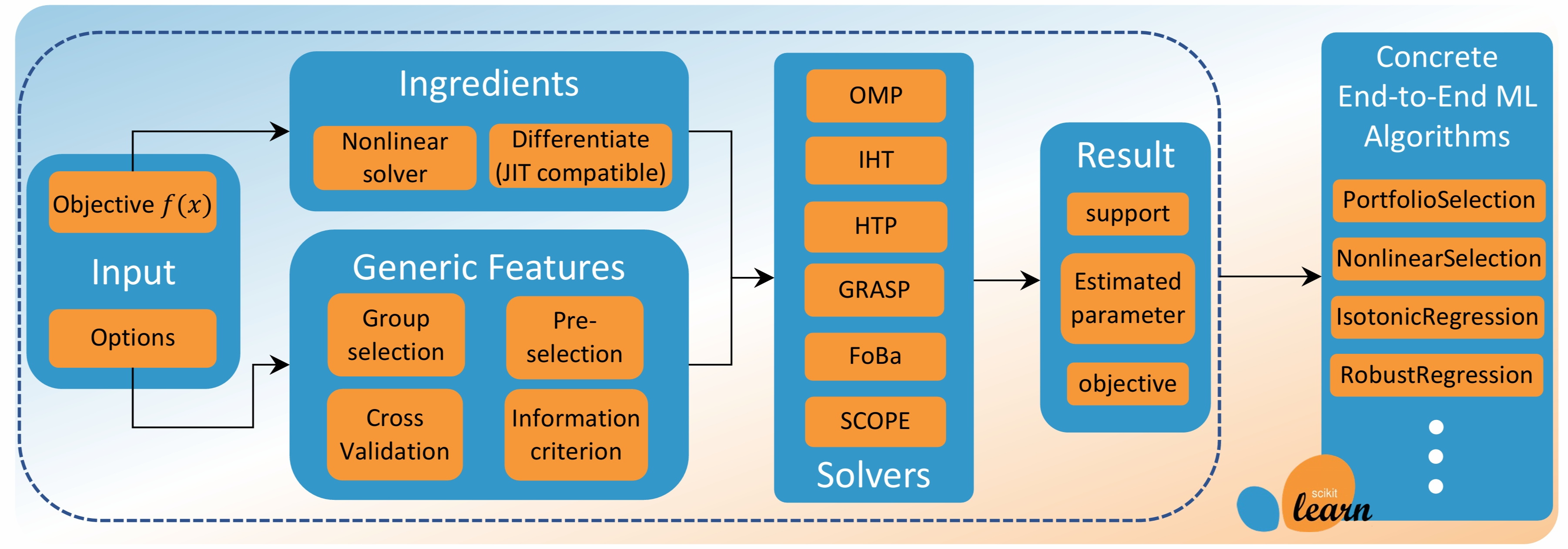
skscopehas supported these algorithms: SCOPE, HTP, Grasp, IHT, OMP, and FoBa. -
User-friendly API
-
zero-knowledge of SCO solvers: the state-of-the-art solvers in
skscopehas intuitive and highly unified APIs. -
extensive documentation:
skscopeis fully documented and accompanied by example gallery and reproduction scripts.
-
-
Solving SCO and its generalization:
-
SCO: $\arg\min\limits_{\theta \in R^p} f(\theta) \text{ s.t. } ||\theta||_0 \leq s$;
-
SCO for group-structure parameters: $\arg\min\limits_{\theta \in R^p} f(\theta) \text{ s.t. } I(||\theta_{G_i}||2 \neq 0) \leq s$ where ${G_i}{i=1}^q$ is a non-overlapping partition for ${1, \ldots, p}$;
-
SCO when pre-selecting parameters in set $\mathcal{P}$: $\arg\min\limits_{\theta \in R^p} f(\theta) \text{ s.t. } ||\theta_{\mathcal{P}^c}||_0 \leq s$.
-
-
Data science toolkit
-
Information criterion and cross-validation for selecting $s$
-
Portable interface for developing new machine-learning methods
-
-
Just-in-time-compilation compatibility
Benchmark
- Support recovery accuracy
| Methods | Linear regression | Logistic regression | Trend filtering | Multi-task learning | Ising model | Nonlinear feature selection |
|---|---|---|---|---|---|---|
OMPSolver | 1.00(0.01) | 0.91(0.05) | 0.70(0.18) | 1.00(0.00) | 0.98(0.03) | 0.77(0.09) |
IHTSolver | 0.79(0.04) | 0.97(0.03) | 0.08(0.10) | 0.97(0.02) | 0.96(0.05) | 0.78(0.09) |
HTPSolver | 1.00(0.00) | 0.84(0.05) | 0.41(0.22) | 1.00(0.00) | 0.97(0.03) | 0.78(0.09) |
GraspSolver | 1.00(0.00) | 0.90(0.08) | 0.58(0.23) | 1.00(0.00) | 0.99(0.01) | 0.78(0.08) |
FoBaSolver | 1.00(0.00) | 0.92(0.06) | 0.87(0.13) | 1.00(0.00) | 1.00(0.01) | 0.77(0.09) |
ScopeSolver | 1.00(0.00) | 0.94(0.04) | 0.79(0.19) | 1.00(0.00) | 1.00(0.01) | 0.77(0.09) |
cvxpy | 0.83(0.17) | 0.83(0.05) | 0.19(0.22) | 1.00(0.00) | 0.94(0.04) | 0.74(0.09) |
All solvers (except IHTSolver) in skscope consistently outperformed cvxpy in terms of accuracy for the selection of the support set.
- Runtime (measured in seconds):
| Methods | Linear regression | Logistic regression | Trend filtering | Multi-task learning | Ising model | Nonlinear feature selection |
|---|---|---|---|---|---|---|
OMPSolver | 0.62(0.11) | 0.80(0.11) | 0.03(0.00) | 2.70(0.26) | 1.39(0.13) | 13.24(3.91) |
IHTSolver | 0.23(0.05) | 0.18(0.12) | 0.30(0.06) | 0.80(0.11) | 0.98(0.08) | 1.67(0.50) |
HTPSolver | 0.50(0.14) | 0.94(0.44) | 0.03(0.01) | 14.18(5.13) | 3.41(1.22) | 12.97(6.23) |
GraspSolver | 0.18(0.06) | 2.55(0.86) | 0.08(0.03) | 0.54(0.28) | 0.53(0.22) | 3.06(0.75) |
FoBaSolver | 3.71(0.50) | 3.28(0.39) | 0.13(0.02) | 6.22(0.61) | 11.10(1.04) | 57.42(12.95) |
ScopeSolver | 0.30(0.08) | 1.20(2.14) | 0.09(0.01) | 1.14(0.89) | 1.17(0.25) | 7.78(2.23) |
cvxpy | 14.59(5.60) | 69.45(53.47) | 0.47(0.16) | 39.36(155.70) | 32.26(17.88) | 534.49(337.72) |
skscope demonstrated significant computational advantages over cvxpy, exhibiting speedups ranging from approximately 3-500 times.
Software architecture
Citation
If you use skscope or reference our tutorials in a presentation or publication, we would appreciate citations of our library.
The corresponding BibteX entry:
@article{JMLR:v25:23-1574,
  author  = {Zezhi Wang and Junxian Zhu and Xueqin Wang and Jin Zhu and Huiyang Pen and Peng Chen and Anran Wang and Xiaoke Zhang},
  title   = {skscope: Fast Sparsity-Constrained Optimization in Python},
  journal = {Journal of Machine Learning Research},
  year    = {2024},
  volume  = {25},
  number  = {290},
  pages   = {1--9},
  url     = {http://jmlr.org/papers/v25/23-1574.html}
}
Contributions
<div align="center"> <!-- <details> --> <summary>👏 Thanks for the following support 👏</summary>Stargazers
<div align="center">Forkers
<div align="center" >Any kind of contribution to skscope would be highly appreciated! Please check the contributor's guide.
- Bug report via github issues
Contributors
Showing top 10 contributors by commit count.


![github-actions[bot]](https://avatars.githubusercontent.com/in/15368?v=4)

![imgbot[bot]](https://avatars.githubusercontent.com/in/4706?v=4)