

Pl2map
[IROS 2024] Representing 3D sparse map points and lines for camera relocalization; [IROS 2025] Improved 3D Point-Line Mapping Regression for Camera Relocalization
We introduce a lightweight neural network for visual localization that efficiently represents both 3D points and lines. Specifically, we use a single transformer block to convert line features into distinctive point-like descriptors. These features are then refined through self- and cross-attention in a graph-based framework before 3D map regression using simple MLPs. Our method outperforms [Hloc](https://github.com/cvg/Hierarchical-Localization) and [Limap](https://github.com/cvg/limap) in smal... The project is written primarily in Python, distributed under the Apache License 2.0 license, first published in 2024. Key topics include: camera-relocalization, lightweight, point-line, pytorch, scene-coordinate-regression.
Point-Line to Map Regresssion for Camera Relocalization
Project Page | PL2Map | PL2Map++
Introduction
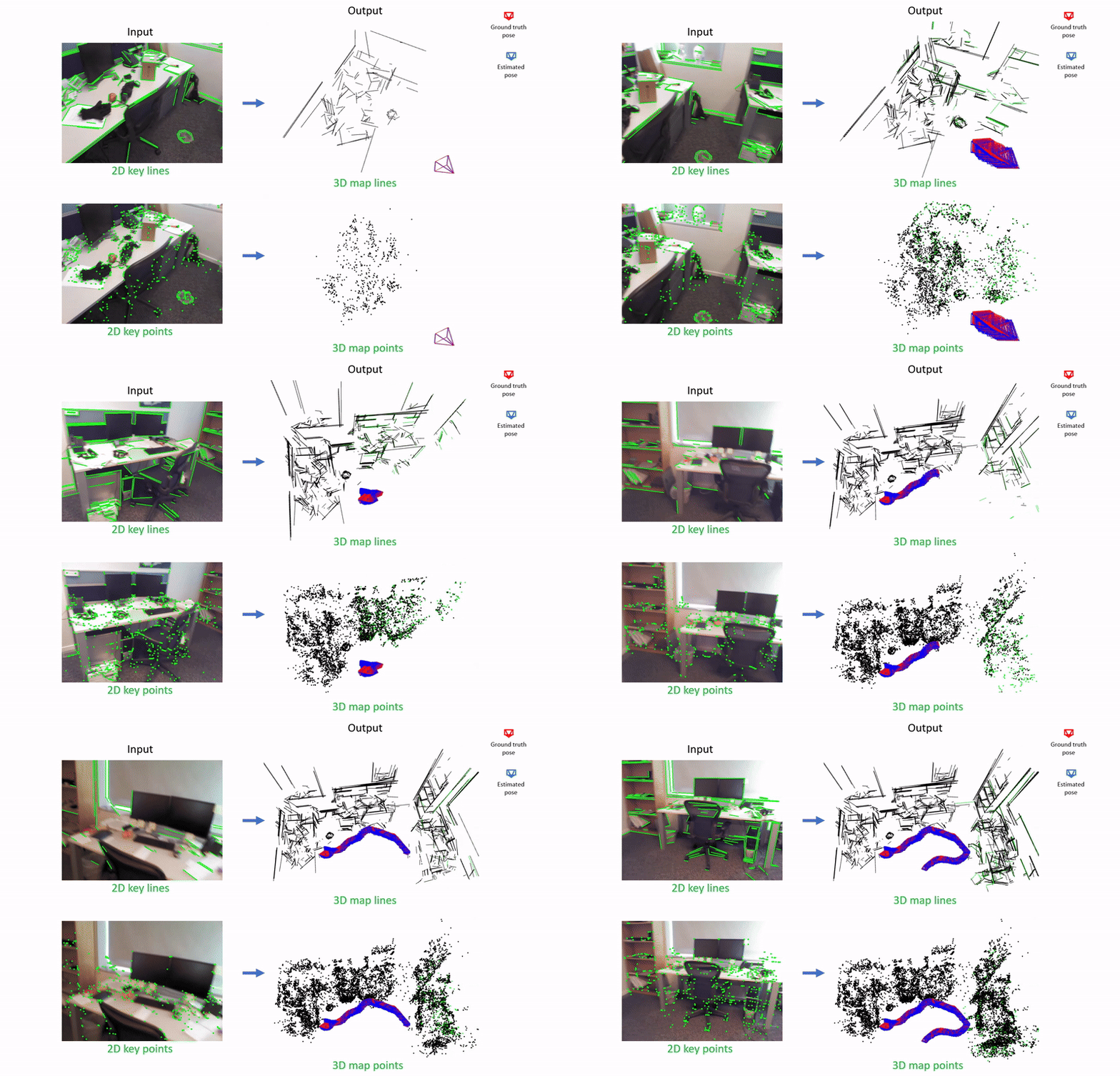
We introduce a lightweight neural network for visual localization that efficiently represents both 3D points and lines. Specifically, we use a single transformer block to convert line features into distinctive point-like descriptors. These features are then refined through self- and cross-attention in a graph-based framework before 3D map regression using simple MLPs. Our method outperforms Hloc and Limap in small-scale indoor localization and achieves the best results in outdoor settings, setting a new benchmark for learning-based approaches. It also operates in real-time at ~16 FPS, compared to Limap’s ~0.03 FPS, while requiring only lightweight network weights of 33MB instead of Limap’s multi-GB memory footprint.
Papers
Improved 3D Point-Line Mapping Regression for Camera Relocalization
Bach-Thuan Bui, Huy-Hoang Bui, Yasuyuki Fujii, Dinh-Tuan Tran, and Joo-Ho Lee.
IEEE/RSJ International Conference on Intelligent Robots and Systems (IROS), 2025.
pdf
Representing 3D sparse map points and lines for camera relocalization
Bach-Thuan Bui, Huy-Hoang Bui, Dinh-Tuan Tran, and Joo-Ho Lee.
IEEE/RSJ International Conference on Intelligent Robots and Systems (IROS), 2024.
pdf
Installation
Python 3.9 + required packages
git clone https://github.com/ais-lab/pl2map.git
cd pl2map
git submodule update --init --recursive
conda create --name pl2map python=3.9
conda activate pl2map
# Refer to https://pytorch.org/get-started/previous-versions/ to install pytorch compatible with your CUDA
python -m pip install torch==1.12.0 torchvision==0.13.0
python -m pip install -r requirements.txt
Supported datasets
Please run the provided scripts to prepare and download the data which has been preprocessed by running:
7scenes
./prepare_scripts/seven_scenes.sh
Cambridge Landmarks
./prepare_scripts/cambridge.sh
Indoor-6
./prepare_scripts/indoor6.sh
Evaluation with pre-trained models
Please download the pre-trained models by running:
./prepare_scripts/download_pre_trained_models.sh
For example, to evaluate KingsCollege scene:
python runners/eval.py --dataset Cambridge --scene KingsCollege -expv pl2map
Training
python runners/train.py --dataset Cambridge --scene KingsCollege -expv pl2map_test
Supported detectors
Lines
Points
Citation
If you use this code in your project, please consider citing the following paper:
bibtex@article{bui2024pl2map, title={Representing 3D sparse map points and lines for camera relocalization}, author={Bui, Bach-Thuan and Bui, Huy-Hoang and Tran, Dinh-Tuan and Lee, Joo-Ho}, booktitle={2024 IEEE/RSJ International Conference on Intelligent Robots and Systems (IROS)}, year={2024} } @article{bui2025improved, title={Improved 3D Point-Line Mapping Regression for Camera Relocalization}, author={Bui, Bach-Thuan and Bui, Huy-Hoang and Fujii, Yasuyuki and Tran, Dinh-Tuan and Lee, Joo-Ho}, journal={arXiv preprint arXiv:2502.20814}, year={2025} }
This code builds on previous camera relocalization pipeline, namely D2S, please consider citing:
bibtex@article{bui2024d2s, title={D2S: Representing sparse descriptors and 3D coordinates for camera relocalization}, author={Bui, Bach-Thuan and Bui, Huy-Hoang and Tran, Dinh-Tuan and Lee, Joo-Ho}, journal={IEEE Robotics and Automation Letters}, year={2024} }
Acknowledgement
This code is built based on Limap, and LineTR. We thank the authors for their useful source code.
Contributors
Showing top 1 contributor by commit count.

Related Repositories

nianticlabs/acezero
[ECCV 2024 - Oral] ACE0 is a learning-based structure-from-motion approach that estimates camera parameters of sets of images by learning a multi-view consistent, implicit scene representation.

siyandong/awesome-visual-localization
A curated list of awesome visual localization research works.

ActiveVisionLab/DFNet
DFNet: Enhance Absolute Pose Regression with Direct Feature Matching (ECCV 2022)

nianticspatial/ace-g
[ICCV 2025] ACE-G is an architecture and pre-training scheme to improve generalization for scene coordinate regression-based visual relocalization.

futurely/deep-camera-relocalization
VidLoc: A Deep Spatio-Temporal Model for 6-DoF Video-Clip Relocalization, Geometric loss functions for camera pose regression with deep learning, PoseNet: A Convolutional Network for Real-Time 6-DOF Camera Relocalization

AaltoVision/hscnet
Hierarchical Scene Coordinate Classification and Regression for Visual Localization