

Wwebjs api
This project is a REST API wrapper for the whatsapp-web.js library, providing an easy-to-use interface to interact with the WhatsApp Web platform.
REST API wrapper for the [whatsapp-web.js](https://github.com/pedroslopez/whatsapp-web.js) library, providing an easy-to-use interface to interact with the WhatsApp Web platform. It is designed to be used as a docker container, scalable, secure, and easy to integrate with other non-NodeJS projects. The project is written primarily in JavaScript, distributed under the MIT License license, first published in 2024. Key topics include: api, bot-api, whatsapp, whatsapp-api, whatsapp-bot.
WWebJS REST API
REST API wrapper for the whatsapp-web.js library, providing an easy-to-use interface to interact with the WhatsApp Web platform.
It is designed to be used as a docker container, scalable, secure, and easy to integrate with other non-NodeJS projects.
This project is a fork of whatsapp-api. As the project was abandoned by the original author, all future improvements will be in this repo.
The project is a work in progress: star it, create issues, features or pull requests ❣️
NOTE: I can't guarantee you will not be blocked by using this method, although it has worked for me. WhatsApp does not allow bots or unofficial clients on their platform, so this shouldn't be considered totally safe.
Table of Contents
Quick Start with Docker

- Clone the repository:
bashgit clone https://github.com/avoylenko/wwebjs-api.git cd wwebjs-api
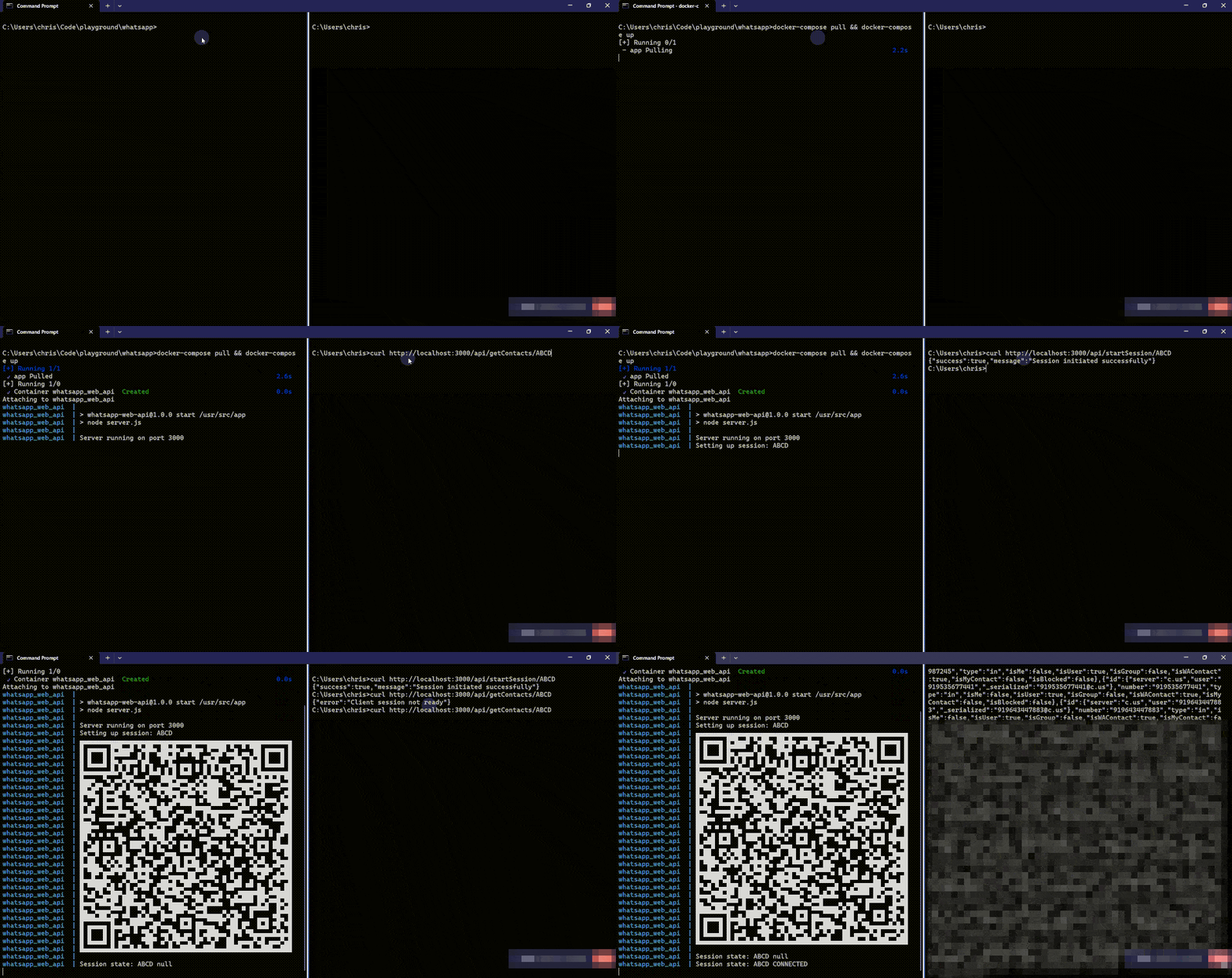
- Run the Docker Compose:
bashdocker compose pull && docker compose up
-
Scan the QR on your console using WhatsApp mobile app -> Linked Device -> Link a Device (it may take time to setup the session)
-
EXTRA: Look at all the callbacks data in
./session/message_log.txt
Features
- API and Callbacks
| Actions | Status | Sessions | Status | Callbacks | Status |
|---|---|---|---|---|---|
| Send Image Message | ✅ | Initiate session | ✅ | Callback QR code | ✅ |
| Send Video Message(requires Google Chrome) | ✅ | Terminate session | ✅ | Callback new message | ✅ |
| Send Audio Message | ✅ | Terminate inactive sessions | ✅ | Callback status change | ✅ |
| Send Document Message | ✅ | Terminate all sessions | ✅ | Callback message media attachment | ✅ |
| Send File URL | ✅ | Restart session | ✅ | ||
| Send Contact Message | ✅ | Get session status | ✅ | ||
| Send Poll Message | ✅ | Health Check | ✅ | ||
| Edit Message | ✅ | ||||
| Set Status | ✅ | ||||
| Is On Whatsapp? | ✅ | ||||
| Download Profile Picture | ✅ | ||||
| User Status | ✅ | ||||
| Block/Unblock User | ✅ | ||||
| Update Profile Picture | ✅ | ||||
| Create Group | ✅ | ||||
| Leave Group | ✅ | ||||
| All Groups | ✅ | ||||
| Invite User | ✅ | ||||
| Make Admin | ✅ | ||||
| Demote Admin | ✅ | ||||
| Group Invite Code | ✅ | ||||
| Update Group Participants | ✅ | ||||
| Update Group Setting | ✅ | ||||
| Update Group Subject | ✅ | ||||
| Update Group Description | ✅ |
-
Handle multiple client sessions (session data saved locally), identified by unique id
-
All endpoints may be secured by a global API key
-
On server start, all existing sessions are restored
-
Set messages automatically as read
-
Disable any of the callbacks
Run Locally
- Clone the repository:
bashgit clone https://github.com/avoylenko/wwebjs-api.git cd wwebjs-api
- Install the dependencies:
bashnpm install
Note: To use the latest edge version of whatsapp-web.js directly from GitHub (with the latest features and fixes), modify the package.json dependency:
json"whatsapp-web.js": "github:pedroslopez/whatsapp-web.js#main"
Then run npm install again. Be aware that edge versions may contain unstable features.
- Copy the
.env.examplefile to.envand update the required environment variables:
bashcp .env.example .env
- Run the application:
bashnpm run start
- Access the API at
http://localhost:3000
Testing
Run the test suite with the following command:
bashnpm run test
Documentation
API documentation can be found in the swagger.json file. See this file directly into Swagger Editor or any other OpenAPI-compatible tool to view and interact with the API documentation.
This documentation is straightforward if you are familiar with whatsapp-web.js library (https://docs.wwebjs.dev/)
If you are still confused - open an issue and I'll improve it.
Also, there is an option to run the documentation endpoint locally by setting the ENABLE_SWAGGER_ENDPOINT environment variable. Restart the service and go to /api-docs endpoint to see it.
By default, all callback events are delivered to the webhook defined with the BASE_WEBHOOK_URL environment variable.
This can be overridden by setting the *_WEBHOOK_URL environment variable, where * is your sessionId.
For example, if you have the sessionId defined as DEMO, the environment variable must be DEMO_WEBHOOK_URL.
By setting the DISABLED_CALLBACKS environment variable you can specify what events you are not willing to receive on your webhook.
By setting the ENABLE_WEBHOOK environment to FALSE you can disable webhook dispatching. This will help you if you want to switch to websocket method(see below).
Scanning QR code
In order to validate a new WhatsApp Web instance you need to scan the QR code using your mobile phone. Official documentation can be found at (https://faq.whatsapp.com/1079327266110265/?cms_platform=android) page. The service itself delivers the QR code content as a webhook event or you can use the REST endpoints (/session/qr/:sessionId or /session/qr/:sessionId/image to get the QR code as a png image).
Outbound Proxy
The Chromium instance that powers each session can be routed through an outbound proxy by setting the PROXY_URL environment variable (e.g. http://10.0.0.10:8118, https://..., or socks5://...). When PROXY_URL is empty, sessions connect directly with no behavior change.
If the proxy requires authentication, set PROXY_USERNAME and PROXY_PASSWORD. When both are defined they are forwarded to Chromium as HTTP Basic auth via puppeteer's proxyAuthentication. For API-key vendor proxies, use the vendor-specified username (often api-key) and the key itself as the password.
WebSocket mode
The service can dispatch realtime events through websocket connection. By default, the websocket is not activated, so you need manually set the ENABLE_WEBSOCKET environment variable to activate it. The server activates a new websocket instance per each active session. The websocket path is /ws/:sessionId, where sessionId is your configured session name. The websocket supports ping/pong scheme to keep the socket running.
The below example shows how to receive the events for test session.
const ws = new WebSocket('ws://127.0.0.1:3000/ws/test');

ws.on('message', (data) => {
    // consume the events
});
Deploy to Production
- Load the docker image in docker-compose, or your Kubernetes environment
- Disable the
ENABLE_LOCAL_CALLBACK_EXAMPLEenvironment variable - Set the
API_KEYenvironment variable to protect the REST endpoints - Run periodically the
/api/terminateInactiveSessionsendpoint to prevent useless sessions to take up space and resources(only in case you are not in control of the sessions)
Contributing
Please read CONTRIBUTING.md for details on our code of conduct, and the process for submitting pull requests to us.
Disclaimer
This project is not affiliated, associated, authorized, endorsed by, or in any way officially connected with WhatsApp or any of its subsidiaries or its affiliates. The official WhatsApp website can be found at https://whatsapp.com. "WhatsApp" as well as related names, marks, emblems and images are registered trademarks of their respective owners.
License
This project is licensed under the MIT License - see the LICENSE.md file for details.
Star History
Contributors
Showing top 7 contributors by commit count.


Related Repositories

public-apis/public-apis
A collective list of free APIs

neovim/neovim
Vim-fork focused on extensibility and usability

fastapi/fastapi
FastAPI framework, high performance, easy to learn, fast to code, ready for production

hoppscotch/hoppscotch
Open-Source API Development Ecosystem • https://hoppscotch.io • Offline, On-Prem & Cloud • Web, Desktop & CLI • Open-Source Alternative to Postman, Insomnia

typicode/json-server
Get a full fake REST API with zero coding in less than 30 seconds (seriously)

ocornut/imgui
Dear ImGui: Bloat-free Graphical User interface for C++ with minimal dependencies