

Obsidian dataview
A data index and query language over Markdown files, for https://obsidian.md/.
Treat your [Obsidian Vault](https://obsidian.md/) as a database which you can query from. Provides a JavaScript API and pipeline-based query language for filtering, sorting, and extracting data from Markdown pages. See the Examples section below for some quick examples, or the full [reference](https://blacksmithgu.github.io/obsidian-dataview/) for all the details. The project is written primarily in TypeScript, distributed under the MIT License license, first published in 2021. It has gained significant community traction with 9,110 stars and 542 forks on GitHub. Key topics include: obsidian-md, obsidian-plugin, query-language, typescript.
Obsidian Dataview
Treat your Obsidian Vault as a database which you can query from. Provides a JavaScript API and
pipeline-based query language for filtering, sorting, and extracting data from Markdown pages. See the Examples section
below for some quick examples, or the full reference for all the details.
Examples
Show all games in the game folder, sorted by rating, with some metadata:
markdown```dataview table time-played, length, rating from "games" sort rating desc ```
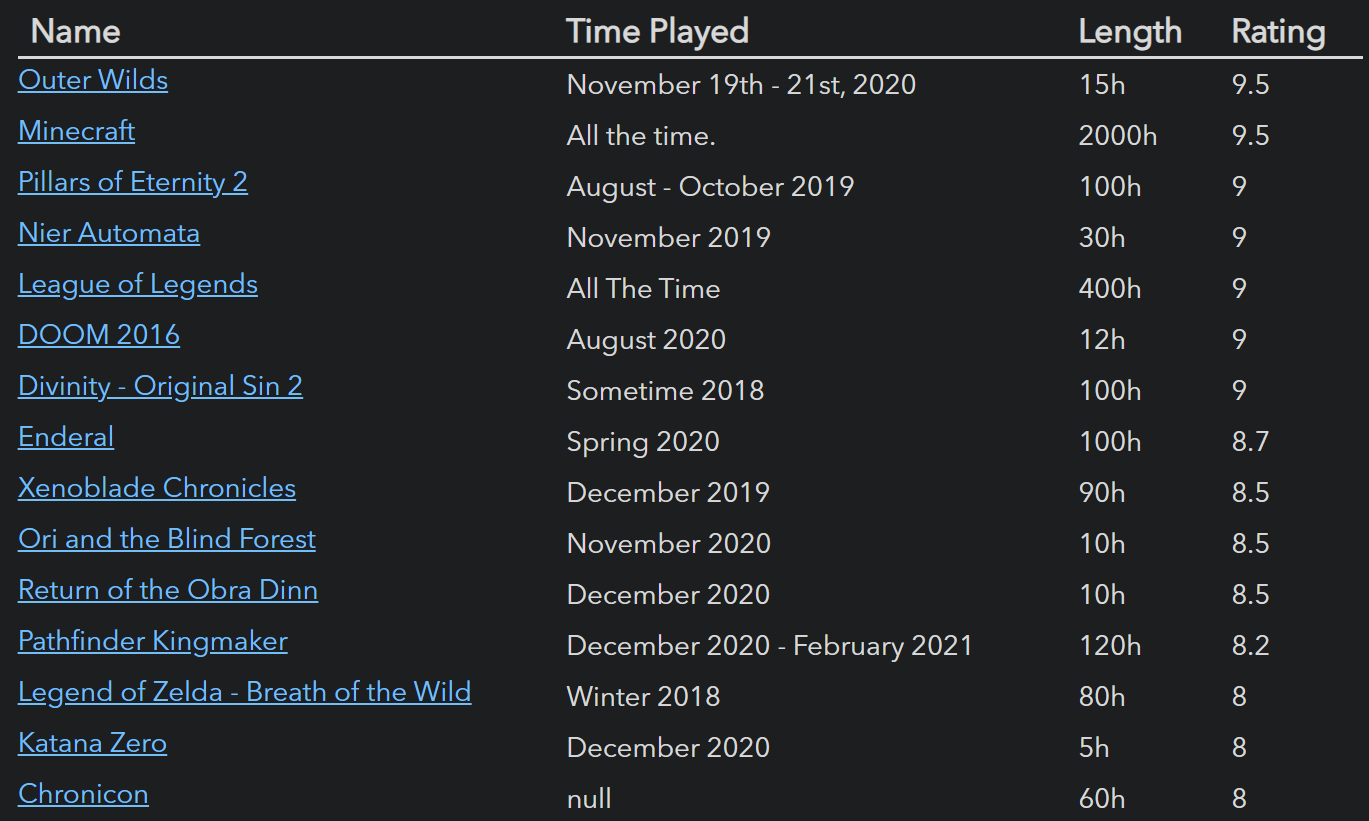
List games which are MOBAs or CRPGs.
markdown```dataview list from #game/moba or #game/crpg ```

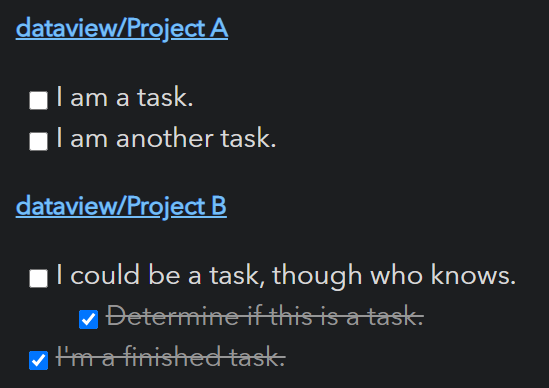
List all markdown tasks in un-completed projects:
markdown```dataview task from #projects/active ```
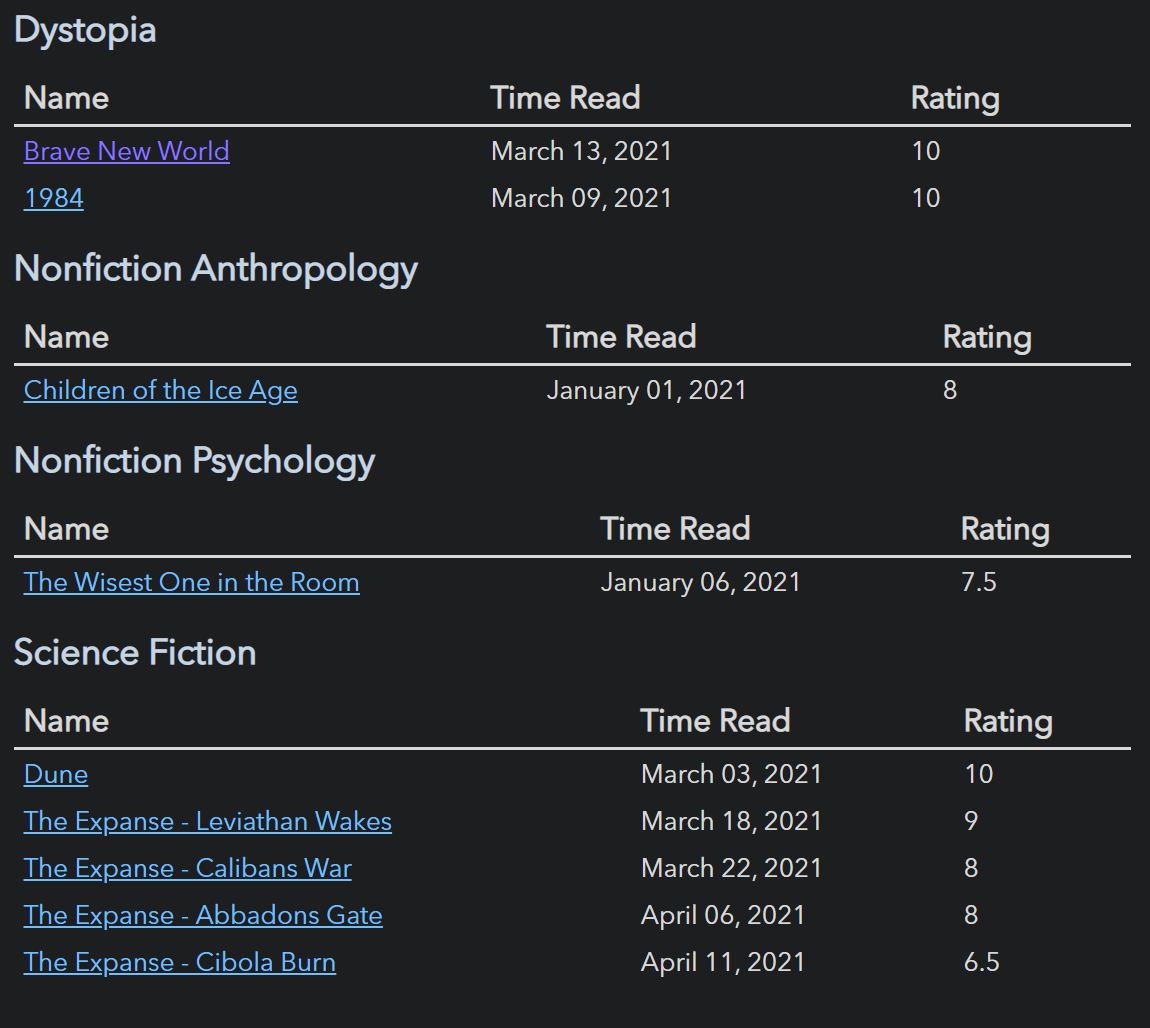
Show all files in the books folder that you read in 2021, grouped by genre and sorted by rating:
markdown```dataviewjs for (let group of dv.pages("#book").where(p => p["time-read"].year == 2021).groupBy(p => p.genre)) { dv.header(3, group.key); dv.table(["Name", "Time Read", "Rating"], group.rows .sort(k => k.rating, 'desc') .map(k => [k.file.link, k["time-read"], k.rating])) } ```
Usage
For a full description of all features, instructions, and examples, see the reference. For a more brief outline, let us examine the two major aspects of Dataview: data and querying.
Data
Dataview generates data from your vault by pulling
information from Markdown frontmatter and Inline fields.
- Markdown frontmatter is arbitrary YAML enclosed by
---at the top of a markdown document which can store metadata
about that document. - Inline fields are a Dataview feature which allow you to write metadata directly inline in your markdown document via
Key:: Valuesyntax.
Examples of both are shown below:
yaml--- alias: "document" last-reviewed: 2021-08-17 thoughts: rating: 8 reviewable: false ---
markdown# Markdown Page Basic Field:: Value **Bold Field**:: Nice! You can also write [field:: inline fields]; multiple [field2:: on the same line]. If you want to hide the (field3:: key), you can do that too.
Querying
Once you've annotated documents and the like with metadata, you can then query it using any of Dataview's four query
modes:
-
Dataview Query Language (DQL): A pipeline-based, vaguely SQL-looking expression language which can support basic
use cases. See the documentation for details.markdown```dataview TABLE file.name AS "File", rating AS "Rating" FROM #book ``` -
Inline Expressions: DQL expressions which you can embed directly inside markdown and which will be evaluated in
preview mode. See the documentation for
allowable queries.markdownWe are on page `= this.file.name`. -
DataviewJS: A high-powered JavaScript API which gives full access to the Dataview index and some convenient
rendering utilities. Highly recommended if you know JavaScript, since this is far more powerful than the query
language. Check the documentation for more details.markdown```dataviewjs dv.taskList(dv.pages().file.tasks.where(t => !t.completed)); ``` -
Inline JS Expressions: The JavaScript equivalent to inline expressions, which allow you to execute arbitrary JS
inline:markdownThis page was last modified at `$= dv.current().file.mtime`.
JavaScript Queries: Security Note
JavaScript queries are very powerful, but they run at the same level of access as any other Obsidian plugin. This means
they can potentially rewrite, create, or delete files, as well as make network calls. You should generally write
JavaScript queries yourself or use scripts that you understand or that come from reputable sources. Regular Dataview
queries are sandboxed and cannot make negative changes to your vault (in exchange for being much more limited).
Contributing
Contributions via bug reports, bug fixes, documentation, and general improvements are always welcome. For more major
feature work, make an issue about the feature idea / reach out to me so we can judge feasibility and how best to
implement it.
Local Development
The codebase is written in TypeScript and uses rollup / node for compilation; for a first time set up, all you
should need to do is pull, install, and build:
consolefoo@bar:~$ git clone git@github.com:blacksmithgu/obsidian-dataview.git foo@bar:~$ cd obsidian-dataview foo@bar:~/obsidian-dataview$ npm install foo@bar:~/obsidian-dataview$ npm run dev
This will install libraries, build dataview, and deploy it to test-vault, which you can then open in Obsidian. This
will also put rollup in watch mode, so any changes to the code will be re-compiled and the test vault will automatically
reload itself.
Preparing for creating pull requests
If you plan on doing pull request, we would also recommend to do the following in advance of creating the pull request:
consolefoo@bar:~$ npm run dev foo@bar:~$ npm run check-format foo@bar:~$ npm run format foo@bar:~$ npm run test
The third step of npm run format is only needed if the format check reports some issue.
Installing to Other Vaults
If you want to dogfood dataview in your real vault, you can build and install manually. Dataview is predominantly a
read-only store, so this should be safe, but watch out if you are adjusting functionality that performs file edits!
consolefoo@bar:~/obsidian-dataview$ npm run build foo@bar:~/obsidian-dataview$ ./scripts/install-built path/to/your/vault
Building Documentation
We use MkDocs for documentation (found in docs/). You'll need to have python and pip to run it locally:
consolefoo@bar:~/obsidian-dataview$ pip3 install mkdocs mkdocs-material mkdocs-redirects foo@bar:~/obsidian-dataview$ cd docs foo@bar:~/obsidian-dataview/docs$ mkdocs serve
This will start a local web server rendering the documentation in docs/docs, which will live-reload on change.
Documentation changes are automatically pushed to blacksmithgu.github.io/obsidian-dataview once they are merged
to the main branch.
Using Dataview Types In Your Own Plugin
Dataview publishes TypeScript typings for all of its APIs onto NPM (as blacksmithgu/obsidian-dataview). For
instructions on how to set up development using Dataview, see setup instructions.
Support
Have you found the Dataview plugin helpful, and want to support it? I accept donations which go towards future
development efforts. I generally do not accept payment for bug bounties/feature requests, as financial incentives add
stress/expectations which I want to avoid for a hobby project!
Support @blacksmithgu:

Support @holroy:
<a href="https://www.buymeacoffee.com/holroy" target="_blank"><img src="https://cdn.buymeacoffee.com/buttons/v2/default-yellow.png" alt="Buy Me A Coffee" style="height: 40px !important;width: 175px !important;" ></a>
Contributors
Showing top 12 contributors by commit count.


![dependabot[bot]](https://avatars.githubusercontent.com/in/29110?v=4)



Related Repositories

khoj-ai/khoj
Your AI second brain. Self-hostable. Get answers from the web or your docs. Build custom agents, schedule automations, do deep research. Turn any online or local LLM into your personal, autonomous AI (gpt, claude, gemini, llama, qwen, mistral). Get started - free.

obsidianmd/obsidian-releases
Community plugins list, theme list, and releases of Obsidian.

jackyzha0/quartz
🌱 a fast, batteries-included static-site generator that transforms Markdown content into fully functional websites

Vinzent03/obsidian-git
Integrate Git version control with automatic commit-and-sync and other advanced features in Obsidian.md

windingwind/zotero-better-notes
Everything about note management. All in Zotero.

brianpetro/obsidian-smart-connections
Find related notes and excerpts while writing. Your link building copilot displays relevant content in graph + list view. A local embedding model powers semantic search. Zero setup. No API key.