

Vulnapi
API Security Vulnerability Scanner designed to help you secure your APIs.
VulnAPI is an Open-Source DAST designed to help you scan your APIs for common security vulnerabilities and weaknesses. The project is written primarily in Go, distributed under the MIT License license, first published in 2023. Key topics include: api-security, api-security-testing, api-testing, authentication, authorization.





VulnAPI: An API Security Vulnerability Scanner
VulnAPI is an Open-Source DAST designed to help you scan your APIs for common security vulnerabilities and weaknesses.
By using this tool, you can detect and mitigate security vulnerabilities in your APIs before they are exploited by attackers.
Installation
Before making your first scan with VulnAPI, you have to download and install it. Please follow the instructions on the Installation documentation page.
Documentation
Before scanning, you can discover target API useful information by using the discover command.
The Vulnerability Scanner CLI offers two methods for scanning APIs:
- Using Curl-like CLI: This method involves directly invoking the CLI with parameters resembling curl commands.
- Using OpenAPI Contracts: This method utilizes OpenAPI contracts to specify API endpoints for scanning.
Discover Command
To discover target API useful information, leaked files and well-known path execute the following command:
bashvulnapi discover api [API_URL]
Example output:
bash| TYPE | URL | |---------------|---------------------------------------------| | OpenAPI | http://localhost:5000/openapi.json | | GraphQL | http://localhost:5000/graphql | | Well-Known | http://localhost:8080/.well-known/jwks.json | | Exposed Files | http://localhost:8080/.env.dev | | TECHNOLOGIE/SERVICE | VALUE | |---------------------|---------------| | Framework | Flask:2.2.3 | | Language | Python:3.7.17 | | Server | Flask:2.2.3 |
Using Curl-like CLI
To perform a scan using the Curl-like CLI, execute the following command:
bashvulnapi scan curl [API_URL] [CURL_OPTIONS]
Replace [API_URL] with the URL of the API to scan, and [CURL_OPTIONS] with any additional curl options you wish to include.
Using OpenAPI Contracts
To perform a scan using OpenAPI contracts, execute the following command:
bashecho "[JWT_TOKEN]" | vulnapi scan openapi [PATH_OR_URL_TO_OPENAPI_FILE]
Replace [PATH_OR_URL_TO_OPENAPI_FILE] with the path or the URL to the OpenAPI contract JSON file and [JWT_TOKEN] with the JWT token to use for authentication.
Output
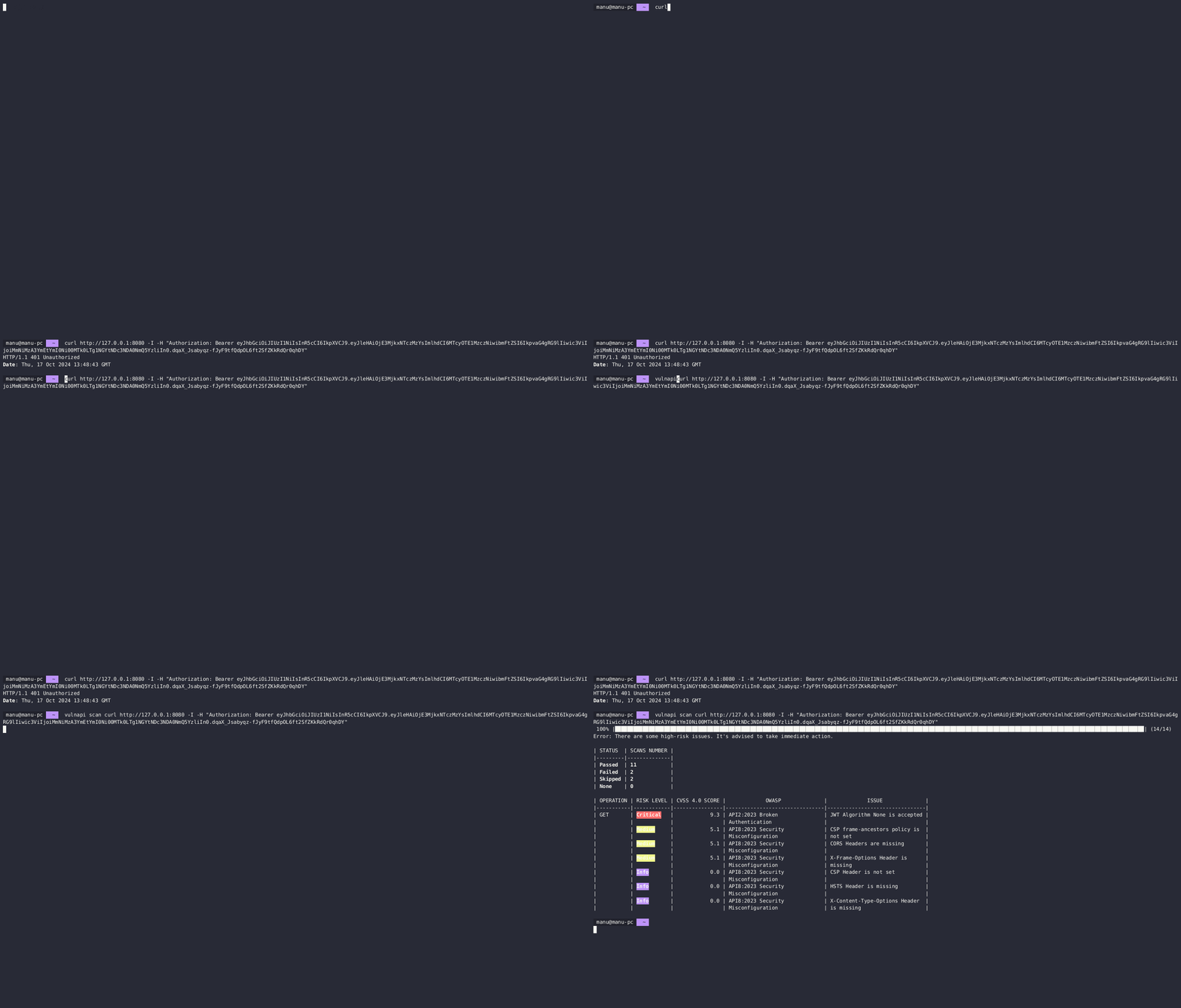
The CLI provides detailed reports on any vulnerabilities detected during the scan. Below is an example of the output format:
| TECHNOLOGIE/SERVICE | VALUE |
|---|---|
| Framework | Flask:2.2.3 |
| Language | Python:3.11.9 |
| Server | Flask:2.2.3 |
Advice: There are some low-risk issues. It's advised to take a look.
| OPERATION | RISK LEVEL | CVSS 4.0 SCORE | OWASP | VULNERABILITY |
|---|---|---|---|---|
| GET / | Medium | 5.1 | API8:2023 Security | X-Frame-Options Header is |
| Misconfiguration | missing | |||
| Medium | 5.1 | API8:2023 Security | CORS Headers are missing | |
| Misconfiguration | ||||
| Medium | 5.1 | API8:2023 Security | CSP frame-ancestors policy is | |
| Misconfiguration | not set | |||
| Info | 0.0 | API8:2023 Security | X-Content-Type-Options Header | |
| Misconfiguration | is missing | |||
| Info | 0.0 | API8:2023 Security | Operation May Accepts | |
| Misconfiguration | Unauthenticated Requests | |||
| Info | 0.0 | API8:2023 Security | HSTS Header is missing | |
| Misconfiguration | ||||
| Info | 0.0 | API8:2023 Security | CSP Header is not set | |
| Misconfiguration | ||||
| GET /books/v1 | Medium | 5.1 | API8:2023 Security | CSP frame-ancestors policy is |
| Misconfiguration | not set | |||
| Medium | 5.1 | API8:2023 Security | X-Frame-Options Header is | |
| Misconfiguration | missing | |||
| Medium | 5.1 | API8:2023 Security | CORS Headers are missing | |
| Misconfiguration | ||||
| Info | 0.0 | API8:2023 Security | CSP Header is not set | |
| Misconfiguration | ||||
| Info | 0.0 | API8:2023 Security | HSTS Header is missing | |
| Misconfiguration | ||||
| Info | 0.0 | API8:2023 Security | X-Content-Type-Options Header | |
| Misconfiguration | is missing | |||
| Info | 0.0 | API8:2023 Security | Operation May Accepts | |
| Misconfiguration | Unauthenticated Requests |
In this example, each line represents a detected vulnerability, severity level (critical), vulnerability type, affected operation (GET http://localhost:8080/), and a description of the vulnerability.
Vulnerabilities Detected
All the vulnerabilities detected by the project are listed at this URL: API Vulnerabilities Detected.
More vulnerabilities and best practices will be added in future releases. If you have any suggestions or requests for additional vulnerabilities or best practices to be included, please feel free to open an issue or submit a pull request.
Proxy Support
The scanner supports proxy configurations for scanning APIs behind a proxy server. To use a proxy, set the HTTP_PROXY or HTTPS_PROXY environment variables with the proxy URL.
A command arg --proxy is also available to specify the proxy URL.
Additional Options
The VulnAPI may support additional options for customizing scans or output formatting. Run vulnapi -h or vulnapi help command to view available options and their descriptions.
Telemetry
The scanner collects anonymous usage data to help improve the tool. This data includes the number of scans performed, number of detected vulnerabilities, and the severity of vulnerabilities. No sensitive information is collected. You can opt-out of telemetry by passing the --sqa-opt-out flag.
Complete CLI Help
To view the complete CLI help, execute the following command:
bashvulnapi -h
Here is the output of the help command:
bashvulnapi Usage: vulnapi [command] Available Commands: completion Generate the autocompletion script for the specified shell help Help about any command jwt Generate JWT tokens scan API Scan serve Start the server Flags: -h, --help help for vulnapi --sqa-opt-out Opt out of sending anonymous usage statistics and crash reports to help improve the tool Use "vulnapi [command] --help" for more information about a command.
Disclaimer
This scanner is provided for educational and informational purposes only. It should not be used for malicious purposes or to attack any system without proper authorization. Always respect the security and privacy of others.
Thanks
This project used the following open-source libraries:
License
This repository is licensed under the MIT License @ CerberAuth. You are free to use, modify, and distribute the contents of this repository for educational and testing purposes.
Contributors
Showing top 3 contributors by commit count.

![renovate[bot]](https://avatars.githubusercontent.com/in/2740?v=4)
![mend-bolt-for-github[bot]](https://avatars.githubusercontent.com/in/16809?v=4)
Related Repositories

sqlmapproject/sqlmap
Automatic SQL injection and database takeover tool

jassics/security-study-plan
Complete Practical Study Plan to become a successful cybersecurity engineer based on roles like Pentest, AppSec, Cloud Security, DevSecOps and so on...

arainho/awesome-api-security
A collection of awesome API Security tools and resources. The focus goes to open-source tools and resources that benefit all the community.

API-Security/APIKit
APIKit:Discovery, Scan and Audit APIs Toolkit All In One.

inonshk/31-days-of-API-Security-Tips
This challenge is Inon Shkedy's 31 days API Security Tips.

HolyBugx/HolyTips
A Collection of Notes, Checklists, Writeups on Bug Bounty Hunting and Web Application Security.