

Genann
simple neural network library in ANSI C
Genann is a minimal, well-tested library for training and using feedforward artificial neural networks (ANN) in C. Its primary focus is on being simple, fast, reliable, and hackable. It achieves this by providing only the necessary functions and little extra. The project is written primarily in C, distributed under the zlib License license, first published in 2016. It has gained significant community traction with 2,268 stars and 268 forks on GitHub. Key topics include: ann, ansi, artificial-neural-networks, backpropagation, c.

Genann
Genann is a minimal, well-tested library for training and using feedforward
artificial neural networks (ANN) in C. Its primary focus is on being simple,
fast, reliable, and hackable. It achieves this by providing only the necessary
functions and little extra.
Features
- C99 with no dependencies.
- Contained in a single source code and header file.
- Simple.
- Fast and thread-safe.
- Easily extendible.
- Implements backpropagation training.
- Compatible with alternative training methods (classic optimization, genetic algorithms, etc)
- Includes examples and test suite.
- Released under the zlib license - free for nearly any use.
Building
Genann is self-contained in two files: genann.c and genann.h. To use Genann, simply add those two files to your project.
Example Code
Four example programs are included with the source code.
example1.c- Trains an ANN on the XOR function using backpropagation.example2.c- Trains an ANN on the XOR function using random search.example3.c- Loads and runs an ANN from a file.example4.c- Trains an ANN on the IRIS data-set using backpropagation.
Quick Example
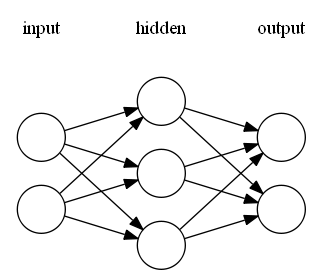
We create an ANN taking 2 inputs, having 1 layer of 3 hidden neurons, and
providing 2 outputs. It has the following structure:
We then train it on a set of labeled data using backpropagation and ask it to
predict on a test data point:
C#include "genann.h" /* Not shown, loading your training and test data. */ double **training_data_input, **training_data_output, **test_data_input; /* New network with 2 inputs, * 1 hidden layer of 3 neurons each, * and 2 outputs. */ genann *ann = genann_init(2, 1, 3, 2); /* Learn on the training set. */ for (i = 0; i < 300; ++i) { for (j = 0; j < 100; ++j) genann_train(ann, training_data_input[j], training_data_output[j], 0.1); } /* Run the network and see what it predicts. */ double const *prediction = genann_run(ann, test_data_input[0]); printf("Output for the first test data point is: %f, %f\n", prediction[0], prediction[1]); genann_free(ann);
This example is to show API usage, it is not showing good machine learning
techniques. In a real application you would likely want to learn on the test
data in a random order. You would also want to monitor the learning to prevent
over-fitting.
Usage
Creating and Freeing ANNs
Cgenann *genann_init(int inputs, int hidden_layers, int hidden, int outputs); genann *genann_copy(genann const *ann); void genann_free(genann *ann);
Creating a new ANN is done with the genann_init() function. Its arguments
are the number of inputs, the number of hidden layers, the number of neurons in
each hidden layer, and the number of outputs. It returns a genann struct pointer.
Calling genann_copy() will create a deep-copy of an existing genann struct.
Call genann_free() when you're finished with an ANN returned by genann_init().
Training ANNs
Cvoid genann_train(genann const *ann, double const *inputs, double const *desired_outputs, double learning_rate);
genann_train() will preform one update using standard backpropogation. It
should be called by passing in an array of inputs, an array of expected outputs,
and a learning rate. See example1.c for an example of learning with
backpropogation.
A primary design goal of Genann was to store all the network weights in one
contigious block of memory. This makes it easy and efficient to train the
network weights using direct-search numeric optimization algorthims,
such as Hill Climbing,
the Genetic Algorithm, Simulated
Annealing, etc.
These methods can be used by searching on the ANN's weights directly.
Every genann struct contains the members int total_weights; and
double *weight;. *weight points to an array of total_weights
size which contains all weights used by the ANN. See example2.c for
an example of training using random hill climbing search.
Saving and Loading ANNs
Cgenann *genann_read(FILE *in); void genann_write(genann const *ann, FILE *out);
Genann provides the genann_read() and genann_write() functions for loading or saving an ANN in a text-based format.
Evaluating
Cdouble const *genann_run(genann const *ann, double const *inputs);
Call genann_run() on a trained ANN to run a feed-forward pass on a given set of inputs. genann_run()
will provide a pointer to the array of predicted outputs (of ann->outputs length).
Hints
- All functions start with
genann_. - The code is simple. Dig in and change things.
Extra Resources
The comp.ai.neural-nets
FAQ is an excellent
resource for an introduction to artificial neural networks.
If you need an even smaller neural network library, check out the excellent single-hidden-layer library tinn.
If you're looking for a heavier, more opinionated neural network library in C,
I recommend the FANN library. Another
good library is Peter van Rossum's Lightweight Neural
Network, which despite its name, is
heavier and has more features than Genann.
Contributors
Showing top 6 contributors by commit count.





Related Repositories

RyanCodrai/turbovec
A vector index built on TurboQuant, written in Rust with Python bindings

postgresml/postgresml
Postgres with GPUs for ML/AI apps.

datastax/jvector
JVector: the most advanced embedded vector search engine

endee-io/endee
Endee.io – A high-performance vector database, designed to handle up to 1B vectors on a single node, delivering significant performance gains through optimized indexing and execution. Also available in cloud https://endee.io/

RedaOps/ann-visualizer
A python library for visualizing Artificial Neural Networks (ANN)

myscale/MyScaleDB
A @ClickHouse fork that supports high-performance vector search and full-text search.