

BREDS
"Bootstrapping Relationship Extractors with Distributional Semantics" (Batista et al., 2015) in EMNLP'15 - Python implementation
BREDS extracts relationships using a bootstrapping/semi-supervised approach, it relies on an initial set of seeds, i.e. pairs of named-entities representing relationship type to be extracted. The project is written primarily in Python, distributed under the GNU Lesser General Public License v3.0 license, first published in 2014. Key topics include: bootstrapping, distributional-semantics, emnlp, natural-language-processing, nlp.





BREDS
BREDS extracts relationships using a bootstrapping/semi-supervised approach, it relies on an initial set of
seeds, i.e. pairs of named-entities representing relationship type to be extracted.
The algorithm expands the initial set of seeds using distributional semantics to generalize the relationship while
limiting the semantic drift.
Extracting companies headquarters:
The input text needs to have the named-entities tagged, like show in the example bellow:
yamlThe tech company <ORG>Soundcloud</ORG> is based in <LOC>Berlin</LOC>, capital of Germany. <ORG>Pfizer</ORG> says it has hired <ORG>Morgan Stanley</ORG> to conduct the review. <ORG>Allianz</ORG>, based in <LOC>Munich</LOC>, said net income rose to EUR 1.32 billion. <LOC>Switzerland</LOC> and <LOC>South Africa</LOC> are co-chairing the meeting. <LOC>Ireland</LOC> beat <LOC>Italy</LOC> , then lost 43-31 to <LOC>France</LOC>. <ORG>Pfizer</ORG>, based in <LOC>New York City</LOC> , employs about 90,000 workers. <PER>Burton</PER> 's engine passed <ORG>NASCAR</ORG> inspection following the qualifying session.
We need to give seeds to boostrap the extraction process, specifying the type of each named-entity and
relationships examples that should also be present in the input text:
yamle1:ORG e2:LOC Lufthansa;Cologne Nokia;Espoo Google;Mountain View DoubleClick;New York SAP;Walldorf
To run a simple example, download the following files
- afp_apw_xin_embeddings.bin
- sentences_short.txt.bz2
- seeds_positive.txt
Install BREDS using pip
shpip install breads
Run the following command:
shbreds --word2vec=afp_apw_xin_embeddings.bin --sentences=sentences_short.txt --positive_seeds=seeds_positive.txt --similarity=0.6 --confidence=0.6
After the process is terminated an output file relationships.jsonl is generated containing the extracted relationships.
You can pretty print it's content to the terminal with: jq '.' < relationships.jsonl:
<br>json{ "entity_1": "Medtronic", "entity_2": "Minneapolis", "confidence": 0.9982486865148862, "sentence": "<ORG>Medtronic</ORG> , based in <LOC>Minneapolis</LOC> , is the nation 's largest independent medical device maker . ", "bef_words": "", "bet_words": ", based in", "aft_words": ", is", "passive_voice": false } { "entity_1": "DynCorp", "entity_2": "Reston", "confidence": 0.9982486865148862, "sentence": "Because <ORG>DynCorp</ORG> , headquartered in <LOC>Reston</LOC> , <LOC>Va.</LOC> , gets 98 percent of its revenue from government work .", "bef_words": "Because", "bet_words": ", headquartered in", "aft_words": ", Va.", "passive_voice": false } { "entity_1": "Handspring", "entity_2": "Silicon Valley", "confidence": 0.893486865148862, "sentence": "There will be more firms like <ORG>Handspring</ORG> , a company based in <LOC>Silicon Valley</LOC> that looks as if it is about to become a force in handheld computers , despite its lack of machinery .", "bef_words": "firms like", "bet_words": ", a company based in", "aft_words": "that looks", "passive_voice": false }
BREDS has several parameters to tune the extraction process, in the example above it uses the default values, but these
can be set in the configuration file: parameters.cfg
yamlmax_tokens_away=6 # maximum number of tokens between the two entities min_tokens_away=1 # minimum number of tokens between the two entities context_window_size=2 # number of tokens to the left and right of each entity alpha=0.2 # weight of the BEF context in the similarity function beta=0.6 # weight of the BET context in the similarity function gamma=0.2 # weight of the AFT context in the similarity function wUpdt=0.5 # < 0.5 trusts new examples less on each iteration number_iterations=4 # number of bootstrap iterations wUnk=0.1 # weight given to unknown extracted relationship instances wNeg=2 # weight given to extracted relationship instances min_pattern_support=2 # minimum number of instances in a cluster to be considered a pattern
and passed with the argument --config=parameters.cfg.
The full command line parameters are:
sh-h, --help show this help message and exit --config CONFIG file with bootstrapping configuration parameters --word2vec WORD2VEC an embedding model based on word2vec, in the format of a .bin file --sentences SENTENCES a text file with a sentence per line, and with at least two entities per sentence --positive_seeds POSITIVE_SEEDS a text file with a seed per line, in the format, e.g.: 'Nokia;Espoo' --negative_seeds NEGATIVE_SEEDS a text file with a seed per line, in the format, e.g.: 'Microsoft;San Francisco' --similarity SIMILARITY the minimum similarity between tuples and patterns to be considered a match --confidence CONFIDENCE the minimum confidence score for a match to be considered a true positive --number_iterations NUMBER_ITERATIONS the number of iterations the run
Please, refer to the section References and Citations for details on the parameters.
In the first step, BREDS pre-processes the input file sentences.txt generating word vector representations of
relationships (i.e.: processed_tuples.pkl).
This is done so that then you can experiment with different seed examples without having to repeat the process of
generating word vectors representations. Just pass the argument --sentences=processed_tuples.pkl instead to skip
this generation step.
References and Citations
Semi-Supervised Bootstrapping of Relationship Extractors with Distributional Semantics, EMNLP'15
BibTeX@inproceedings{batista-etal-2015-semi, title = "Semi-Supervised Bootstrapping of Relationship Extractors with Distributional Semantics", author = "Batista, David S. and Martins, Bruno and Silva, M{\'a}rio J.", booktitle = "Proceedings of the 2015 Conference on Empirical Methods in Natural Language Processing", month = sep, year = "2015", address = "Lisbon, Portugal", publisher = "Association for Computational Linguistics", url = "https://aclanthology.org/D15-1056", doi = "10.18653/v1/D15-1056", pages = "499--504", }
BibTeX@incollection{phd-dsbatista2016 title = {Large-Scale Semantic Relationship Extraction for Information Discovery}, author = {Batista, David S.}, school = {Instituto Superior Técnico, Universidade de Lisboa}, year = {2016} }
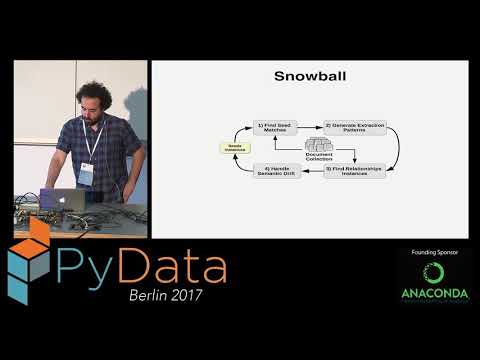
Presenting BREDS at PyData Berlin 2017
Contributing to BREDS
Improvements, adding new features and bug fixes are welcome. If you wish to participate in the development of BREDS,
please read the following guidelines.
The contribution process at a glance
- Preparing the development environment
- Code away!
- Continuous Integration
- Submit your changes by opening a pull request
Small fixes and additions can be submitted directly as pull requests, but larger changes should be discussed in
an issue first. You can expect a reply within a few days, but please be patient if it takes a bit longer.
Preparing the development environment
Make sure you have Python3.9 installed on your system
macOs
shbrew install python@3.9 python3.9 -m pip install --user --upgrade pip python3.9 -m pip install virtualenv
Clone the repository and prepare the development environment:
shgit clone git@github.com:davidsbatista/BREDS.git cd BREDS python3.9 -m virtualenv venv # create a new virtual environment for development using python3.9 source venv/bin/activate # activate the virtual environment pip install -r requirements_dev.txt # install the development requirements pip install -e . # install BREDS in edit mode
Continuous Integration
BREDS runs a continuous integration (CI) on all pull requests. This means that if you open a pull request (PR), a full
test suite is run on your PR:
- The code is formatted using
blackandisort - Unused imports are auto-removed using
pycln - Linting is done using
pylingandflake8 - Type checking is done using
mypy - Tests are run using
pytest
Nevertheless, if you prefer to run the tests & formatting locally, it's possible too.
shmake all
Opening a Pull Request
Every PR should be accompanied by short description of the changes, including:
- Impact and motivation for the changes
- Any open issues that are closed by this PR
Give a ⭐️ if this project helped you!
Contributors
Showing top 6 contributors by commit count.

![dependabot[bot]](https://avatars.githubusercontent.com/in/29110?v=4)


Related Repositories

merklefruit/SaaS4Devs
Awesome collection of content for developers trying to bootstrap their SaaS

johackim/awesome-indiehackers
Awesome list about indie hackers

AleshaOleg/holy-grail-markup
All CSS methodologies compared examples at one place.

attila-lendvai/maru
Maru - a tiny self-hosting lisp dialect

LukaszLapaj/software-testing-resource-pack
Various files useful for manual testing and test automation etc.

zephinzer/godev
Golang development tool that supports project bootstrap, live-reload (tests + application), and auto dependency retrieval based on Go Modules