

IQA optimization
Comparison of IQA models in Perceptual Optimization
This repository re-implemented the existing IQA models with PyTorch, including - [SSIM](https://www.cns.nyu.edu/~lcv/ssim/), [MS-SSIM](https://ece.uwaterloo.ca/~z70wang/publications/msssim.html), [CW-SSIM](https://www.mathworks.com/matlabcentral/fileexchange/43017-complex-wavelet-structural-similarity-index-cw-ssim), - [FSIM](https://sse.tongji.edu.cn/linzhang/IQA/FSIM/FSIM.htm), [VSI](https://sse.tongji.edu.cn/linzhang/IQA/VSI/VSI.htm), [GMSD](https://www4.comp.polyu.edu.hk/~cslzhang/IQA/GMSD/G... The project is written primarily in Python, distributed under the MIT License license, first published in 2020. Key topics include: dists, fsim, image-quality-assessment, iqa, loss-functions.
Perceptual Optimization of Image Quality Assessment (IQA) Models
This repository re-implemented the existing IQA models with PyTorch, including
Note: The reproduced results may be a little different from the original matlab version.
Installation:
pip install IQA_pytorch
Requirements:
- Python>=3.6
- Pytorch>=1.2
Usage:
pythonfrom IQA_pytorch import SSIM, GMSD, LPIPSvgg, DISTS D = SSIM(channels=3) # Calculate score of the image X with the reference Y # X: (N,3,H,W) # Y: (N,3,H,W) # Tensor, data range: 0~1 score = D(X, Y, as_loss=False) # set 'as_loss=True' to get a value as loss for optimizations. loss = D(X, Y, as_loss=True) loss.backward()
DNN-based optimization examples:
- Image denoising
- Blind image deblurring
- Single image super-resolution
- Lossy image compression
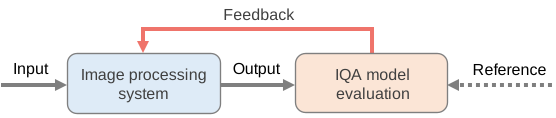
For the experiment results, please see Comparison of Image Quality Models for Optimization of Image Processing Systems
Citation:
@article{ding2020optim,
  title={Comparison of Image Quality Models for Optimization of Image Processing Systems},
  author={Ding, Keyan and Ma, Kede and Wang, Shiqi and Simoncelli, Eero P.},
  journal = {CoRR},
  volume = {abs/2005.01338},
  year={2020},
  url = {https://arxiv.org/abs/2005.01338}
}
Contributors
Showing top 1 contributor by commit count.
