

Correlation
:link: Methods for Correlation Analysis
`correlation` is an [**easystats**](https://github.com/easystats/easystats) package focused on correlation analysis. It’s lightweight, easy to use, and allows for the computation of many different kinds of correlations, such as **partial** correlations, **Bayesian** correlations, **multilevel** correlations, **polychoric** correlations, **biweight**, **percentage bend** or **Sheperd’s Pi** correlations (types of robust correlation), **distance** correlation (a type of non-linear correlation) and... The project is written primarily in R, distributed under the Other license, first published in 2019. Key topics include: bayesian, bayesian-correlations, biserial, cor, correlation.
correlation <img src='man/figures/logo.png' align="right" height="139" />

correlation is an
easystats package focused
on correlation analysis. It’s lightweight, easy to use, and allows for
the computation of many different kinds of correlations, such as
partial correlations, Bayesian correlations, multilevel
correlations, polychoric correlations, biweight, percentage
bend or Sheperd’s Pi correlations (types of robust correlation),
distance correlation (a type of non-linear correlation) and more,
also allowing for combinations between them (for instance, Bayesian
partial multilevel correlation).
Citation
You can cite the package as follows:
Makowski, D., Ben-Shachar, M. S., Patil, I., & Lüdecke, D. (2020).
Methods and algorithms for correlation analysis in R. Journal of Open
Source Software, 5(51), 2306. https://doi.org/10.21105/joss.02306
Makowski, D., Wiernik, B. M., Patil, I., Lüdecke, D., & Ben-Shachar, M.
S. (2022). correlation: Methods for correlation analysis [R
package]. https://CRAN.R-project.org/package=correlation (Original
work published 2020)
Installation

The correlation package is available on CRAN, while its latest
development version is available on R-universe (from rOpenSci).
| Type | Source | Command |
|---|---|---|
| Release | CRAN | install.packages("correlation") |
| Development | R-universe | install.packages("correlation", repos = "https://easystats.r-universe.dev") |
Once you have downloaded the package, you can then load it using:
rlibrary("correlation")
Tip
Instead of
library(bayestestR), uselibrary(easystats). This will
make all features of the easystats-ecosystem available.To stay updated, use
easystats::install_latest().
Documentation



Check out package website
for documentation.
Features
The correlation package can compute many different types of
correlation, including:
✅ Pearson’s correlation<br> ✅ Spearman’s rank correlation<br>
✅ Kendall’s rank correlation<br> ✅ Biweight midcorrelation<br>
✅ Distance correlation<br> ✅ Percentage bend correlation<br>
✅ Shepherd’s Pi correlation<br> ✅ Blomqvist’s coefficient<br>
✅ Hoeffding’s D<br> ✅ Gamma correlation<br> ✅ Gaussian rank
correlation<br> ✅ Point-Biserial and biserial correlation<br> ✅
Winsorized correlation<br> ✅ Polychoric correlation<br> ✅
Tetrachoric correlation<br> ✅ Multilevel correlation<br>
An overview and description of these correlations types is available
here.
Moreover, many of these correlation types are available as partial
or within a Bayesian framework.
Examples
The main function is
correlation(),
which builds on top of
cor_test()
and comes with a number of possible options.
Correlation details and matrix
rresults <- correlation(iris) results ## # Correlation Matrix (pearson-method) ## ## Parameter1 | Parameter2 | r | 95% CI | t(148) | p ## ------------------------------------------------------------------------- ## Sepal.Length | Sepal.Width | -0.12 | [-0.27, 0.04] | -1.44 | 0.152 ## Sepal.Length | Petal.Length | 0.87 | [ 0.83, 0.91] | 21.65 | < .001*** ## Sepal.Length | Petal.Width | 0.82 | [ 0.76, 0.86] | 17.30 | < .001*** ## Sepal.Width | Petal.Length | -0.43 | [-0.55, -0.29] | -5.77 | < .001*** ## Sepal.Width | Petal.Width | -0.37 | [-0.50, -0.22] | -4.79 | < .001*** ## Petal.Length | Petal.Width | 0.96 | [ 0.95, 0.97] | 43.39 | < .001*** ## ## p-value adjustment method: Holm (1979) ## Observations: 150
The output is not a square matrix, but a (tidy) dataframe with all
correlations tests per row. One can also obtain a matrix using:
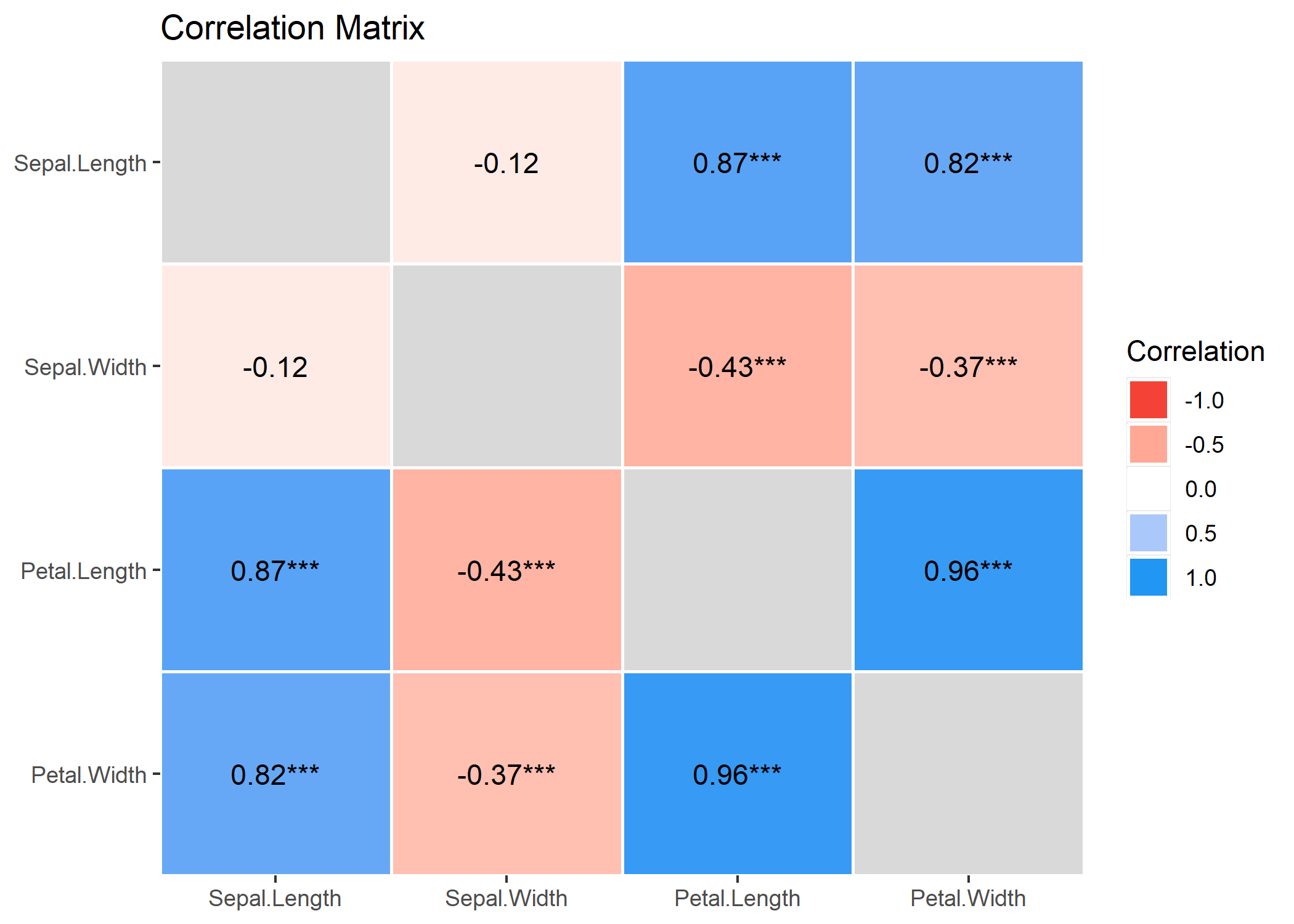
rsummary(results) ## # Correlation Matrix (pearson-method) ## ## Parameter | Petal.Width | Petal.Length | Sepal.Width ## ------------------------------------------------------- ## Sepal.Length | 0.82*** | 0.87*** | -0.12 ## Sepal.Width | -0.37*** | -0.43*** | ## Petal.Length | 0.96*** | | ## ## p-value adjustment method: Holm (1979)
Note that one can also obtain the full, square and redundant matrix
using:
rsummary(results, redundant = TRUE) ## # Correlation Matrix (pearson-method) ## ## Parameter | Sepal.Length | Sepal.Width | Petal.Length | Petal.Width ## ---------------------------------------------------------------------- ## Sepal.Length | | -0.12 | 0.87*** | 0.82*** ## Sepal.Width | -0.12 | | -0.43*** | -0.37*** ## Petal.Length | 0.87*** | -0.43*** | | 0.96*** ## Petal.Width | 0.82*** | -0.37*** | 0.96*** | ## ## p-value adjustment method: Holm (1979)
rlibrary(see) results %>% summary(redundant = TRUE) %>% plot()
 <!-- -->
Correlation tests
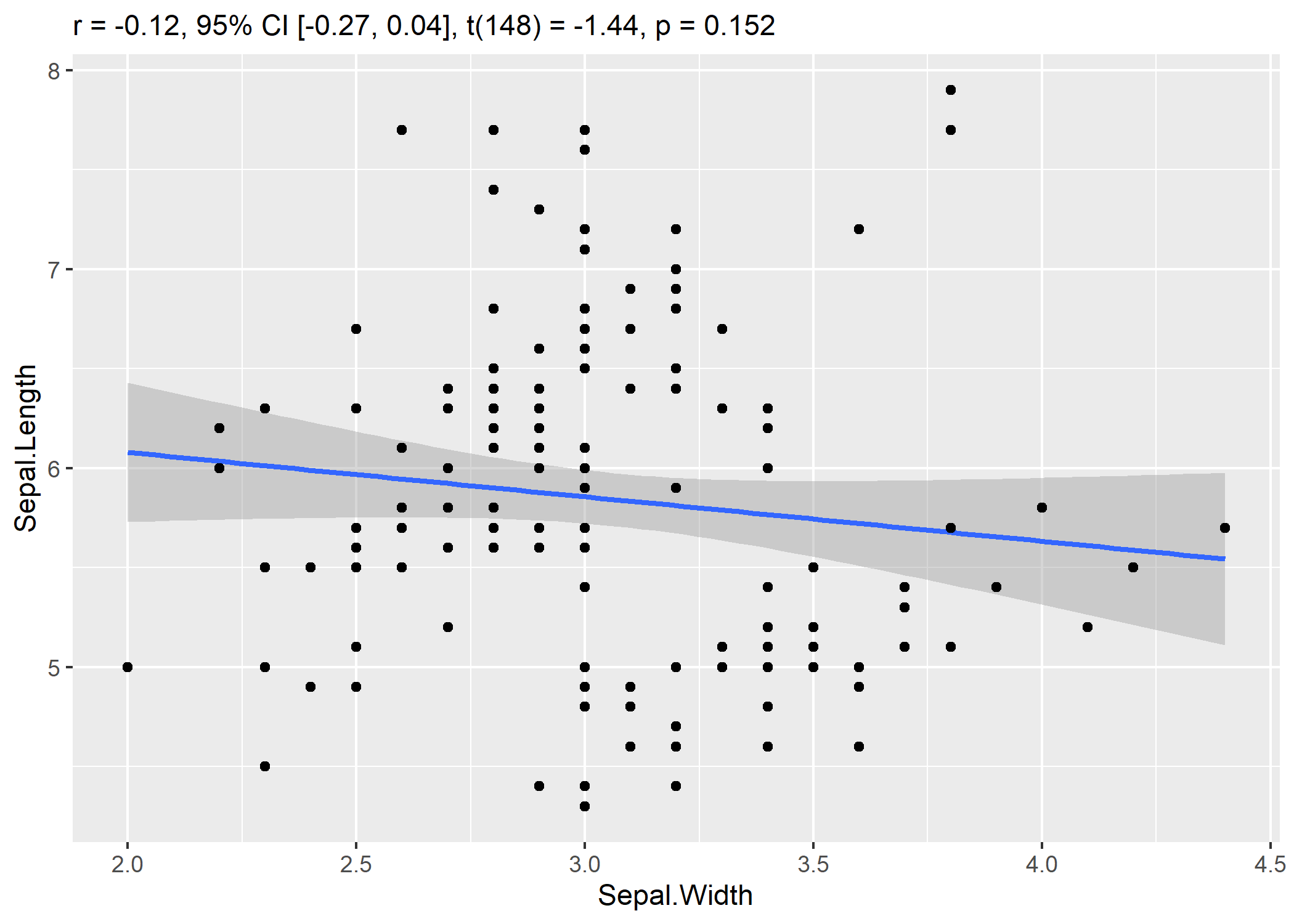
The cor_test() function, for pairwise correlations, is also very
convenient for making quick scatter plots.
rplot(cor_test(iris, "Sepal.Width", "Sepal.Length"))
 <!-- -->
Grouped dataframes
The correlation() function also supports stratified correlations,
all within the tidyverse workflow!
riris %>% select(Species, Sepal.Length, Sepal.Width, Petal.Width) %>% group_by(Species) %>% correlation() ## # Correlation Matrix (pearson-method) ## ## Group | Parameter1 | Parameter2 | r | 95% CI | t(48) | p ## ---------------------------------------------------------------------------------- ## setosa | Sepal.Length | Sepal.Width | 0.74 | [ 0.59, 0.85] | 7.68 | < .001*** ## setosa | Sepal.Length | Petal.Width | 0.28 | [ 0.00, 0.52] | 2.01 | 0.101 ## setosa | Sepal.Width | Petal.Width | 0.23 | [-0.05, 0.48] | 1.66 | 0.104 ## versicolor | Sepal.Length | Sepal.Width | 0.53 | [ 0.29, 0.70] | 4.28 | < .001*** ## versicolor | Sepal.Length | Petal.Width | 0.55 | [ 0.32, 0.72] | 4.52 | < .001*** ## versicolor | Sepal.Width | Petal.Width | 0.66 | [ 0.47, 0.80] | 6.15 | < .001*** ## virginica | Sepal.Length | Sepal.Width | 0.46 | [ 0.20, 0.65] | 3.56 | 0.002** ## virginica | Sepal.Length | Petal.Width | 0.28 | [ 0.00, 0.52] | 2.03 | 0.048* ## virginica | Sepal.Width | Petal.Width | 0.54 | [ 0.31, 0.71] | 4.42 | < .001*** ## ## p-value adjustment method: Holm (1979) ## Observations: 50
Bayesian Correlations
It is very easy to switch to a Bayesian framework.
rcorrelation(iris, bayesian = TRUE) ## # Correlation Matrix (pearson-method) ## ## Parameter1 | Parameter2 | rho | 95% CI | pd | % in ROPE ## -------------------------------------------------------------------------- ## Sepal.Length | Sepal.Width | -0.11 | [-0.27, 0.04] | 92.70% | 42.83% ## Sepal.Length | Petal.Length | 0.86 | [ 0.82, 0.90] | 100%*** | 0% ## Sepal.Length | Petal.Width | 0.81 | [ 0.75, 0.86] | 100%*** | 0% ## Sepal.Width | Petal.Length | -0.41 | [-0.55, -0.28] | 100%*** | 0% ## Sepal.Width | Petal.Width | -0.35 | [-0.49, -0.22] | 100%*** | 0% ## Petal.Length | Petal.Width | 0.96 | [ 0.95, 0.97] | 100%*** | 0% ## ## Parameter1 | Prior | BF ## ------------------------------------------ ## Sepal.Length | Beta (3 +- 3) | 0.509 ## Sepal.Length | Beta (3 +- 3) | 2.14e+43*** ## Sepal.Length | Beta (3 +- 3) | 2.62e+33*** ## Sepal.Width | Beta (3 +- 3) | 3.49e+05*** ## Sepal.Width | Beta (3 +- 3) | 5.29e+03*** ## Petal.Length | Beta (3 +- 3) | 1.24e+80*** ## ## Observations: 150
Tetrachoric, Polychoric, Biserial, Biweight…
The correlation package also supports different types of methods,
which can deal with correlations between factors!
rcorrelation(iris, include_factors = TRUE, method = "auto") ## # Correlation Matrix (auto-method) ## ## Parameter1 | Parameter2 | r | 95% CI | t(148) | p ## ------------------------------------------------------------------------------------- ## Sepal.Length | Sepal.Width | -0.12 | [-0.27, 0.04] | -1.44 | 0.452 ## Sepal.Length | Petal.Length | 0.87 | [ 0.83, 0.91] | 21.65 | < .001*** ## Sepal.Length | Petal.Width | 0.82 | [ 0.76, 0.86] | 17.30 | < .001*** ## Sepal.Length | Species.setosa | -0.72 | [-0.79, -0.63] | -12.53 | < .001*** ## Sepal.Length | Species.versicolor | 0.08 | [-0.08, 0.24] | 0.97 | 0.452 ## Sepal.Length | Species.virginica | 0.64 | [ 0.53, 0.72] | 10.08 | < .001*** ## Sepal.Width | Petal.Length | -0.43 | [-0.55, -0.29] | -5.77 | < .001*** ## Sepal.Width | Petal.Width | -0.37 | [-0.50, -0.22] | -4.79 | < .001*** ## Sepal.Width | Species.setosa | 0.60 | [ 0.49, 0.70] | 9.20 | < .001*** ## Sepal.Width | Species.versicolor | -0.47 | [-0.58, -0.33] | -6.44 | < .001*** ## Sepal.Width | Species.virginica | -0.14 | [-0.29, 0.03] | -1.67 | 0.392 ## Petal.Length | Petal.Width | 0.96 | [ 0.95, 0.97] | 43.39 | < .001*** ## Petal.Length | Species.setosa | -0.92 | [-0.94, -0.89] | -29.13 | < .001*** ## Petal.Length | Species.versicolor | 0.20 | [ 0.04, 0.35] | 2.51 | 0.066 ## Petal.Length | Species.virginica | 0.72 | [ 0.63, 0.79] | 12.66 | < .001*** ## Petal.Width | Species.setosa | -0.89 | [-0.92, -0.85] | -23.41 | < .001*** ## Petal.Width | Species.versicolor | 0.12 | [-0.04, 0.27] | 1.44 | 0.452 ## Petal.Width | Species.virginica | 0.77 | [ 0.69, 0.83] | 14.66 | < .001*** ## Species.setosa | Species.versicolor | -0.88 | [-0.91, -0.84] | -22.43 | < .001*** ## Species.setosa | Species.virginica | -0.88 | [-0.91, -0.84] | -22.43 | < .001*** ## Species.versicolor | Species.virginica | -0.88 | [-0.91, -0.84] | -22.43 | < .001*** ## ## p-value adjustment method: Holm (1979) ## Observations: 150
Partial Correlations
It also supports partial correlations (as well as Bayesian partial
correlations).
riris %>% correlation(partial = TRUE) %>% summary() ## # Correlation Matrix (pearson-method) ## ## Parameter | Petal.Width | Petal.Length | Sepal.Width ## ------------------------------------------------------- ## Sepal.Length | -0.34*** | 0.72*** | 0.63*** ## Sepal.Width | 0.35*** | -0.62*** | ## Petal.Length | 0.87*** | | ## ## p-value adjustment method: Holm (1979)
Gaussian Graphical Models (GGMs)
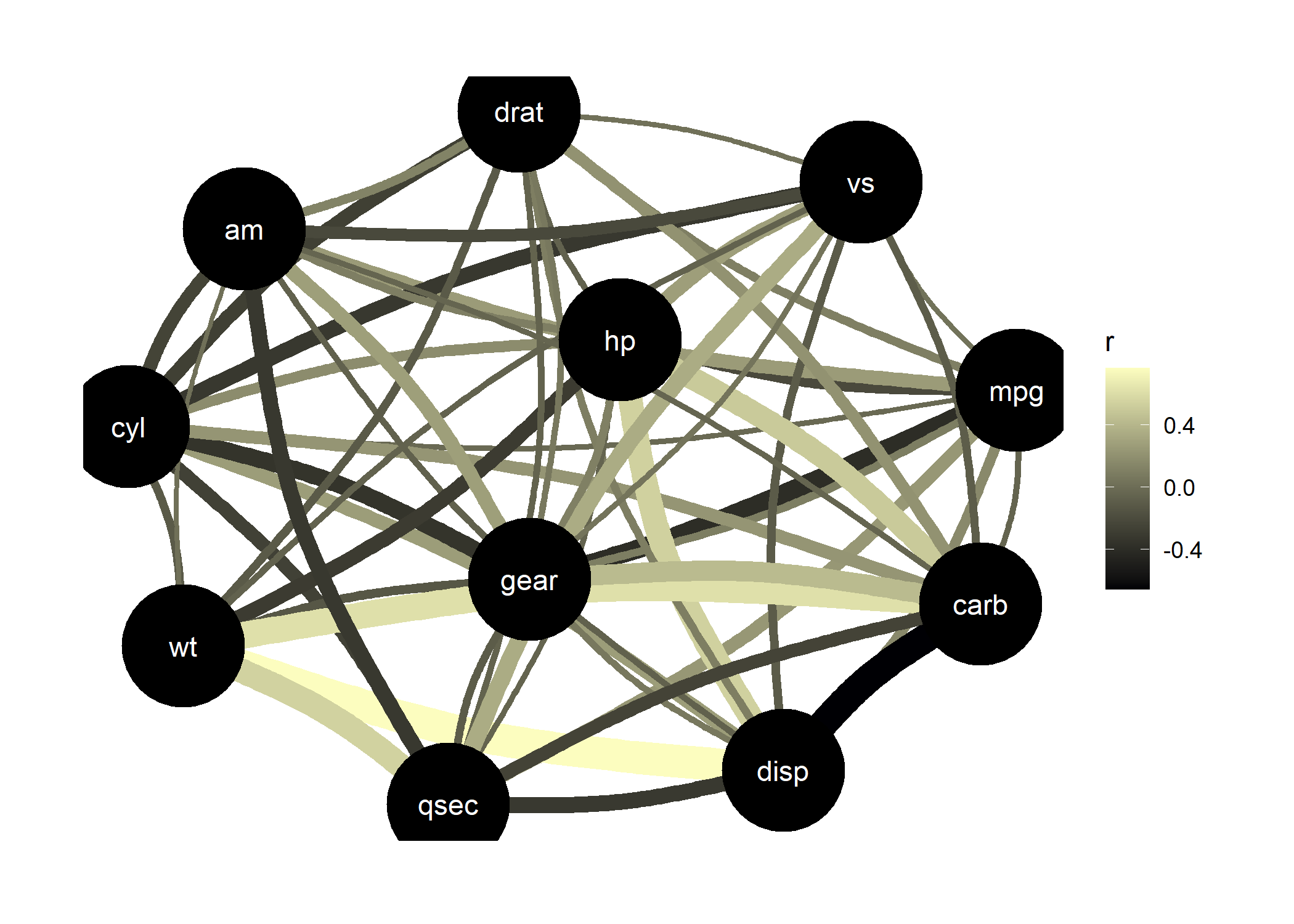
Such partial correlations can also be represented as Gaussian
Graphical Models (GGM), an increasingly popular tool in psychology. A
GGM traditionally include a set of variables depicted as circles
(“nodes”), and a set of lines that visualize relationships between them,
which thickness represents the strength of association (see Bhushan et
al.,
2019).
rlibrary(see) # for plotting library(ggraph) # needs to be loaded plot(correlation(mtcars, partial = TRUE)) + scale_edge_color_continuous(low = "#000004FF", high = "#FCFDBFFF")
 <!-- -->
Multilevel Correlations
It also provide some cutting-edge methods, such as Multilevel (partial)
correlations. These are are partial correlations based on linear
mixed-effects models that include the factors as random effects.
They can be see as correlations adjusted for some group
(hierarchical) variability.
riris %>% correlation(partial = TRUE, multilevel = TRUE) %>% summary() ## # Correlation Matrix (pearson-method) ## ## Parameter | Petal.Width | Petal.Length | Sepal.Width ## ------------------------------------------------------- ## Sepal.Length | -0.17* | 0.71*** | 0.43*** ## Sepal.Width | 0.39*** | -0.18* | ## Petal.Length | 0.38*** | | ## ## p-value adjustment method: Holm (1979)
However, if the partial argument is set to FALSE, it will try to
convert the partial coefficient into regular ones.These can be
converted back to full correlations:
riris %>% correlation(partial = FALSE, multilevel = TRUE) %>% summary() ## Parameter | Petal.Width | Petal.Length | Sepal.Width ## ------------------------------------------------------- ## Sepal.Length | 0.36*** | 0.76*** | 0.53*** ## Sepal.Width | 0.47*** | 0.38*** | ## Petal.Length | 0.48*** | |
Contributing and Support
In case you want to file an issue or contribute in another way to the
package, please follow this
guide. For
questions about the functionality, you may either contact us via email
or also file an issue.
Code of Conduct
Please note that this project is released with a Contributor Code of
Conduct.
By participating in this project you agree to abide by its terms.
Contributors
Showing top 12 contributors by commit count.






![github-actions[bot]](https://avatars.githubusercontent.com/in/15368?v=4)


Related Repositories

pyro-ppl/pyro
Deep universal probabilistic programming with Python and PyTorch

MingchaoZhu/DeepLearning
Python for《Deep Learning》,该书为《深度学习》(花书) 数学推导、原理剖析与源码级别代码实现

stan-dev/stan
Stan development repository. The master branch contains the current release. The develop branch contains the latest stable development. See the Developer Process Wiki for details.

avehtari/BDA_course_Aalto
Bayesian Data Analysis course at Aalto

uber/orbit
A Python package for Bayesian forecasting with object-oriented design and probabilistic models under the hood.

probcomp/Gen.jl
A general-purpose probabilistic programming system with programmable inference