

Mplchart
Classic Stock Charts in Python
Create classic technical analysis stock charts in Python with minimal code. The library is built around [matplotlib](https://github.com/matplotlib/matplotlib) and supports both [pandas](https://github.com/pandas-dev/pandas) and [polars](https://github.com/pola-rs/polars) DataFrames. Charts can be defined using a declarative interface, based on a set of drawing primitives like `Candlesticks`, `Volume` and technical indicators like `SMA`, `EMA`, `RSI`, `ROC`, `MACD`, etc ... The project is written primarily in Python, distributed under the MIT License license, first published in 2022. Key topics include: candlesticks, charting, finance, indicators, matplotlib.
Classic Stock Charts in Python
Create classic technical analysis stock charts in Python with minimal code.
The library is built around matplotlib
and supports both pandas
and polars DataFrames.
Charts can be defined using a declarative interface,
based on a set of drawing primitives like Candlesticks, Volume
and technical indicators like SMA, EMA, RSI, ROC, MACD, etc ...
Warning:
This project is experimental and the interface is likely to change.
For a related project with a mature api you may want to look into mplfinance.
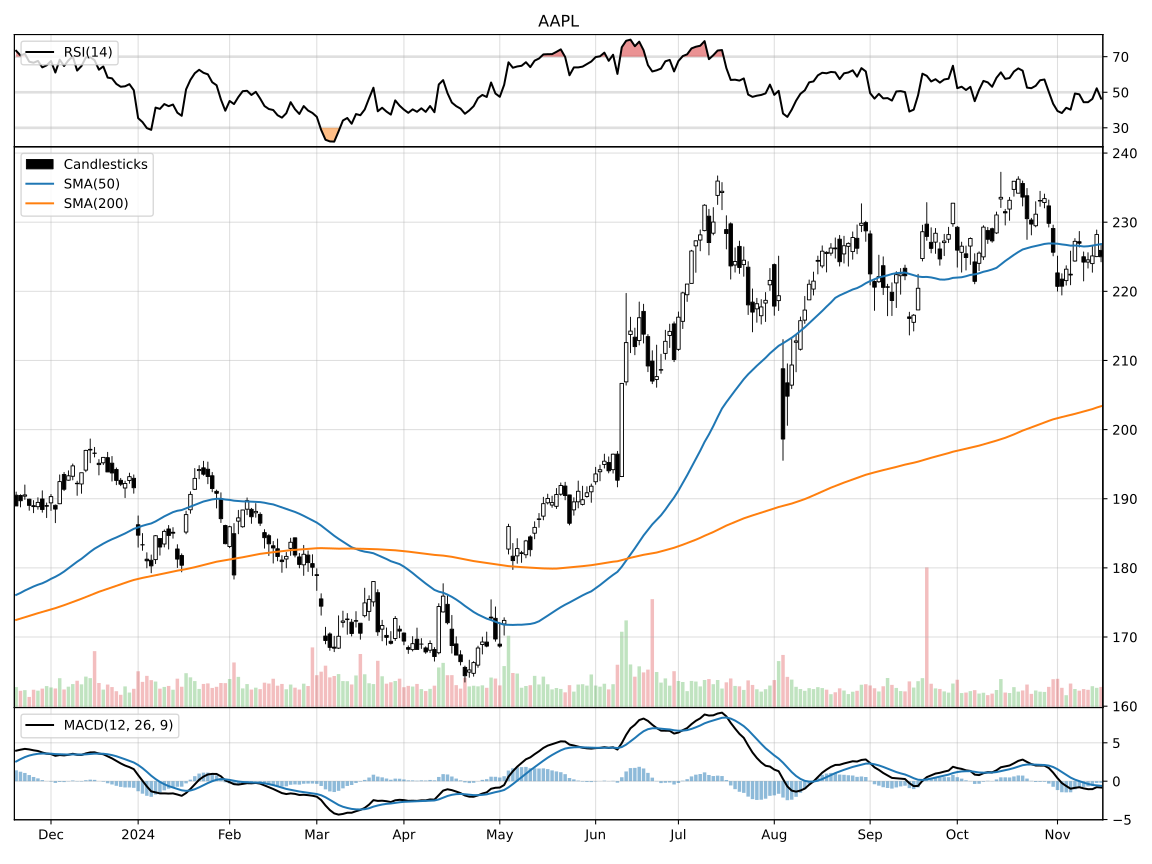
Typical Usage
python# Candlesticks chart with SMA, RSI and MACD indicators import yfinance as yf from mplchart.chart import Chart from mplchart.primitives import Candlesticks, Volume, Pane, LinePlot from mplchart.indicators import SMA, RSI, MACD ticker = 'AAPL' prices = yf.Ticker(ticker).history('5y') Chart(prices, title=ticker, max_bars=250, normalize=True).plot( Candlesticks(), Volume(), SMA(50), SMA(200), Pane("above", yticks=(30, 50, 70)), RSI(14) @ LinePlot(overbought=70, oversold=30), Pane("below"), MACD(), ).show()
Conventions
Prices data is expected to be a dataframe with columns open, high, low, close, volume in lower case and a datetime column named date or datetime (or a datetime index for pandas).
Note: The
Chart, indicators and primitives strictly require lower case column names. UseChart(..., normalize=True)or callnormalize_pricesfrommplchart.utilswhen using prices with a different naming convention, like prices fromyfinancewhich are capitalized by default.pythonimport yfinance as yf from mplchart.utils import normalize_prices prices = normalize_prices(yf.Ticker(ticker).history('5y'))
Drawing Primitives
The library contains drawing primitives that can be used like an indicator in the plot api.
Primitives are classes and must be instantiated as objects before being used with the plot api.
python# Candlesticks chart from mplchart.chart import Chart from mplchart.primitives import Candlesticks Chart(prices, title=title, max_bars=250).plot( Candlesticks() ).show()
The main drawing primitives are :
Candlesticksfor candlestick plotsOHLCfor open, high, low, close bar plotsPricefor price line plotsVolumefor volume bar plotsPaneto switch to a different pane (above or below)LinePlotdraw an indicator as line plotAreaPlotdraw an indicator as area plotBarPlotdraw an indicator as bar plotZigZaglines between pivot pointsPeaksto mark peaks and valleysHLineto draw a horizontal reference line on the current paneVLineto draw a vertical line across all panes at a given date
Builtin Indicators
The library includes some standard technical analysis indicators for pandas DataFrames.
Indicators are classes and must be instantiated as objects before being used with the plot api.
Some of the indicators included are:
SMASimple Moving AverageEMAExponential Moving AverageWMAWeighted Moving AverageHMAHull Moving AverageRMARolling Moving Average (Wilder's)DEMADouble Exponential Moving AverageTEMATriple Exponential Moving AverageMOMMomentumROCRate of ChangeRSIRelative Strength IndexADXAverage Directional IndexDMIDirectional Movement IndexMACDMoving Average Convergence DivergencePPOPrice Percentage OscillatorBOPBalance of PowerCMFChaikin Money FlowMFIMoney Flow IndexSTOCHStochastic OscillatorTRANGETrue RangeATRAverage True RangeNATRNormalized Average True RangeBBANDSBollinger BandsBBPBollinger Bands PercentBBWBollinger Bands WidthKELTNERKeltner ChannelDONCHIANDonchian ChannelMIDPRICEMidpoint PriceTYPPRICETypical PriceWCLPRICEWeighted Close Price
Use @ to bind an indicator to a rendering primitive, and | to chain indicators:
pythonSMA(50) @ LinePlot(style="dashed", color="red") # bind indicator to primitive SMA(50) | ROC(1) # chain indicators
python# Customizing indicator style with LinePlot from mplchart.indicators import SMA, EMA, ROC from mplchart.primitives import Candlesticks, LinePlot indicators = [ Candlesticks(), SMA(20) @ LinePlot(style="dashed", color="red", alpha=0.5, width=3) ] Chart(prices).plot(indicators)
If the indicator returns a DataFrame instead of a Series, specify an item (column name) in the primitive.
Indicators are callables — apply one directly with indicator(prices) or prices.pipe(indicator).
For boolean / arithmetic composition, wrap an indicator with as_expr() to obtain a
pandas Expression (requires pandas ≥ 3.0). Multi-output indicators take an item
argument to select one column:
pythonRSI(14).as_expr() < 30 # pandas Expression MACD().as_expr("macdhist") > 0 # select histogram column Stripes(MACD().as_expr("macdhist") > 0) # use as a binding condition
Polars Expressions
For polars DataFrames, the expressions subpackage provides polars Expr factories
as an alternative to the indicator pattern.
These can be used directly with chart.plot().
python# Candlesticks chart with polars expressions from mplchart.chart import Chart from mplchart.primitives import Candlesticks, Volume, Pane, LinePlot from mplchart.expressions import SMA, EMA, RSI, MACD Chart(prices, title=ticker, max_bars=250).plot( Candlesticks(), Volume(), SMA(50), SMA(200), Pane("above", yticks=(30, 50, 70)), RSI() @ LinePlot(overbought=70, oversold=30), Pane("below"), MACD(), ).show()
Expressions are plain polars.Expr values — they can be composed with standard polars operators,
passed to df.select(), or used anywhere polars expressions are accepted.
Use @ to bind an expression to a rendering primitive:
pythonfrom mplchart.primitives import LinePlot, AreaPlot from mplchart.expressions import SMA, RSI SMA(50) @ LinePlot(color="red") # expression → primitive RSI(14) @ AreaPlot(color="blue") # expression → primitive
Talib Functions
If you have ta-lib installed you can use its abstract functions as indicators. They are created by calling Function with the name of the function and its parameters. Ta-lib functions work with both pandas and polars backends.
python# Candlesticks chart with talib functions from mplchart.primitives import Candlesticks from talib.abstract import Function indicators = [ Candlesticks(), Function('SMA', 50), Function('SMA', 200), ] Chart(prices).plot(indicators).show()
Examples
Example notebooks live in the examples/ folder — see the examples README for the full list.
Installation
consolepip install mplchart
The indicators module requires pandas; the expressions module requires polars.
If either is already in your environment, mplchart will use it automatically.
The [pandas], [polars], and [all] extras are just a convenience — they
install pandas or polars alongside mplchart, nothing more:
consolepip install mplchart[pandas] pip install mplchart[polars] pip install mplchart[all]
Dependencies
Required:
- python >= 3.10
- matplotlib
- numpy
- pyarrow
Optional extras:
[pandas]— pandas[polars]— polars[all]— pandas and polars
Related Projects
- mplfinance - Matplotlib utilities for the visualization, and visual analysis, of financial data
- cufflinks - Productivity Tools for Plotly + Pandas
- matplotlib - Matplotlib: plotting with Python
- pandas - Flexible and powerful data analysis / manipulation library for Python
- polars - Fast DataFrame library for Python
- yfinance - Download market data from Yahoo! Finance's API
Contributors
Showing top 1 contributor by commit count.

Related Repositories

imaNNeo/fl_chart
FL Chart is a highly customizable Flutter chart library that supports Line Chart, Bar Chart, Pie Chart, Scatter Chart, Radar Chart and Candlestick Chart.

cm45t3r/candlestick
Candlestick patterns detection.

SockTrader/SockTrader
🚀 Websocket based trading bot for 💰cryptocurrencies 📈

trentpiercy/flutter-candlesticks
Elegant OHLC Candlestick and Trade Volume charts for @Flutter

shunjizhan/all-candlestick-pattern-indicators
All candlestick patterns indicator (所有技术形态指标) in TradingView

vybenetwork/solana-ohlc-api
Solana OHLC API