

Trainer
Distributed AI Model Training and LLM Fine-Tuning on Kubernetes
- [2026/03] Kubeflow Trainer v2.2 is officially released with support for JAX and XGBoost Training Runtimes, enhanced observability with metrics propagation to TrainJob status, and Flux Framework integration for HPC and MPI workloads. Check out [the blog post announcement](https://blog.kubeflow.org/kubeflow-trainer-v2.2-release/). - [2025/11] Kubeflow Trainer v2.1 is officially released with support of [Distributed Data Cache](https://www.kubeflow.org/docs/components/trainer/user-guides/data-cac... The project is written primarily in Go, distributed under the Apache License 2.0 license, first published in 2017. It has gained significant community traction with 2,115 stars and 970 forks on GitHub. Key topics include: ai, distributed, fine-tuning, gpu, huggingface.
Kubeflow Trainer




Latest News 🔥
- [2026/03] Kubeflow Trainer v2.2 is officially released with support for JAX and XGBoost
Training Runtimes, enhanced observability with metrics propagation to TrainJob status,
and Flux Framework integration for HPC and MPI workloads. Check out
the blog post announcement. - [2025/11] Kubeflow Trainer v2.1 is officially released with support of
Distributed Data Cache,
topology aware scheduling with Kueue and Volcano, and LLM post-training enhancements. Check out
the GitHub release notes. - [2025/09] Kubeflow SDK v0.1 is officially released with support for CustomTrainer,
BuiltinTrainer, and local PyTorch execution. Check out
the GitHub release notes. - [2025/07] PyTorch on Kubernetes: Kubeflow Trainer Joins the PyTorch Ecosystem. Find the
announcement in the PyTorch blog post.
- [2025/07] Kubeflow Trainer v2.0 has been officially released. Check out
the blog post announcement and the
release notes. - [2025/04] From High Performance Computing To AI Workloads on Kubernetes: MPI Runtime in
Kubeflow TrainJob. See the KubeCon + CloudNativeCon London talk
Overview
Kubeflow Trainer is a Kubernetes-native distributed AI platform for scalable large language model
(LLM) fine-tuning and training of AI models across a wide range of frameworks, including
PyTorch, MLX, HuggingFace, DeepSpeed, JAX, XGBoost, and more.
Kubeflow Trainer brings MPI to Kubernetes, orchestrating multi-node, multi-GPU distributed
jobs efficiently across high-performance computing (HPC) clusters. This enables high-throughput
communication between processes, making it ideal for large-scale AI training that requires
ultra-fast synchronization between GPUs nodes.
Kubeflow Trainer seamlessly integrates with the Cloud Native AI ecosystem, including
Kueue for topology-aware scheduling and
multi-cluster job dispatching, as well as JobSet and
LeaderWorkerSet for AI workload orchestration.
Kubeflow Trainer provides a distributed data cache designed to stream large-scale data with zero-copy
transfer directly to GPU nodes. This ensures memory-efficient training jobs while maximizing
GPU utilization.
With the Kubeflow Python SDK, AI practitioners can effortlessly
develop and fine-tune LLMs while leveraging the Kubeflow Trainer APIs: TrainJob and Runtimes.
Kubeflow Trainer Introduction
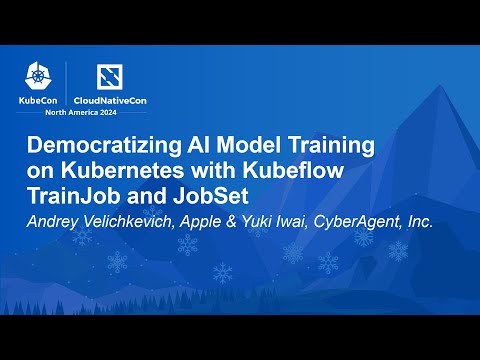
Checkout following KubeCon + CloudNativeCon talks for Kubeflow Trainer capabilities:
Additional talks:
- From High Performance Computing To AI Workloads on Kubernetes: MPI Runtime in Kubeflow TrainJob
- Streamline LLM Fine-tuning on Kubernetes With Kubeflow LLM Trainer
Getting Started
Please check the official Kubeflow Trainer documentation
to install and get started with Kubeflow Trainer.
Community
The following links provide information on how to get involved in the community:
- Join our
#kubeflow-trainerSlack channel. - Attend the bi-weekly AutoML and Training Working Group community meeting.
- Check out who is using Kubeflow Trainer.
Contributing
Please refer to the CONTRIBUTING guide.
Changelog
Please refer to the CHANGELOG directory.
Kubeflow Training Operator V1
Kubeflow Trainer project is currently in <strong>alpha</strong> status, and APIs may change.
If you are using Kubeflow Training Operator V1, please refer to this migration document.
Kubeflow Community will maintain the Training Operator V1 source code at
the release-1.9 branch.
You can find the documentation for Kubeflow Training Operator V1 in these guides.
Acknowledgement
This project was originally started as a distributed training operator for TensorFlow and later we
merged efforts from other Kubeflow Training Operators to provide a unified and simplified experience
for both users and developers. We are very grateful to all who filed issues or helped resolve them,
asked and answered questions, and were part of inspiring discussions.
We'd also like to thank everyone who's contributed to and maintained the original operators.
- PyTorch Operator: list of contributors
and maintainers. - MPI Operator: list of contributors
and maintainers. - XGBoost Operator: list of contributors
and maintainers. - Common library: list of contributors and
maintainers.
Contributors
Showing top 12 contributors by commit count.
![dependabot[bot]](https://avatars.githubusercontent.com/in/29110?v=4)





Related Repositories

openclaw/openclaw
Your own personal AI assistant. Any OS. Any Platform. The lobster way. 🦞

NousResearch/hermes-agent
The agent that grows with you

n8n-io/n8n
Fair-code workflow automation platform with native AI capabilities. Combine visual building with custom code, self-host or cloud, 400+ integrations.

Significant-Gravitas/AutoGPT
AutoGPT is the vision of accessible AI for everyone, to use and to build on. Our mission is to provide the tools, so that you can focus on what matters.

f/prompts.chat
f.k.a. Awesome ChatGPT Prompts. Share, discover, and collect prompts from the community. Free and open source — self-host for your organization with complete privacy.

AUTOMATIC1111/stable-diffusion-webui
Stable Diffusion web UI