

Safetyfast
An Go library of synchronization primitives to help make use of hardware transactional memory (HTM)
This is a Go library that implements synchronization primitives over [Intel TSX][wikipedia-tsx] (hardware transactional primitives). The project is written primarily in Go, distributed under the MIT License license, first published in 2018. Key topics include: go-library, hardware-transactional-memory, hle, htm, multithreading.



SafetyFast - Put thread-safety first, with the performance of safety last.
This is a Go library that implements synchronization primitives over
Intel TSX (hardware transactional primitives).
shellgo get github.com/linux4life798/safetyfast
Checkout the SafetyFast Project Page.
Benchmarking
The following plot shows the number of milliseconds it took for 8 goroutines
to increments 480000 random elements (per goroutine) of an array of ints.
The x axis denotes how large (and therefore sparse) the array was.
The synchronization primitive used during the increment is indicated as
a series/line.
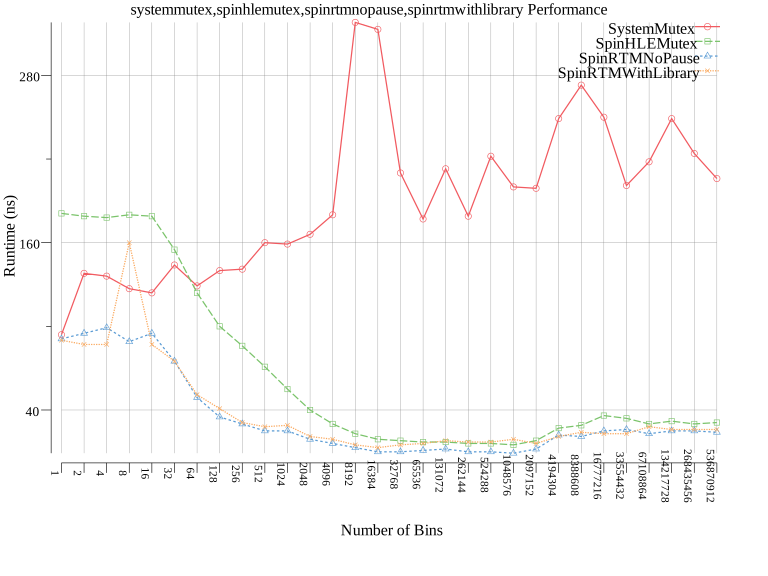
Note that, as the array size increases, the likelihood of two goroutines
touching the same element at the same instance decreases.
This is why we see such a dramatic increase in speed, when using either
the HLE or RTM style synchronization primitive.
The SystemMutex is just sync.Mutex.
It is also worth observing that the performance started to degrade towards the
very large array sizes. This is most likely due to a cache size limitation.
Snippets
Using RTM
gom := map[string]int{ "word1": 0, } c := NewRTMContexDefault() c.Atomic(func() { // Action to be done transactionally m["word1"] = m["word1"] + 1 })
Using HLE
gom := map[string]int{ "word1": 0, } var lock safetyfast.SpinHLEMutex lock.Lock() // Action to be done transactionally m["word1"] = m["word1"] + 1 lock.Unlock()
Check if your CPU supports Intel TSX
Use the doihavetsx utility
bashgo get github.com/linux4life798/safetyfast/doihavetsx doihavetsx
The output should look something like:
CPU Brand:  Intel(R) Core(TM) i7-7820HQ CPU @ 2.90GHz
RTM:        Yes
HLE:        Yes
Common CPUs and Machines
| CPU Name | CPU Codename / Generation | TSX Supported | Machine Description |
|---|---|---|---|
| Intel(R) Xeon(R) CPU E3-1505M v5 @ 2.80GHz | Skylake/6th | Yes | Dell Precision 5510 |
| Intel(R) Xeon(R) Gold 6136 CPU @ 3.00GHz | Skylake/6th | Yes | Dell Precision 7920 |
| Intel(R) Core(TM) i7-3720QM CPU @ 2.60GHz | Ivy Bridge/3rd | No | MacBook Pro (Retina, Mid 2012) |
| Intel(R) Core(TM) i7-7820HQ CPU @ 2.90GHz | Kaby Lake/7th | Yes | MacBook Pro "Core i7" 2.9 15" Touch/Mid-2017 |
| Intel(R) Core(TM) i7-4650U CPU @ 1.70GHz | Haswell/4th | No (Yes-before microcode install) | MacBook Air (13-inch, Early 2014) |
| Intel(R) Core(TM) i7-7Y75 CPU @ 1.30GHz | Kaby Lake/7th | Yes | MacBook (Retina, 12-inch, 2017) |
| Intel(R) Core(TM) i7-4980HQ CPU @ 2.80GHz | Haswell/4th | No | MacBook Pro (Retina, 15-inch, Mid 2015) |
| Intel(R) Core(TM) i7-7920HQ CPU @ 3.10GHz | Kaby Lake/7th | Yes | MacBook Pro (15-inch, 2017) |
Please add your machine to this table! Pull-request or issues welcome.
Code Examples
Checking for HLE and RTM support in code
It is necessary to check that the CPU you are using support Intel RTM and/or
Intel HLE instruction sets, since safetyfast does not check.
This can be accomplished by using the Intel provided cpuid package, as shown
below.
goimport ( "github.com/intel-go/cpuid" ) func main() { if !cpuid.HasExtendedFeature(cpuid.RTM) { panic("The CPU does not support Intel RTM") } if !cpuid.HasExtendedFeature(cpuid.HLE) { panic("The CPU does not support Intel HLE") } }
Using RTM
gopackage main import ( "fmt" "sync" "github.com/linux4life798/safetyfast" ) func main() { m := map[string]int{ "word1": 0, "word2": 0, } c := safetyfast.NewRTMContexDefault() var wg sync.WaitGroup wg.Add(2) go c.Atomic(func() { // Action to be done transactionally m["word1"] = m["word1"] + 1 wg.Done() }) go c.Atomic(func() { // Action to be done transactionally m["word1"] = m["word1"] + 1 wg.Done() }) wg.Wait() fmt.Println("word1 =", m["word1"]) }
Using HLE
gopackage main import ( "fmt" "sync" "github.com/linux4life798/safetyfast" ) func main() { m := map[string]int{ "word1": 0, "word2": 0, } var lock safetyfast.SpinHLEMutex var wg sync.WaitGroup wg.Add(2) go func() { lock.Lock() // Action to be done transactionally m["word1"] = m["word1"] + 1 lock.Unlock() wg.Done() }() go func() { lock.Lock() // Action to be done transactionally m["word1"] = m["word1"] + 1 lock.Unlock() wg.Done() }() wg.Wait() fmt.Println("word1 =", m["word1"]) }
Contributors
Showing top 2 contributors by commit count.


Related Repositories

go-resty/resty
Simple HTTP, REST, and SSE client library for Go

g3n/engine
Go 3D Game Engine (http://g3n.rocks)

gookit/goutil
💪 Helper Utils(900+): int, byte, string, array/slice, map, struct, dump, convert/format, error, web/http, cli/flag, OS/ENV, filesystem, system, test/assert, time and more. Go 常用的工具函数:数字,字符串,数组,Map,结构体,反射,文本,文件,错误,时间日期,特殊处理,格式化,常用信息获取等等

ChimeraCoder/anaconda
A Go client library for the Twitter 1.1 API

piquette/finance-go
:bar_chart: Financial markets data library implemented in go.

satmihir/fair
A Go library for serving resources fairly