

Flare bytecode graph
Module designed to modify Python bytecode. Allows instructions to be added or removed from a Python bytecode string. The modified bytecode can be refactored to correct offsets and produce a new functional code object. The project is written primarily in Python, distributed under the Apache License 2.0 license, first published in 2016. Key topics include: fireeye-flare.
bytecode_graph
Module designed to modify Python bytecode.
Allows instructions to be added or removed from a Python bytecode string. The modified bytecode can be refactored to correct offsets and produce a new functional code object.
You should use the same Python interpretor version as the bytecode being analyzed.
Example - Inserting NOP instructions
The following example inserts a NOP instruction after each instruction in the Sample function:
pythonimport bytecode_graph from dis import opmap def Sample(): i = 2 + 2 if i == 4: print "2 + 2 = %d" % i else: print "oops" print bytecode_graph.disassemble(Sample.__code__) print bcg = bytecode_graph.BytecodeGraph(Sample.__code__) nodes = [x for x in bcg.nodes()] for n in nodes: bc = bytecode_graph.Bytecode(0, chr(opmap['NOP'])) bcg.add_node(n, bc) new_code = bcg.get_code() print bytecode_graph.disassemble(new_code) print exec new_code nodes = [x for x in bcg.nodes()] for n in nodes: if n.opcode == opmap['NOP']: bcg.delete_node(n) new_code = bcg.get_code() print bytecode_graph.disassemble(new_code) exec new_code
Disassembly of Sample():
          0 640500  LOAD_CONST          5 (4)
          3 7d0000  STORE_FAST          0 (i)
          6 7c0000  LOAD_FAST           0 (i)
          9 640200  LOAD_CONST          2 (4)
         12 6b0200  COMPARE_OP          2 (==)
         15 721e00  POP_JUMP_IF_FALSE    30
         18 640300  LOAD_CONST          3 ('2 + 2 = %d')
         21 7c0000  LOAD_FAST           0 (i)
         24 16      BINARY_MODULO
         25 47      PRINT_ITEM
         26 48      PRINT_NEWLINE
         27 6e0500  JUMP_FORWARD        5 (to 35)
    >>   30 640400  LOAD_CONST          4 ('oops')
         33 47      PRINT_ITEM
         34 48      PRINT_NEWLINE
    >>   35 640000  LOAD_CONST          0 (None)
         38 53      RETURN_VALUE
Disassembly of Sample() with NOPs:
          0 640500  LOAD_CONST          5 (4)
          3 09      NOP
          4 7d0000  STORE_FAST          0 (i)
          7 09      NOP
          8 7c0000  LOAD_FAST           0 (i)
         11 09      NOP
         12 640200  LOAD_CONST          2 (4)
         15 09      NOP
         16 6b0200  COMPARE_OP          2 (==)
         19 09      NOP
         20 722a00  POP_JUMP_IF_FALSE    42
         23 09      NOP
         24 640300  LOAD_CONST          3 ('2 + 2 = %d')
         27 09      NOP
         28 7c0000  LOAD_FAST           0 (i)
         31 09      NOP
         32 16      BINARY_MODULO
         33 09      NOP
         34 47      PRINT_ITEM
         35 09      NOP
         36 48      PRINT_NEWLINE
         37 09      NOP
         38 6e0900  JUMP_FORWARD        9 (to 50)
         41 09      NOP
    >>   42 640400  LOAD_CONST          4 ('oops')
         45 09      NOP
         46 47      PRINT_ITEM
         47 09      NOP
         48 48      PRINT_NEWLINE
         49 09      NOP
    >>   50 640000  LOAD_CONST          0 (None)
         53 09      NOP
         54 53      RETURN_VALUE
         55 09      NOP
Output of running modified code object:
2 + 2 = 4
To remove the NOPs append the following to the above example:
pythonnodes = [x for x in bcg.nodes()] for n in nodes: #verify opcode is NOP if n.opcode == opmap['NOP']: #remove instruction node from the graph bcg.delete_node(n) #create a new code object new_code = bcg.get_code() bytecode_graph.disassemble(new_code) exec new_code
To load code from a PYC file:
pythonimport bytecode_graph from dis import opmap import sys import marshal pyc_file = open(sys.argv[1], "rb").read() pyc = marshal.loads(pyc_file[8:]) bytecode_graph.disassemble(pyc) print bcg = bytecode_graph.BytecodeGraph(pyc) nodes = [x for x in bcg.nodes()] for n in nodes: bc = bytecode_graph.Bytecode(0, chr(opmap['NOP'])) bcg.add_node(n, bc) new_code = bcg.get_code() bytecode_graph.disassemble(new_code) print nodes = [x for x in bcg.nodes()] for n in nodes: if n.opcode == opmap['NOP']: bcg.delete_node(n) new_code = bcg.get_code() bytecode_graph.disassemble(new_code) print
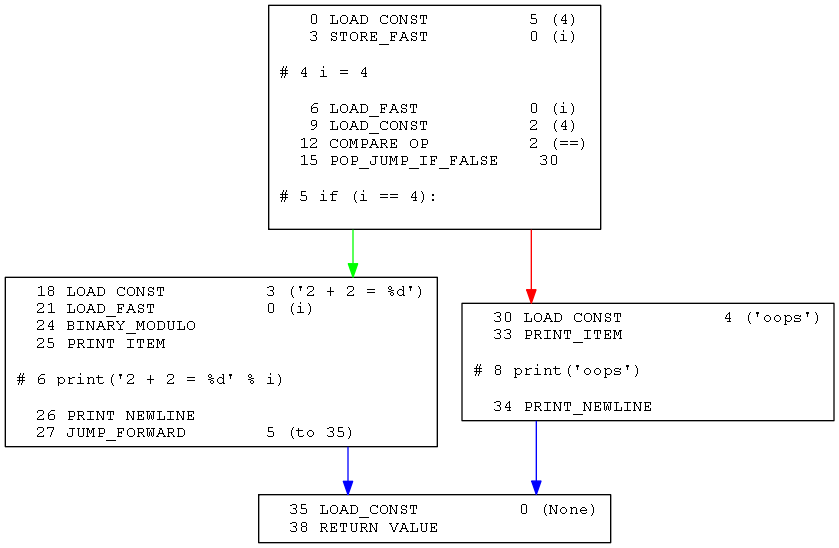
It is also possible to create control flow diagrams using GraphViz. The disassembly within the graph can include the output from a simple peephole decompiler. This can be helpful when reviewing bytecode that fails to decompile.
pythonimport bytecode_graph def Sample(): i = 2 + 2 if i == 4: print "2 + 2 = %d" % i else: print "oops" bcg = bytecode_graph.BytecodeGraph(Sample.__code__) graph = bytecode_graph.Render(bcg, Sample.__code__).dot() graph.write_png('example_graph.png')
Contributors
Showing top 3 contributors by commit count.


Related Repositories

mandiant/commando-vm
Complete Mandiant Offensive VM (Commando VM), a fully customizable Windows-based pentesting virtual machine distribution. commandovm@mandiant.com
mandiant/flare-ida
IDA Pro utilities from FLARE team
mandiant/gocrack
GoCrack is a management frontend for password cracking tools written in Go
mandiant/flare-emu
mandiant/stringsifter
A machine learning tool that ranks strings based on their relevance for malware analysis.
mandiant/flare-wmi