

PyMFEM
Python wrapper for MFEM
This repository provides Python binding for MFEM. MFEM is a high performance parallel finite element method (FEM) library (http://mfem.org/). The project is written primarily in SWIG, distributed under the BSD 3-Clause "New" or "Revised" License license, first published in 2017. Key topics include: fem, finite-elements, gpu-computing, hpc, parallel-computing.


MFEM + PyMFEM (FEM library)
This repository provides Python binding for MFEM. MFEM is a high performance parallel finite element method (FEM) library (http://mfem.org/).
Installer (setup.py) builds both MFEM and binding together.
By default, "pip install mfem" downloads and builds the serial version of MFEM and PyMFEM.
Additionally, the installer supports building MFEM with specific options together with other external libraries, including MPI version.
Install
Using pip (Serial MFEM)
shellpip install mfem # binary install is available only on linux platforms (Py38-312)
Build with additional features (MPI, GPU, GPU-Hypre, GSLIB, SuiteSparse, libCEED, LAPACK)
The setup script accept various options. Download the package manually and run the script. Examples below downloads and build parallel version of MFEM library (linked with Metis and Hypre) and installs under <prefix>/mfem. See INSTALL for various other options
Download source and build
shell$ git clone https://github.com/mfem/PyMFEM.git # Build it from local source with MPI $ pip install ./ -C"with-parallel=Yes" --verbose
Cleaning
shell$ rm -rf build # clean build directory $ rm -rf external # clean external dependencies + wrapper code $ git clean -f # clean files under mfem/_ser and mfem/_par
Run test
shellcd test python test_examples.py -serial
Usage
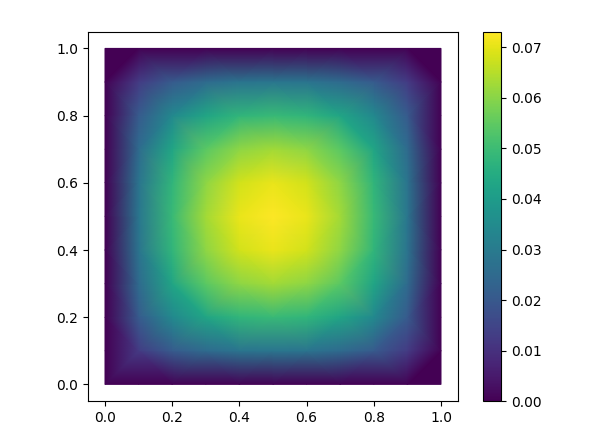
This example (modified from ex1.cpp) solves the Poisson equation,
$$\nabla \cdot (\alpha \nabla u) = f$$
in a square and plots the result using matplotlib.
Use the badge above to open this in Colab.
pythonimport mfem.ser as mfem # Create a square mesh mesh = mfem.Mesh(10, 10, "TRIANGLE") # Define the finite element function space fec = mfem.H1_FECollection(1, mesh.Dimension()) # H1 order=1 fespace = mfem.FiniteElementSpace(mesh, fec) # Define the essential dofs ess_tdof_list = mfem.intArray() ess_bdr = mfem.intArray([1]*mesh.bdr_attributes.Size()) fespace.GetEssentialTrueDofs(ess_bdr, ess_tdof_list) # Define constants for alpha (diffusion coefficient) and f (RHS) alpha = mfem.ConstantCoefficient(1.0) rhs = mfem.ConstantCoefficient(1.0) """ Note ----- In order to represent a variable diffusion coefficient, you must use a numba-JIT compiled function. For example: >>> @mfem.jit.scalar >>> def alpha(x): >>> return x+1.0 """ # Define the bilinear and linear operators a = mfem.BilinearForm(fespace) a.AddDomainIntegrator(mfem.DiffusionIntegrator(alpha)) a.Assemble() b = mfem.LinearForm(fespace) b.AddDomainIntegrator(mfem.DomainLFIntegrator(rhs)) b.Assemble() # Initialize a gridfunction to store the solution vector x = mfem.GridFunction(fespace) x.Assign(0.0) # Form the linear system of equations (AX=B) A = mfem.OperatorPtr() B = mfem.Vector() X = mfem.Vector() a.FormLinearSystem(ess_tdof_list, x, b, A, X, B) print("Size of linear system: " + str(A.Height())) # Solve the linear system using PCG and store the solution in x AA = mfem.OperatorHandle2SparseMatrix(A) M = mfem.GSSmoother(AA) mfem.PCG(AA, M, B, X, 1, 200, 1e-12, 0.0) a.RecoverFEMSolution(X, b, x) # Extract vertices and solution as numpy arrays verts = mesh.GetVertexArray() sol = x.GetDataArray() # Plot the solution using matplotlib import matplotlib.pyplot as plt import matplotlib.tri as tri triang = tri.Triangulation(verts[:,0], verts[:,1]) fig, ax = plt.subplots() ax.set_aspect('equal') tpc = ax.tripcolor(triang, sol, shading='gouraud') fig.colorbar(tpc) plt.show()
License
PyMFEM is licensed under BSD-3 license. All new contributions
must be made under this license. See License for details.
Please refer the developers' web sites for the external libraries
Contributors
Showing top 12 contributors by commit count.


Related Repositories

FreeCAD/FreeCAD
Official source code of FreeCAD, a free and opensource multiplatform 3D parametric modeler.

idaholab/moose
Multiphysics Object Oriented Simulation Environment

mfem/mfem
Lightweight, general, scalable C++ library for finite element methods

dealii/dealii
The development repository for the deal.II finite element library

ElmerCSC/elmerfem
Official git repository of Elmer FEM software

btholt/complete-intro-to-react-v6
learn React.js with Brian Holt