

Gravity
A Data Replication Center
**Gravity** is used to replicate data between various inputs and outputs (databases, message queues). The project is written primarily in Go, distributed under the Apache License 2.0 license, first published in 2018. Key topics include: change-data-capture, gravity, mysql, replication, storage.
Gravity 简体中文

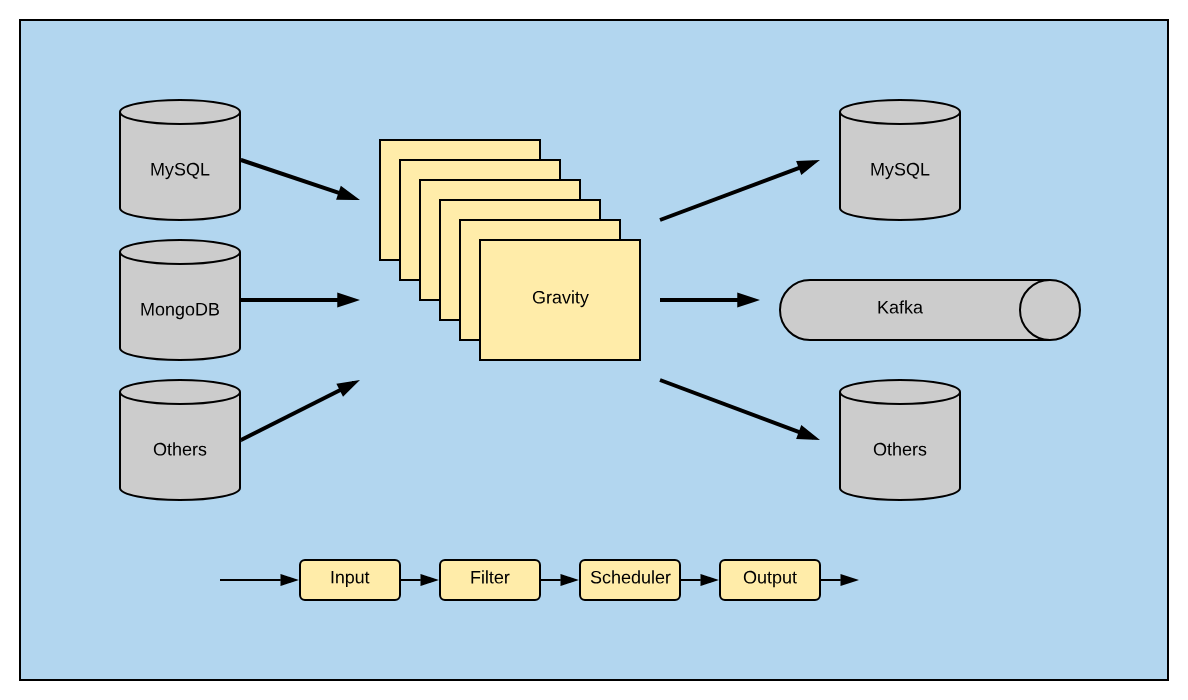
Gravity is used to replicate data between various inputs and outputs (databases, message queues).
It is designed to be a customizable data replication tool that:
-
Supports multiple sources and destinations
-
Supports Kubernetes-based replication cluster
Use Cases
- Data Bus: Use Change Data Capture (MySQL binlog, MongoDB Oplog) and batch table scan to publish data to message queue like Kafka.
- Unidirectional data replication: Replicates data from one MySQL cluster to another MySQL cluster.
- Bidirectional data replication: Replicates data between two MySQL clusters bidirectionally.
- Synchronization of shards to the merged table: Synchronizes MySQL sharded tables to the merged table. You can specify the corresponding relationship between the source table and the target table.
- Online data mutation: Data can be changed during the replication. For example, rename the column, encrypt/decrypt data columns.
Features
Input support
| Input | Status |
|---|---|
| MySQL Binlog | ✅ |
| MySQL Scan | ✅ |
| Mongo Oplog | ✅ |
| Mongo Scan | ✅ |
| TiDB Binlog | Doing |
| PostgreSQL WAL | Doing |
output support
| Output | Status |
|---|---|
| MySQL/TiDB | ✅ |
| Kafka | ✅ |
| Elasticsearch | Beta |
Data mutation support
Gravity supports the following data mutations:
- Ignore specific data
- Renaming columns
- Deleting columns
Documentation
Special thanks to @dantin, @LiangShang, and @liwink for the early support to this project, and thanks @CaitinChen for the initial translation of the documentation.
Contributors
Showing top 8 contributors by commit count.


![dependabot[bot]](https://avatars.githubusercontent.com/in/29110?v=4)


Related Repositories

airbytehq/airbyte
Open-source data movement for ELT pipelines and AI agents — from APIs, databases & files to warehouses, lakes, and AI applications. Both self-hosted and Cloud.

debezium/debezium
Change data capture for a variety of databases. Please log issues at https://github.com/debezium/dbz/issues.

cocoindex-io/cocoindex
Incremental engine for long horizon agents 🌟 Star if you like it!

apache/seatunnel
SeaTunnel is a multimodal, high-performance, distributed, massive data integration tool.

supabase/realtime
Broadcast, Presence, and Postgres Changes via WebSockets
apache/flink-cdc
Flink CDC is a streaming data integration tool