

Nodebots interchange
Project related to creating hardware backpacks for your nodebot to make them more capable.
Provides a mechanism to use custom backpacks and firmatas in your nodebots easily and without needing to use arduino or compile firmwares and all their dependencies. The project is written primarily in JavaScript, distributed under the MIT License license, first published in 2015. Key topics include: arduino, backpack, backpack-firmware, board, custom-firmata.
nodebots-interchange




Provides a mechanism to use custom backpacks and firmatas in your nodebots easily
and without needing to use arduino or compile firmwares and all their dependencies.
Want to use a ping sensor on your nodebot or play around with neopixels? Plug in
your arduino or backpack, install the relevant firmware with interchange and
start building that nodebot.
It's as easy as:
interchange install hc-sr04 -a nano -p /dev/tty.wchserial1410
No need to install arduino, no need to find the right firmware - interchange is
like npm for your backpacks.
Interchange provides the following:
- A specification for how backpack devices should behave
- An installation method for backpack firmware onto target boards to make
backpack firmware selection and installation easy. - A method of updating select parts of the firmware if required without recompilation.
- An ability to install Standard or Custom Firmatas to a board.
- An interface for retrieving information from a backpack firmware.
Installation
It is recommended to install nodebots-interchange locally so different versions
can coexist as part of projects. If you do this, make sure the node modules
.bin directory is on your path, like this:
export PATH=./node_modules/.bin:$PATH
After that just install locally using npm
npm install nodebots-interchange
Or alternatively
git clone https://github.com/johnny-five-io/nodebots-interchange.git
npm install
If you'd prefer to have interchange available to all users globally then do this:
npm install -g nodebots-interchange
Once installed you will have access to the interchange application which will allow
you to flash your board with a firmware of choice as described in the usage
section below.
Usage
In general:
interchange install <firmware> -p <port> -a <board_type> -i <I2C_address> [--firmata [name]]
Where <firmware> is the name of the firmware you would like to flash to the board,
<port> is the name of the serial port you want to use, <board_type> is the
specific type of board you would like to use and <I2C_address> is an optional
parameter allowing you to change the default address of the I2C device.
Note: If you do not supply a port and you have multiple boards plugged in
it's unknown which of them will get flashed and configured. Best to be specific
or only do this while there's one board plugged in. To use avrgirl's @noopkat phrase
"without a port, Arduino Roulette will occur".
Using the --firmata switch will attempt to download and install a custom firmata
instead if this is available.
As a convenience, if you would like to install StandardFirmata you can do so by:
interchange install StandardFirmata -a <board> -p <port>
For an interactive interface that will prompt you with choices for each option, use
interchange install --interactive
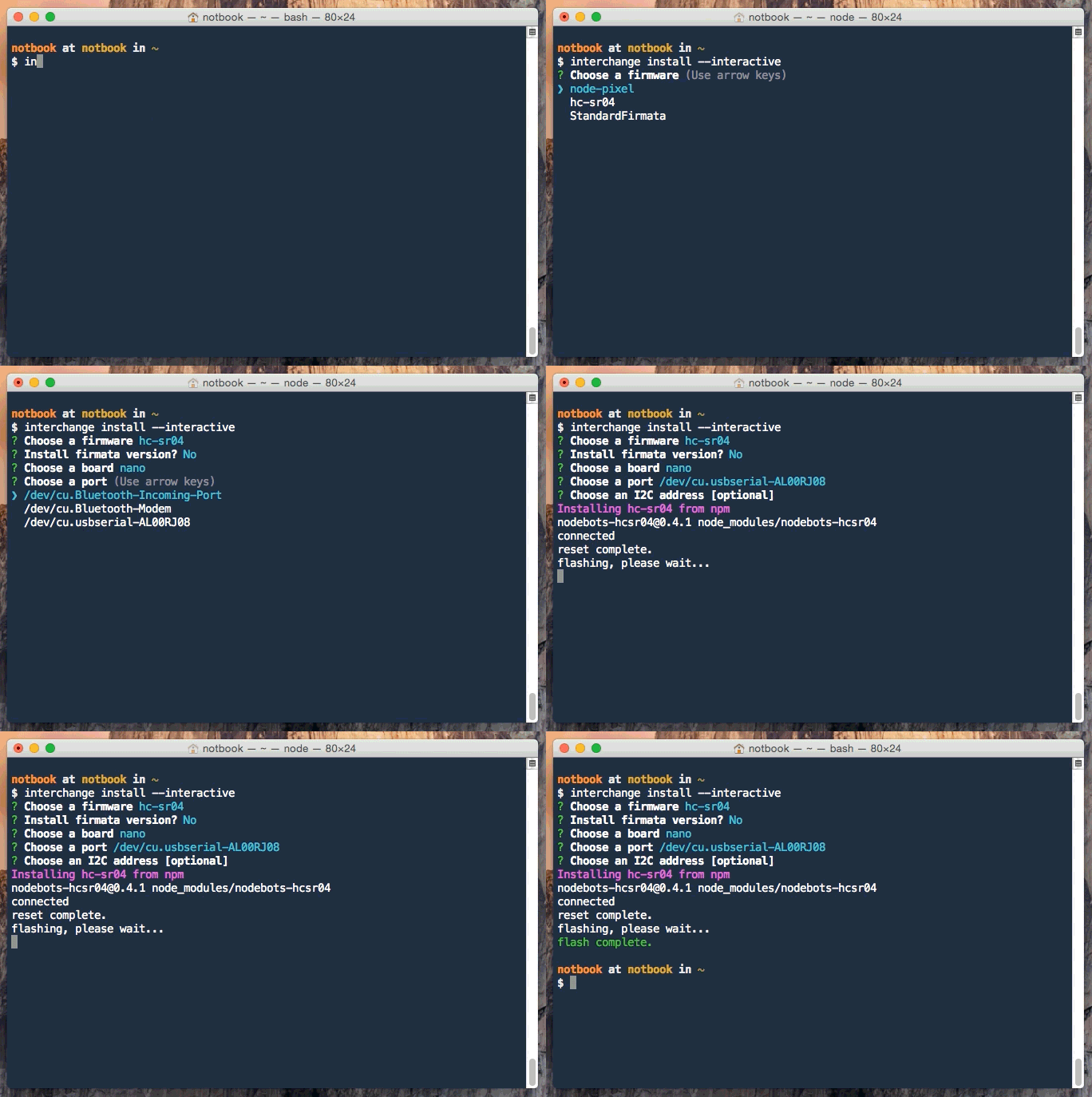
Usage examples
Get help:
interchange --help
List the firmwares available and get details about them, including whether they
are firmata capable or not.
interchange list
Get a list of all the available serial devices you can see (use the --verbose
switch if you want to get much more detail about the devices.
interchange ports [--verbose]
Install the HC-SR04 backpack firmware to an arduino nano on port /dev/tty.wchserial1410.
(Ensure configuration mode is set on the arduino)
interchange install hc-sr04 -a nano -p /dev/tty.wchserial1410
Install the HC-SR04 backpack firmware to an arduino nano on port /dev/tty.wchserial1410
however change the default I2C address to 0x65 instead. (Ensure configuration
mode on the arduino is set).
interchange install hc-sr04 -a nano -p /dev/tty.wchserial1410 -i 0x65
Install StandardFirmata on an arduino Uno at port /dev/tty.usbmodem1230
interchange install StandardFirmata -a uno -p /dev/tty.usbmodem1230
Install the HC-SR04 custom firmata on an arduino Uno at port /dev/tty.usbmodem1230
interchange install hc-sr04 -a uno -p /dev/tty.usbmodem1230 --firmata
Install a custom firmata (in this case for the mbot) onto an arduino from a git
repository and not from the interchange directory (good for testing in development) on port
/dev/tty.wchserial1560
interchange install git+https://github.com/Makeblock-official/mbot_nodebots -p /dev/tty.wchserial1560 -a uno --firmata
Install a named custom firmata (in this case the mbot Bluetooth firmata) onto
an arduino from git repo on port /dev/tty.wchserial1560 - note the use of
--firmata [name] here.
interchange install git+https://github.com/Makeblock-official/mbot_nodebots -p /dev/tty.wchserial1560 -a uno --firmata bluetooth
Install the HC-SR04 backpack code on an arduino nano from a named branch on a
git repo (very handy for testing when you're in dev) on port /dev/tty.wchserial1560
interchange install git+https://github.com/ajfisher/nodebots-hcsr04#devbranch -p /dev/tty.wchserial1560 -a nano
Read the details of a backpack firmware on /dev/tty.usbmodem1130 to see what
is on it.
interchange read -p /dev/tty.usbmodem1130
Building your own interchange package.
If you want to build your own interchange package you can get more information
in the developer guide.
Contribution
If you are interesting in contibuting, please read the dev getting started
guide.
Additional documentation: https://docs.google.com/document/d/1j6Jce2MUSA-V-I9iO6lReZGtDWXvi9BI2Xh1RjErYek/edit?usp=sharing
Acknowledgements
Interchange was born of an idea that came out of RobotsConf 2014 that started
with a discussion about how to incorporate NeoPixel support into
Firmata and
Johnny-Five. Adding custom additions
to firmata created numerous problems, not just with the bloat that it would
cause in firmata but additionally the support requirements it would impose on
other IO Plugins as any custom instructions would then need to be supported as well.
The end solution was to instead create a custom NodeBots "board", in the
style of a "BackPack" (as used by AdaFruit & others in the hardware space) that
would act as a bridge between "dumb" devices such as ultrasonic sensors,
neopixels and touch screens that would then expose these components as I2C
devices. In this way, any nodebots capable board that can talk I2C (just about
all of them) would be able to work with these components, not just those running
firmata.
As the project has developed, it was determined that being able to use it to
eliminate the need for Arduino for beginners was also useful and would use the
same mechanism.
This project would not have seen light were it not for the following people:
- Rick Waldron - believing this was a good approach and supporting the exploration
of the idea to augment Johnny Five. - Suz Hinton - for the excellent avrgirl which provided considerable heavy lifting on the
flashing side of things. - Derek Wheelden - for tuning the experience of the way Interchange has worked
to make it more usable. - Andy Gelme, Luis Montes - for pushing me on backpacks and keep me moving.
Contributors
Showing top 8 contributors by commit count.

![dependabot[bot]](https://avatars.githubusercontent.com/in/29110?v=4)

![greenkeeper[bot]](https://avatars.githubusercontent.com/in/505?v=4)
![dependabot-preview[bot]](https://avatars.githubusercontent.com/in/2141?v=4)



Related Repositories

arendst/Tasmota
Alternative firmware for ESP8266 and ESP32 based devices with easy configuration using webUI, OTA updates, automation using timers or rules, expandability and entirely local control over MQTT, HTTP, Serial or KNX. Full documentation at

tinygo-org/tinygo
Go compiler for small places. Microcontrollers, WebAssembly (WASM/WASI), and command-line tools. Based on LLVM.

MarlinFirmware/Marlin
Marlin is a firmware for RepRap 3D printers optimized for both 8 and 32 bit microcontrollers. Marlin supports all common platforms. Many commercial 3D printers come with Marlin installed. Check with your vendor if you need source code for your specific machine.

espressif/arduino-esp32
Arduino core for the ESP32 family of SoCs

SpacehuhnTech/esp8266_deauther
Affordable WiFi hacking platform for testing and learning

arduino/Arduino
Arduino IDE 1.x