

Coursera ml py
Python programming assignments for Machine Learning by Prof. Andrew Ng in Coursera
If you've finished the amazing introductory Machine Learning on Coursera by Prof. Andrew Ng, you probably got familiar with Octave/Matlab programming. With this repo, you can re-implement them in Python, step-by-step, visually checking your work along the way, just as the course assignments. The project is written primarily in Python, distributed under the MIT License license, first published in 2017. It has gained significant community traction with 1,434 stars and 489 forks on GitHub. Key topics include: andrew-ng-course, andrew-ng-machine-learning, andrew-ng-ml-course, anomaly-detection, coursera-machine-learning.
Coursera Machine Learning Assignments in Python



About
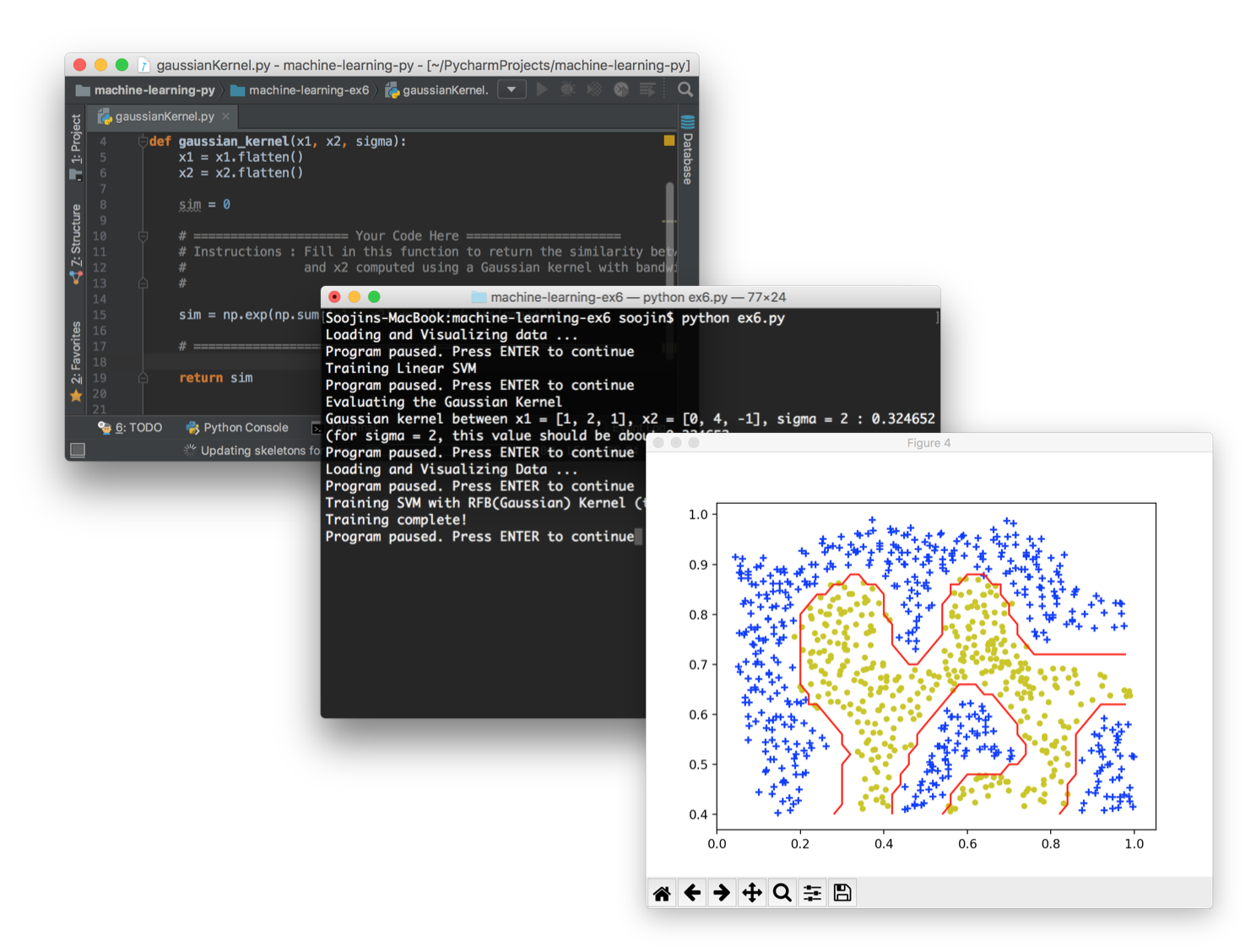
If you've finished the amazing introductory Machine Learning on Coursera by Prof. Andrew Ng, you probably got familiar with Octave/Matlab programming. With this repo, you can re-implement them in Python, step-by-step, visually checking your work along the way, just as the course assignments.
How to start
Dependencies
This project was coded in Python 3.6
- numpy
- matplotlib
- scipy
- scikit-learn
- scikit-image
- nltk
Installation
The fastest and easiest way to install all these dependencies at once is to use Anaconda.
Important Note
There are a couple of things to keep in mind before starting.
- all column vectors from octave/matlab are flattened into a simple 1-dimensional ndarray. (e.g., y's and thetas are no longer m x 1 matrix, just a 1-d ndarray with m elements.)
So in Octave/Matlab,
Now, it ismatlab>> size(theta) >> (2, 1)python>>> theta.shape >>> (2, ) - numpy.matrix is never used, just plain ol' numpy.ndarray
Contents
Exercise 1
- Linear Regression
- Linear Regression with multiple variables
Exercise 2
- Logistic Regression
- Logistic Regression with Regularization
Exercise 3
- Multiclass Classification
- Neural Networks Prediction fuction
Exercise 4
- Neural Networks Learning
Exercise 5
- Regularized Linear Regression
- Bias vs. Variance
Exercise 6
- Support Vector Machines
- Spam email Classifier
Exercise 7
- K-means Clustering
- Principal Component Analysis
Exercise 8
- Anomaly Detection
- Recommender Systems
Solutions
You can check out my implementation of the assignments here. I tried to vectorize all the solutions.
Contributors
Showing top 1 contributor by commit count.

Related Repositories

amanchadha/coursera-deep-learning-specialization
Notes, programming assignments and quizzes from all courses within the Coursera Deep Learning specialization offered by deeplearning.ai: (i) Neural Networks and Deep Learning; (ii) Improving Deep Neural Networks: Hyperparameter tuning, Regularization and Optimization; (iii) Structuring Machine Learning Projects; (iv) Convolutional Neural Networks; (v) Sequence Models

ashishpatel26/Andrew-NG-Notes
This is Andrew NG Coursera Handwritten Notes.

bighuang624/Andrew-Ng-Deep-Learning-notes
吴恩达《深度学习》系列课程笔记及代码 | Notes in Chinese for Andrew Ng Deep Learning Course

ShahariarRabby/deeplearning.ai
deeplearning.ai , By Andrew Ng, All video link

susilvaalmeida/machine-learning-andrew-ng
Implementations in python of methods and programming assignments of course Machine Learning of Coursera by Andrew Ng

azminewasi/Machine-Learning-AndrewNg-DeepLearning.AI
Contains all course modules, exercises and notes of ML Specialization by Andrew Ng, Stanford Un. and DeepLearning.ai in Coursera