

Gget
🧬 gget enables efficient querying of genomic reference databases
`gget` is a free, open-source command-line tool and Python package that enables efficient querying of genomic databases. `gget` consists of a collection of separate but interoperable modules, each designed to facilitate one type of database querying in a single line of code. `gget` was developed by [Laura Luebbert](https://github.com/lauraluebbert) in the [Pachter Lab](https://pachterlab.github.io/). The project is written primarily in Python, distributed under the BSD 2-Clause "Simplified" License license, first published in 2022. It has gained significant community traction with 1,157 stars and 89 forks on GitHub. Key topics include: alphafold, alphafold2, archs4, blast, cellxgene.
gget








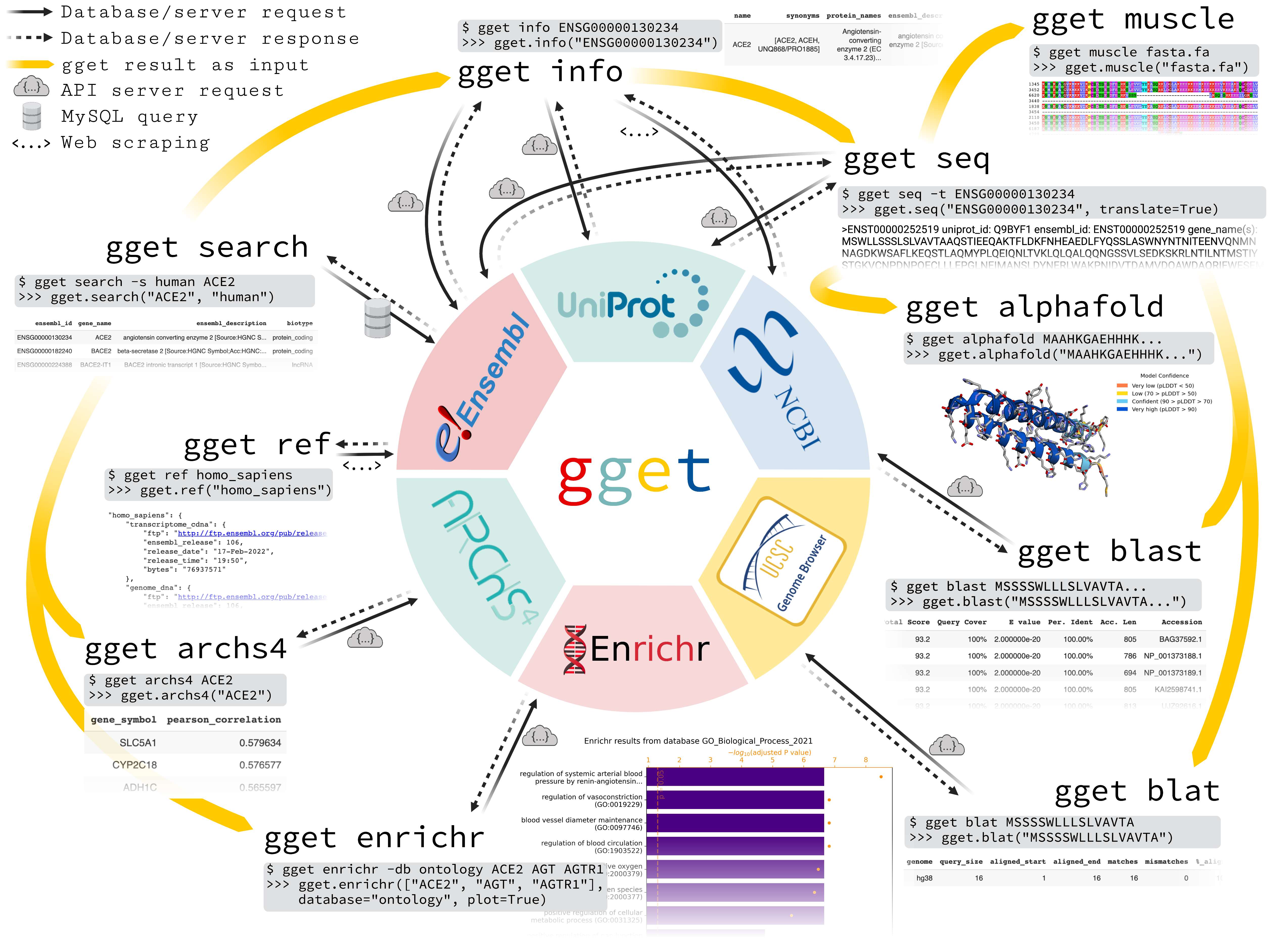
gget is a free, open-source command-line tool and Python package that enables efficient querying of genomic databases. gget consists of a collection of separate but interoperable modules, each designed to facilitate one type of database querying in a single line of code. gget was developed by Laura Luebbert in the Pachter Lab.
gget is part of the scverse® project and is fiscally sponsored by NumFOCUS. If you like gget and want to support our mission, please consider making a tax-deductible donation.
<br>
If you use gget in a publication, please cite*:
Luebbert, L., & Pachter, L. (2023). Efficient querying of genomic reference databases with gget. Bioinformatics. https://doi.org/10.1093/bioinformatics/btac836
Read the article here: https://doi.org/10.1093/bioinformatics/btac836
Installation
bashuv pip install gget
or
bashpip install --upgrade gget
Install from source:
bashgit clone https://github.com/pachterlab/gget.git cd gget uv pip install .
For use in Jupyter Lab / Google Colab:
python# Python import gget
🔗 Manual
🪄 Quick start guide
Command line:
bash# Fetch all Homo sapiens reference and annotation FTPs from the latest Ensembl release $ gget ref homo_sapiens # Get Ensembl IDs of human genes with "ace2" or "angiotensin converting enzyme 2" in their name/description $ gget search -s homo_sapiens 'ace2' 'angiotensin converting enzyme 2' # Look up gene ENSG00000130234 (ACE2) and its transcript ENST00000252519 $ gget info ENSG00000130234 ENST00000252519 # Fetch the amino acid sequence of the canonical transcript of gene ENSG00000130234 $ gget seq --translate ENSG00000130234 # Quickly find the genomic location of (the start of) that amino acid sequence $ gget blat MSSSSWLLLSLVAVTAAQSTIEEQAKTFLDKFNHEAEDLFYQSSLAS # BLAST (the start of) that amino acid sequence $ gget blast MSSSSWLLLSLVAVTAAQSTIEEQAKTFLDKFNHEAEDLFYQSSLAS # Align multiple nucleotide or amino acid sequences against each other (also accepts path to FASTA file) $ gget muscle MSSSSWLLLSLVAVTAAQSTIEEQAKTFLDKFNHEAEDLFYQSSLAS MSSSSWLLLSLVEVTAAQSTIEQQAKTFLDKFHEAEDLFYQSLLAS # Align one or more amino acid sequences against a reference (containing one or more sequences) (local BLAST) (also accepts paths to FASTA files) $ gget diamond MSSSSWLLLSLVAVTAAQSTIEEQAKTFLDKFNHEAEDLFYQSSLAS -ref MSSSSWLLLSLVEVTAAQSTIEQQAKTFLDKFHEAEDLFYQSLLAS # Use Enrichr for an ontology analysis of a list of genes $ gget enrichr -db ontology ACE2 AGT AGTR1 ACE AGTRAP AGTR2 ACE3P # Get the human tissue expression of gene ACE2 $ gget archs4 -w tissue ACE2 # Get the protein structure (in PDB format) of ACE2 as stored in the Protein Data Bank (PDB ID returned by gget info) $ gget pdb 1R42 -o 1R42.pdb # Download virus genome datasets from NCBI Virus (e.g., Zika virus sequences) $ gget virus "Zika virus" --host "Homo sapiens" --nuc_completeness complete # Find Eukaryotic Linear Motifs (ELMs) in a protein sequence $ gget setup elm # setup only needs to be run once $ gget elm -o results MSSSSWLLLSLVAVTAAQSTIEEQAKTFLDKFNHEAEDLFYQSSLAS # Fetch a scRNAseq count matrix (AnnData format) based on specified gene(s), tissue(s), and cell type(s) (default species: human) $ gget setup cellxgene # setup only needs to be run once $ gget cellxgene --gene ACE2 SLC5A1 --tissue lung --cell_type 'mucus secreting cell' -o example_adata.h5ad # Predict the protein structure of GFP from its amino acid sequence $ gget setup alphafold # setup only needs to be run once $ gget alphafold MSKGEELFTGVVPILVELDGDVNGHKFSVSGEGEGDATYGKLTLKFICTTGKLPVPWPTLVTTFSYGVQCFSRYPDHMKQHDFFKSAMPEGYVQERTIFFKDDGNYKTRAEVKFEGDTLVNRIELKGIDFKEDGNILGHKLEYNYNSHNVYIMADKQKNGIKVNFKIRHNIEDGSVQLADHYQQNTPIGDGPVLLPDNHYLSTQSALSKDPNEKRDHMVLLEFVTAAGITHGMDELYK
Python (Jupyter Lab / Google Colab):
pythonimport gget gget.ref("homo_sapiens") gget.search(["ace2", "angiotensin converting enzyme 2"], "homo_sapiens") gget.info(["ENSG00000130234", "ENST00000252519"]) gget.seq("ENSG00000130234", translate=True) gget.blat("MSSSSWLLLSLVAVTAAQSTIEEQAKTFLDKFNHEAEDLFYQSSLAS") gget.blast("MSSSSWLLLSLVAVTAAQSTIEEQAKTFLDKFNHEAEDLFYQSSLAS") gget.muscle(["MSSSSWLLLSLVAVTAAQSTIEEQAKTFLDKFNHEAEDLFYQSSLAS", "MSSSSWLLLSLVEVTAAQSTIEQQAKTFLDKFHEAEDLFYQSLLAS"]) gget.diamond("MSSSSWLLLSLVAVTAAQSTIEEQAKTFLDKFNHEAEDLFYQSSLAS", reference="MSSSSWLLLSLVEVTAAQSTIEQQAKTFLDKFHEAEDLFYQSLLAS") gget.enrichr(["ACE2", "AGT", "AGTR1", "ACE", "AGTRAP", "AGTR2", "ACE3P"], database="ontology", plot=True) gget.archs4("ACE2", which="tissue") gget.pdb("1R42", save=True) gget.virus("Zika virus", host="Homo sapiens", nuc_completeness="complete") gget.setup("elm") # setup only needs to be run once ortho_df, regex_df = gget.elm("MSSSSWLLLSLVAVTAAQSTIEEQAKTFLDKFNHEAEDLFYQSSLAS") gget.setup("cellxgene") # setup only needs to be run once gget.cellxgene(gene = ["ACE2", "SLC5A1"], tissue = "lung", cell_type = "mucus secreting cell") gget.setup("alphafold") # setup only needs to be run once gget.alphafold("MSKGEELFTGVVPILVELDGDVNGHKFSVSGEGEGDATYGKLTLKFICTTGKLPVPWPTLVTTFSYGVQCFSRYPDHMKQHDFFKSAMPEGYVQERTIFFKDDGNYKTRAEVKFEGDTLVNRIELKGIDFKEDGNILGHKLEYNYNSHNVYIMADKQKNGIKVNFKIRHNIEDGSVQLADHYQQNTPIGDGPVLLPDNHYLSTQSALSKDPNEKRDHMVLLEFVTAAGITHGMDELYK")
Call gget from R using reticulate:
rsystem("pip install gget") install.packages("reticulate") library(reticulate) gget <- import("gget") gget$ref("homo_sapiens") gget$search(list("ace2", "angiotensin converting enzyme 2"), "homo_sapiens") gget$info(list("ENSG00000130234", "ENST00000252519")) gget$seq("ENSG00000130234", translate=TRUE) gget$blat("MSSSSWLLLSLVAVTAAQSTIEEQAKTFLDKFNHEAEDLFYQSSLAS") gget$blast("MSSSSWLLLSLVAVTAAQSTIEEQAKTFLDKFNHEAEDLFYQSSLAS") gget$muscle(list("MSSSSWLLLSLVAVTAAQSTIEEQAKTFLDKFNHEAEDLFYQSSLAS", "MSSSSWLLLSLVEVTAAQSTIEQQAKTFLDKFHEAEDLFYQSLLAS"), out="out.afa") gget$diamond("MSSSSWLLLSLVAVTAAQSTIEEQAKTFLDKFNHEAEDLFYQSSLAS", reference="MSSSSWLLLSLVEVTAAQSTIEQQAKTFLDKFHEAEDLFYQSLLAS") gget$enrichr(list("ACE2", "AGT", "AGTR1", "ACE", "AGTRAP", "AGTR2", "ACE3P"), database="ontology") gget$archs4("ACE2", which="tissue") gget$pdb("1R42", save=TRUE) gget$virus("Zika virus", host="Homo sapiens", nuc_completeness="complete")
More tutorials
<p align="center"> <img height="100" alt="scverse_symbol" src="https://github.com/user-attachments/assets/d672bd36-4749-427e-9f08-d807d3bde8fa" /> <img height="100" alt="numfocus" src="https://github.com/user-attachments/assets/a12369cf-e6ae-4b4b-9a30-669aa3d80b5c" /> <img height="100" alt="logo-okfn" src="https://github.com/user-attachments/assets/452ae8d8-69f0-4d0d-848c-ddfb40357eb2" /> </p>Contributors
Showing top 12 contributors by commit count.


![github-actions[bot]](https://avatars.githubusercontent.com/in/15368?v=4)


Related Repositories

shyamsaktawat/OpenAlpha_Evolve
OpenAlpha_Evolve is an open-source Python framework inspired by the groundbreaking research on autonomous coding agents like DeepMind's AlphaEvolve.

kyegomez/Open-AF3
Implementation of Alpha Fold 3 from the paper: "Accurate structure prediction of biomolecular interactions with AlphaFold3" in PyTorch

dptech-corp/Uni-Fold
An open-source platform for developing protein models beyond AlphaFold.

Urinx/alphafold_pytorch
An implementation of the DeepMind's AlphaFold based on PyTorch for research

Zuricho/ParallelFold
Modified version of Alphafold to divide CPU part (MSA and template searching) and GPU part. This can accelerate Alphafold when predicting multiple structures

cbalbin-bio/pymol-color-alphafold
PyMOL extension to color AlphaFold structures by confidence (pLDDT).