

Actions gh pages
GitHub Actions for GitHub Pages 🚀 Deploy static files and publish your site easily. Static-Site-Generators-friendly.
> [!NOTE] > > See also the GitHub official GitHub Pages Action first. > > - [GitHub Pages now uses Actions by default | The GitHub Blog](https://github.blog/2022-08-10-github-pages-now-uses-actions-by-default/) > - [GitHub Pages: Custom GitHub Actions Workflows (beta) | GitHub Changelog](https://github.blog/changelog/2022-07-27-github-pages-custom-github-actions-workflows-beta/) The project is written primarily in TypeScript, distributed under the MIT License license, first published in 2019. It has gained significant community traction with 5,307 stars and 445 forks on GitHub. Key topics include: actions, gatsby, github-actions, github-pages, hugo.





[!NOTE]
See also the GitHub official GitHub Pages Action first.
This is a GitHub Action to deploy your static files to GitHub Pages.
This deploy action can be combined simply and freely with Static Site Generators. (Hugo, MkDocs, Gatsby, mdBook, Next, Nuxt, and so on.)
The next example step will deploy ./public directory to the remote gh-pages branch.
yaml- name: Deploy uses: peaceiris/actions-gh-pages@v4 with: github_token: ${{ secrets.GITHUB_TOKEN }} publish_dir: ./public
For newbies of GitHub Actions:
Note that the GITHUB_TOKEN is NOT a personal access token.
A GitHub Actions runner automatically creates a GITHUB_TOKEN secret to authenticate in your workflow.
So, you can start to deploy immediately without any configuration.
Supported Tokens
Three tokens are supported.
| Token | Private repo | Public repo | Protocol | Setup |
|---|---|---|---|---|
github_token | ✅️ | ✅️ | HTTPS | Unnecessary |
deploy_key | ✅️ | ✅️ | SSH | Necessary |
personal_token | ✅️ | ✅️ | HTTPS | Necessary |
Notes: Actually, the GITHUB_TOKEN works for deploying to GitHub Pages but it has still some limitations.
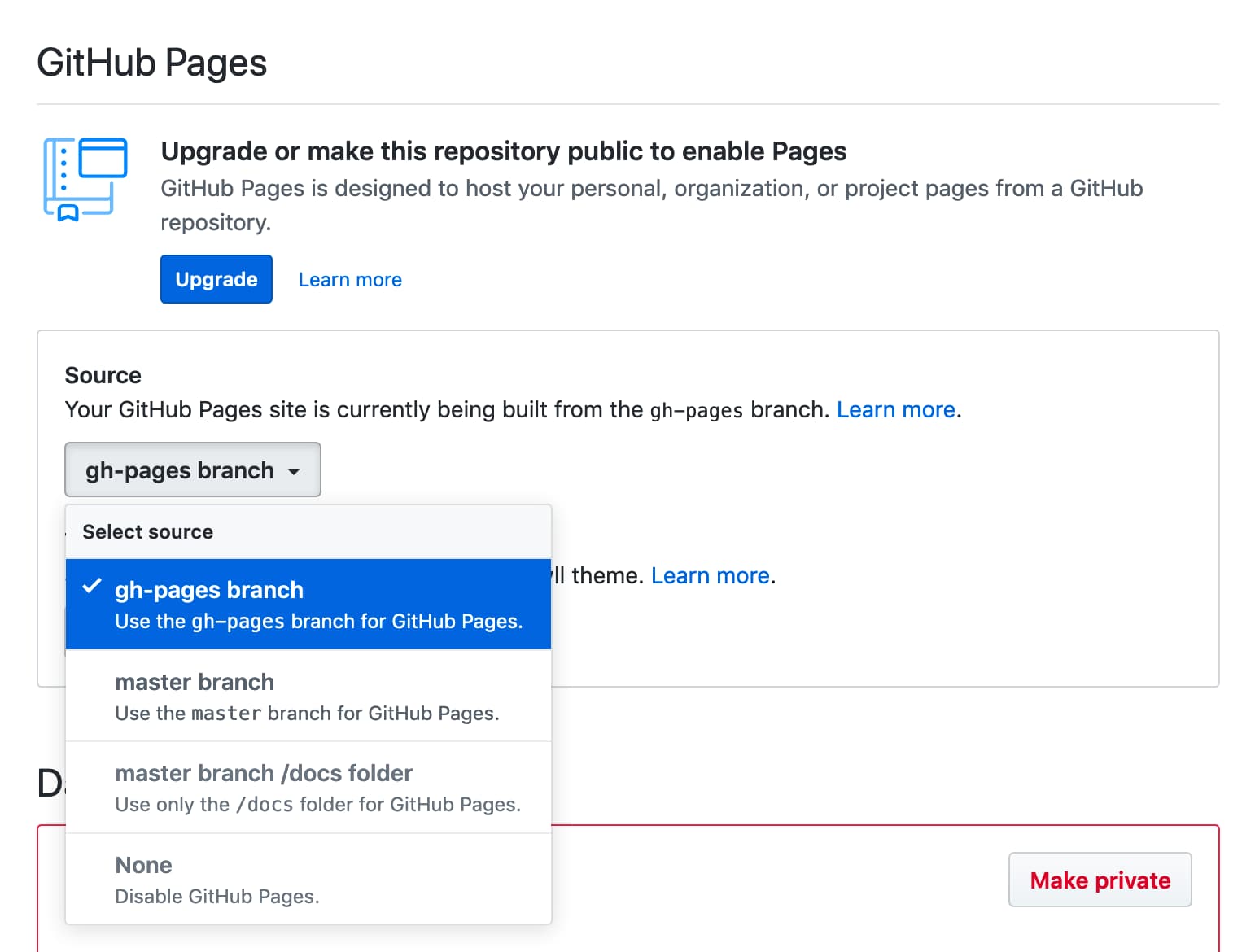
For the first deployment, we need to select the gh-pages branch or another branch on the repository settings tab.
See First Deployment with GITHUB_TOKEN
Supported Platforms
All Actions runners: Linux (Ubuntu), macOS, and Windows are supported.
| runs-on | github_token | deploy_key | personal_token |
|---|---|---|---|
| ubuntu-22.04 | ✅️ | ✅️ | ✅️ |
| ubuntu-20.04 | ✅️ | ✅️ | ✅️ |
| ubuntu-latest | ✅️ | ✅️ | ✅️ |
| macos-latest | ✅️ | ✅️ | ✅️ |
| windows-latest | ✅️ | (2) | ✅️ |
- WIP, See Issue #87
GitHub Enterprise Server Support
✅️ GitHub Enterprise Server is supported above 2.22.6.
Note that the GITHUB_TOKEN that is created by the runner might not inherently have push/publish privileges on GHES. You might need to create/request a technical user with write permissions to your target repository.
Table of Contents
<!-- START doctoc generated TOC please keep comment here to allow auto update --> <!-- DON'T EDIT THIS SECTION, INSTEAD RE-RUN doctoc TO UPDATE -->- Getting started
- Options
- ⭐️ Set Runner's Access Token
github_token - ⭐️ Set SSH Private Key
deploy_key - ⭐️ Set Personal Access Token
personal_token - ⭐️ Set Another GitHub Pages Branch
publish_branch - ⭐️ Source Directory
publish_dir - ⭐️ Deploy to Subdirectory
destination_dir - ⭐️ Filter publishing assets
exclude_assets - ⭐️ Add CNAME file
cname - ⭐️ Enable Built-in Jekyll
enable_jekyll - ⭐️ Allow empty commits
allow_empty_commit - ⭐️ Keeping existing files
keep_files - ⭐️ Deploy to external repository
external_repository - ⭐️ Force orphan
force_orphan - ⭐️ Set Git username and email
- ⭐️ Set custom commit message
- ⭐️ Create Git tag
- ⭐️ Set Runner's Access Token
- Tips and FAQ
- Examples
- License
- Maintainer
Getting started
Add your workflow file .github/workflows/gh-pages.yml and push it to your remote default branch.
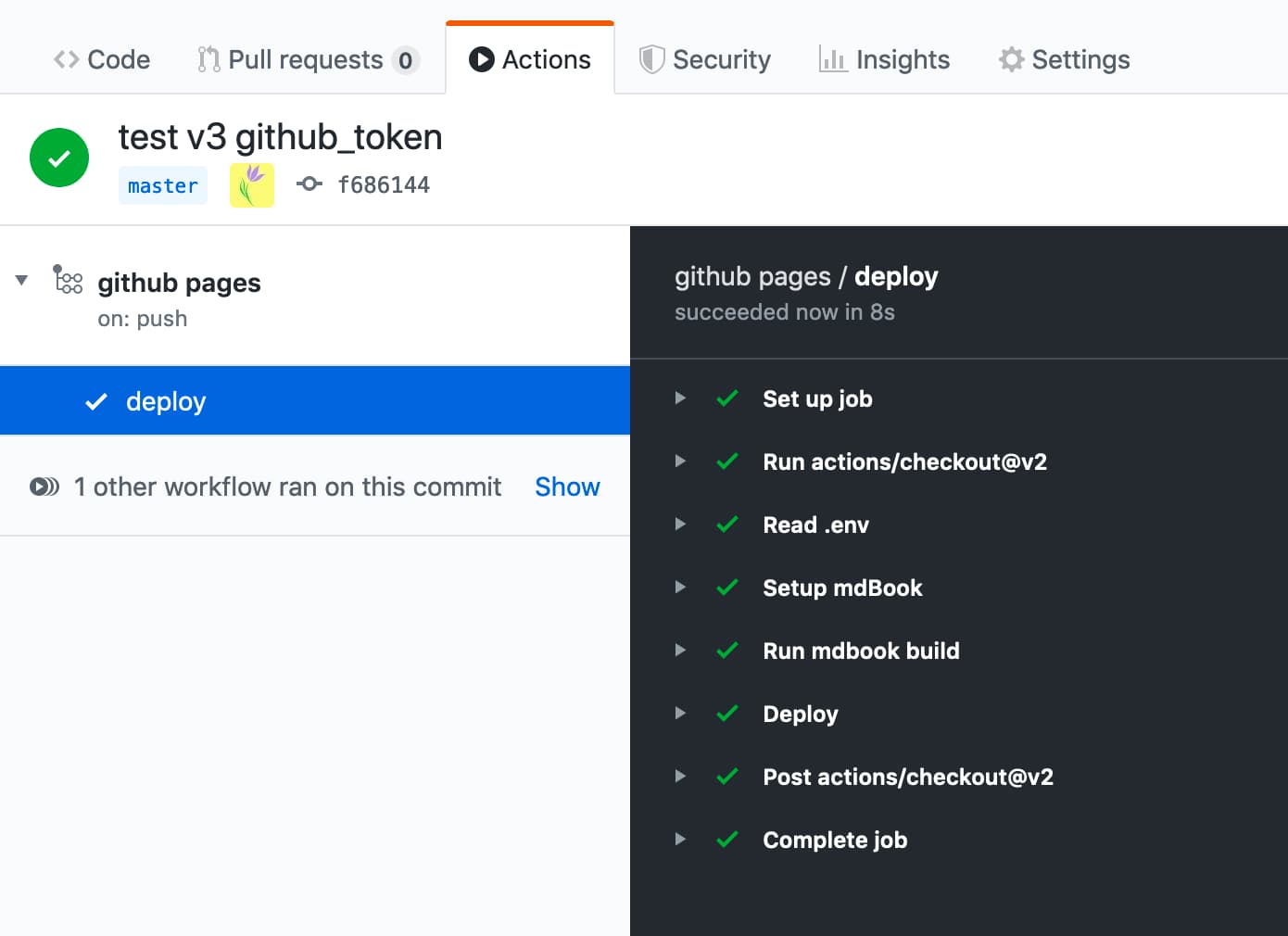
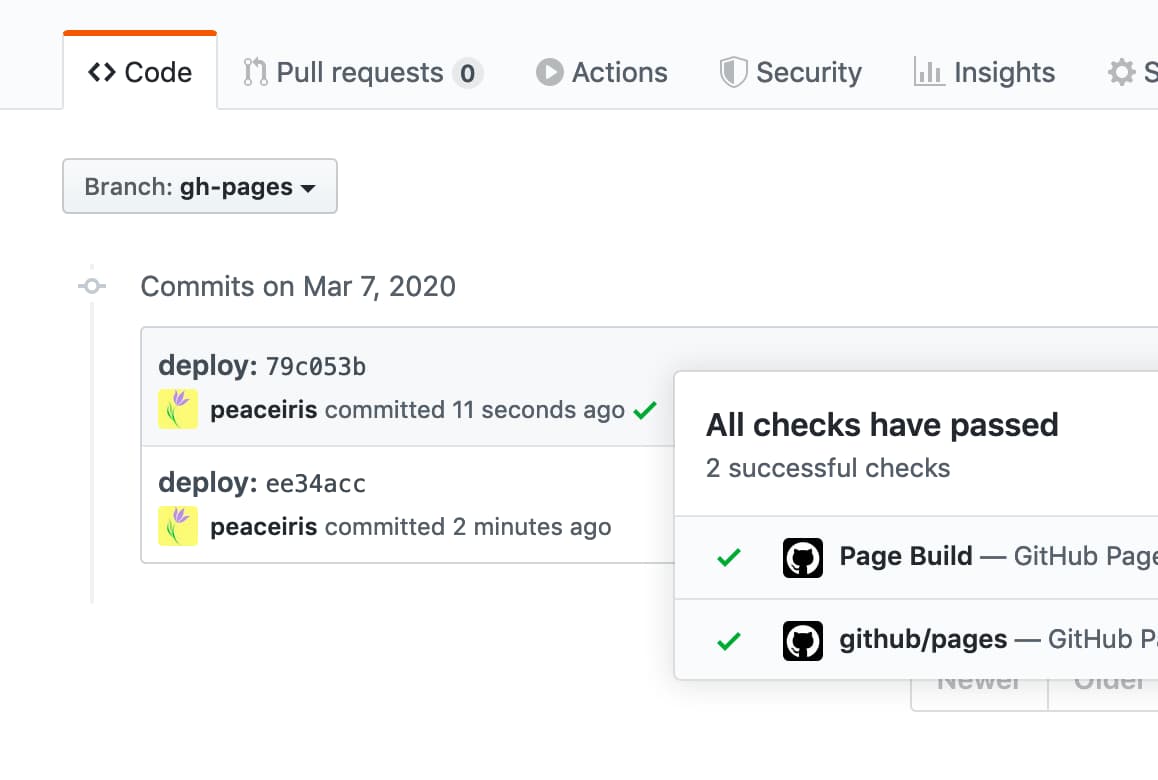
Here is an example workflow for Hugo.
yamlname: GitHub Pages on: push: branches: - main # Set a branch name to trigger deployment pull_request: jobs: deploy: runs-on: ubuntu-22.04 permissions: contents: write concurrency: group: ${{ github.workflow }}-${{ github.ref }} steps: - uses: actions/checkout@v4 with: submodules: true # Fetch Hugo themes (true OR recursive) fetch-depth: 0 # Fetch all history for .GitInfo and .Lastmod - name: Setup Hugo uses: peaceiris/actions-hugo@v2 with: hugo-version: '0.110.0' - name: Build run: hugo --minify - name: Deploy uses: peaceiris/actions-gh-pages@v4 # If you're changing the branch from main, # also change the `main` in `refs/heads/main` # below accordingly. if: github.ref == 'refs/heads/main' with: github_token: ${{ secrets.GITHUB_TOKEN }} publish_dir: ./public
| Actions log overview | GitHub Pages log |
|---|---|
 |  |
Options
⭐️ Set Runner's Access Token github_token
This option is for GITHUB_TOKEN, not a personal access token.
A GitHub Actions runner automatically creates a GITHUB_TOKEN secret to use in your workflow. You can use the GITHUB_TOKEN to authenticate in a workflow run.
yaml- name: Deploy uses: peaceiris/actions-gh-pages@v4 with: github_token: ${{ secrets.GITHUB_TOKEN }} publish_dir: ./public
For more details about GITHUB_TOKEN: Automatic token authentication - GitHub Docs
⭐️ Set SSH Private Key deploy_key
Read Create SSH Deploy Key, create your SSH deploy key, and set the deploy_key option like the following.
yaml- name: Deploy uses: peaceiris/actions-gh-pages@v4 with: deploy_key: ${{ secrets.ACTIONS_DEPLOY_KEY }} publish_dir: ./public
⭐️ Set Personal Access Token personal_token
Generate a personal access token (repo) and add it to Secrets as PERSONAL_TOKEN, it works as well as ACTIONS_DEPLOY_KEY.
yaml- name: Deploy uses: peaceiris/actions-gh-pages@v4 with: personal_token: ${{ secrets.PERSONAL_TOKEN }} publish_dir: ./public
⭐️ Set Another GitHub Pages Branch publish_branch
Set a branch name to use as GitHub Pages branch.
The default is gh-pages.
yaml- name: Deploy uses: peaceiris/actions-gh-pages@v4 with: github_token: ${{ secrets.GITHUB_TOKEN }} publish_branch: your-branch # default: gh-pages
⭐️ Source Directory publish_dir
A source directory to deploy to GitHub Pages. The default is public.
Only the contents of this dir are pushed to GitHub Pages branch, gh-pages by default.
yaml- name: Deploy uses: peaceiris/actions-gh-pages@v4 with: github_token: ${{ secrets.GITHUB_TOKEN }} publish_dir: ./out # default: public
⭐️ Deploy to Subdirectory destination_dir
This feature is on beta.
Any feedback is welcome at Issue #324
A destination subdirectory on a publishing branch. The default is empty.
yaml- name: Deploy uses: peaceiris/actions-gh-pages@v4 with: github_token: ${{ secrets.GITHUB_TOKEN }} destination_dir: subdir
⭐️ Filter publishing assets exclude_assets
This feature is on beta.
Any feedback is welcome at Issue #163
Set files or directories to exclude from publishing assets.
The default is .github.
Values should be split with a comma.
yaml- name: Deploy uses: peaceiris/actions-gh-pages@v4 with: github_token: ${{ secrets.GITHUB_TOKEN }} exclude_assets: '.github,exclude-file1,exclude-file2'
Set exclude_assets to empty for including the .github directory to deployment assets.
yaml- name: Deploy uses: peaceiris/actions-gh-pages@v4 with: deploy_key: ${{ secrets.ACTIONS_DEPLOY_KEY }} # Recommended for this usage # personal_token: ${{ secrets.PERSONAL_TOKEN }} # An alternative # github_token: ${{ secrets.GITHUB_TOKEN }} # This does not work for this usage exclude_assets: ''
The exclude_assets option supports glob patterns.
yaml- name: Deploy uses: peaceiris/actions-gh-pages@v4 with: github_token: ${{ secrets.GITHUB_TOKEN }} exclude_assets: '.github,exclude-file.txt,exclude-dir/**.txt'
⭐️ Add CNAME file cname
To add the CNAME file, we can set the cname option.
Alternatively, put your CNAME file into your publish_dir. (e.g. public/CNAME)
For more details about the CNAME file, read the official documentation: Managing a custom domain for your GitHub Pages site - GitHub Docs
yaml- name: Deploy uses: peaceiris/actions-gh-pages@v4 with: github_token: ${{ secrets.GITHUB_TOKEN }} publish_dir: ./public cname: github.com
⭐️ Enable Built-in Jekyll enable_jekyll
If you want GitHub Pages to process your site with the static site generator Jekyll, set enable_jekyll to true.
By default, this action signals to GitHub Pages that the site shall not be processed with Jekyll. This is done by adding an empty .nojekyll file on your publishing branch. When that file already exists, this action does nothing.
Bypassing Jekyll makes the deployment faster and is necessary if you are deploying files or directories that start with underscores, since Jekyll considers these to be special resources and does not copy them to the final site. You only need to set enable_jekyll to true when you want to deploy a Jekyll-powered website and let GitHub Pages do the Jekyll processing.
yaml- name: Deploy uses: peaceiris/actions-gh-pages@v4 with: github_token: ${{ secrets.GITHUB_TOKEN }} publish_dir: ./public enable_jekyll: true
For more details about .nojekyll: Bypassing Jekyll on GitHub Pages - The GitHub Blog
⭐️ Allow empty commits allow_empty_commit
By default, a commit will not be generated when no file changes. If you want to allow an empty commit, set the optional parameter allow_empty_commit to true.
For example:
yaml- name: Deploy uses: peaceiris/actions-gh-pages@v4 with: github_token: ${{ secrets.GITHUB_TOKEN }} publish_dir: ./public allow_empty_commit: true
⭐️ Keeping existing files keep_files
By default, existing files in the publish branch (or only in destination_dir if given) will be removed. If you want the action to add new files but leave existing ones untouched, set the optional parameter keep_files to true.
Note that users who are using a Static Site Generator do not need this option in most cases. Please reconsider your project structure and building scripts, or use a built-in feature of a Static Site Generator before you enable this flag.
For example:
yaml- name: Deploy uses: peaceiris/actions-gh-pages@v4 with: github_token: ${{ secrets.GITHUB_TOKEN }} publish_dir: ./public keep_files: true
With the v3, this option does not support working with the force_orphan option. The next major release (version 4) will support this.
See the issue #455
⭐️ Deploy to external repository external_repository
By default, your files are published to the repository which is running this action.
If you want to publish to another repository on GitHub, set the environment variable external_repository to <username>/<external-repository>.
For example:
yaml- name: Deploy uses: peaceiris/actions-gh-pages@v4 with: deploy_key: ${{ secrets.ACTIONS_DEPLOY_KEY }} external_repository: username/external-repository publish_branch: your-branch # default: gh-pages publish_dir: ./public
You can use deploy_key or personal_token.
When you use deploy_key, set your private key to the repository which includes this action and set your public key to your external repository.
Note that GITHUB_TOKEN has no permission to access to external repositories. Please create a personal access token and set it to personal_token like personal_token: ${{ secrets.PERSONAL_TOKEN }}.
Use case:
A GitHub Free Plan account cannot use the GitHub Pages in a private repository. To make your source contents private and deploy it with the GitHub Pages, you can deploy your site from a private repository to a public repository using this option.
peaceiris/homepage: A private repository running this action withexternal_repository: peaceiris/peaceiris.github.iopeaceiris/peaceiris.github.io: A public repository using GitHub Pages
⭐️ Force orphan force_orphan
We can set the force_orphan: true option.
This allows you to make your publish branch with only the latest commit.
yaml- name: Deploy uses: peaceiris/actions-gh-pages@v4 with: github_token: ${{ secrets.GITHUB_TOKEN }} publish_dir: ./public force_orphan: true
⭐️ Set Git username and email
Set custom git config user.name and git config user.email.
A commit is always created with the same user.
<img width="400px" alt="Add GitHub Actions bot as a committer" src="./images/committer_github_actions_bot.jpg">yaml- name: Deploy uses: peaceiris/actions-gh-pages@v4 with: github_token: ${{ secrets.GITHUB_TOKEN }} publish_dir: ./public user_name: 'github-actions[bot]' user_email: 'github-actions[bot]@users.noreply.github.com'
⭐️ Set custom commit message
Set a custom commit message.
When we create a commit with a message docs: Update some post, a deployment commit will be generated with a message docs: Update some post ${GITHUB_SHA}.
<img width="400px" alt="Set a custom commit message - GitHub Actions for GitHub Pages" src="./images/commit_message.jpg">yaml- name: Deploy uses: peaceiris/actions-gh-pages@v4 with: github_token: ${{ secrets.GITHUB_TOKEN }} publish_dir: ./public commit_message: ${{ github.event.head_commit.message }}
To set a full custom commit message without a triggered commit hash,
use the full_commit_message option instead of the commit_message option.
yaml- name: Deploy uses: peaceiris/actions-gh-pages@v4 with: github_token: ${{ secrets.GITHUB_TOKEN }} publish_dir: ./public full_commit_message: ${{ github.event.head_commit.message }}
⭐️ Create Git tag
Here is an example workflow.
yamlname: GitHub Pages on: push: branches: - main tags: - 'v*.*.*' jobs: deploy: runs-on: ubuntu-22.04 permissions: contents: write concurrency: group: ${{ github.workflow }}-${{ github.ref }} steps: - uses: actions/checkout@v4 - name: Some build - name: Prepare tag id: prepare_tag if: startsWith(github.ref, 'refs/tags/') run: | echo "DEPLOY_TAG_NAME=deploy-${TAG_NAME}" >> "${GITHUB_OUTPUT}" - name: Deploy uses: peaceiris/actions-gh-pages@v4 with: github_token: ${{ secrets.GITHUB_TOKEN }} publish_dir: ./public tag_name: ${{ steps.prepare_tag.outputs.DEPLOY_TAG_NAME }} tag_message: 'Deployment ${{ github.ref_name }}'
Commands on a local machine.
<div align="right"> <a href="#table-of-contents">Back to TOC ☝️</a> </div>console$ # On a main branch $ git tag -a "v1.2.3" -m "Release v1.2.3" $ git push origin "v1.2.3" $ # After deployment $ git fetch origin $ git tag deploy-v1.2.3 # Tag on the gh-pages branch v1.2.3 # Tag on the main branch
Tips and FAQ
⭐️ Create SSH Deploy Key
Generate your deploy key with the following command.
shssh-keygen -t rsa -b 4096 -C "$(git config user.email)" -f gh-pages -N ""
You will get 2 files:
gh-pages.pubis a public keygh-pagesis a private key
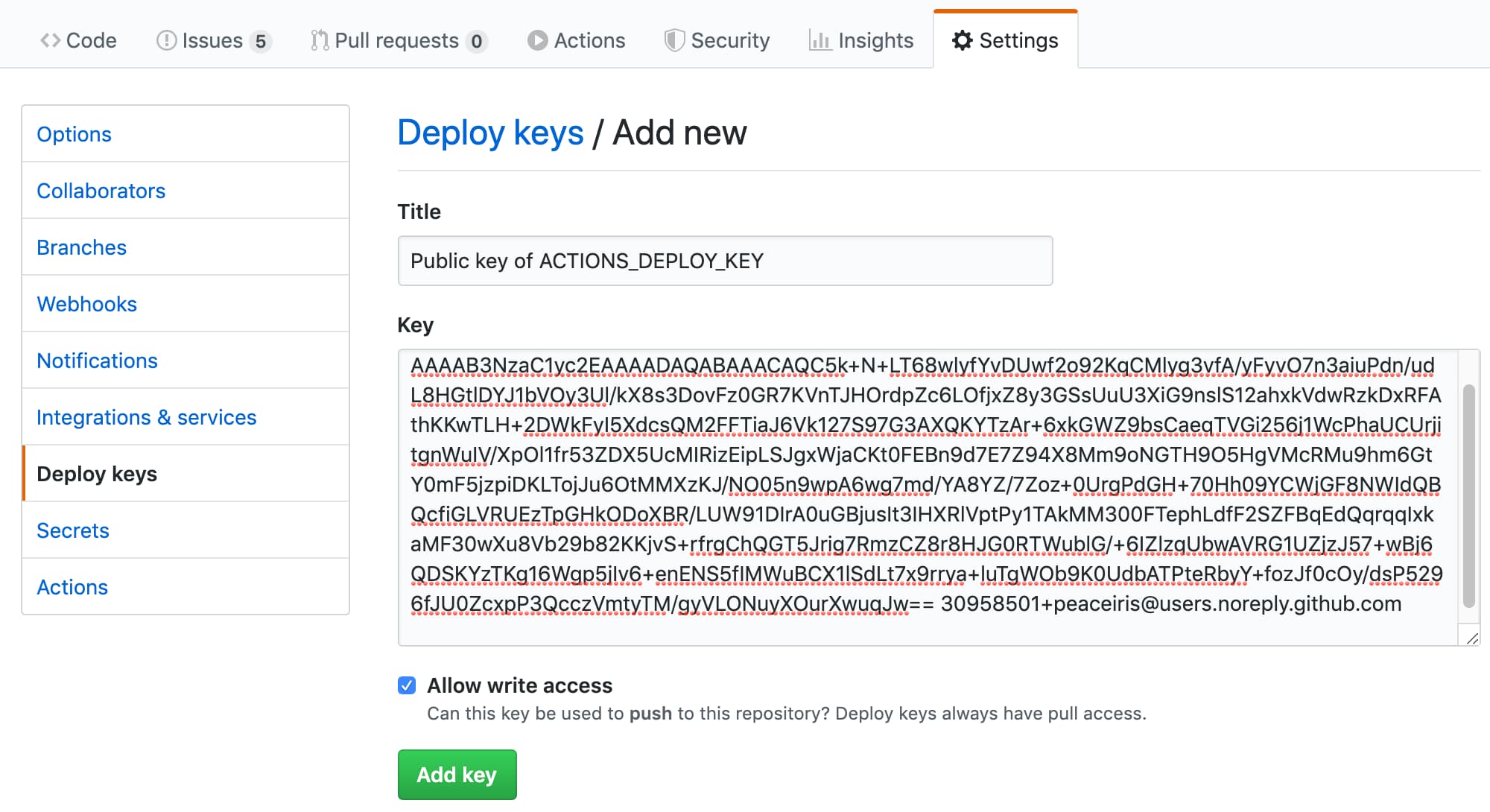
Next, Go to Repository Settings
- Go to Deploy Keys and add your public key with the Allow write access
- Go to Secrets and add your private key as
ACTIONS_DEPLOY_KEY
| Add your public key | Success |
|---|---|
 | 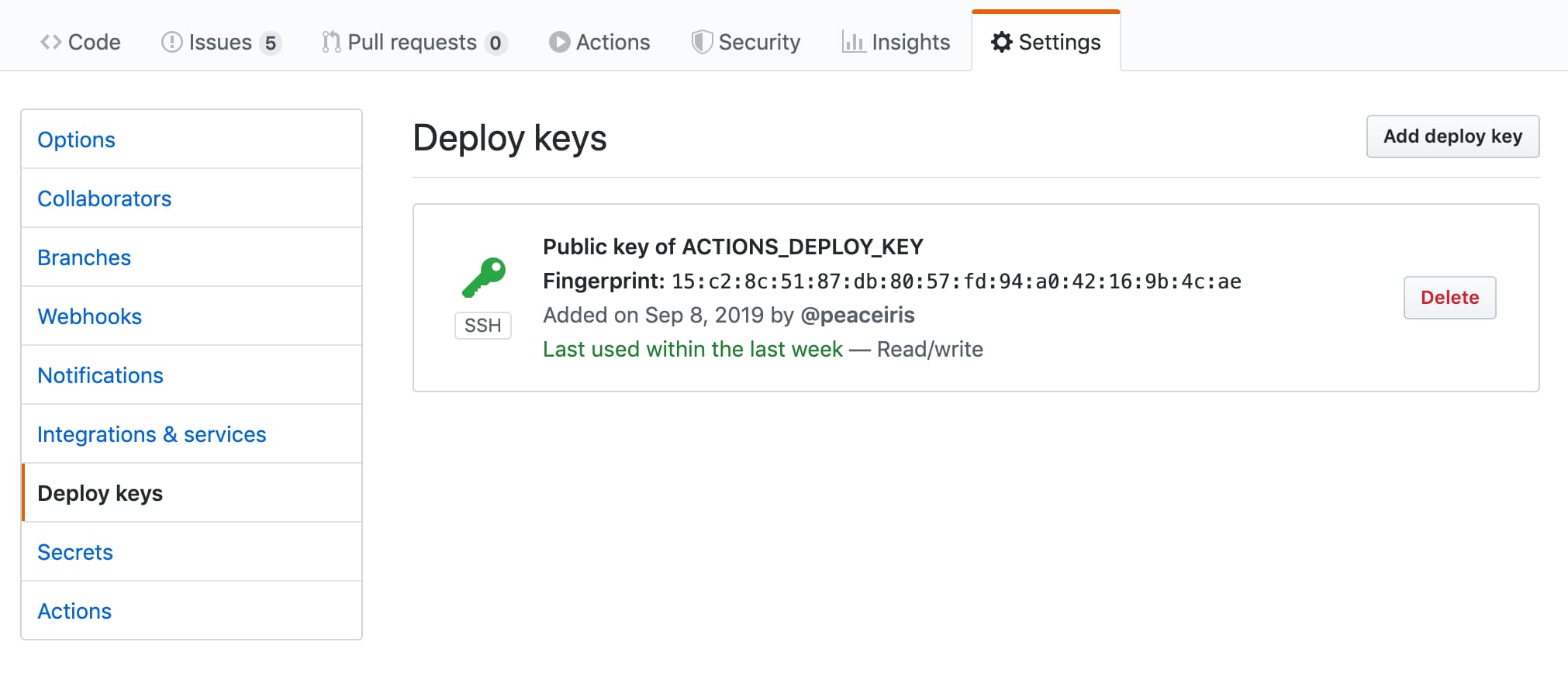 |
| Add your private key | Success |
|---|---|
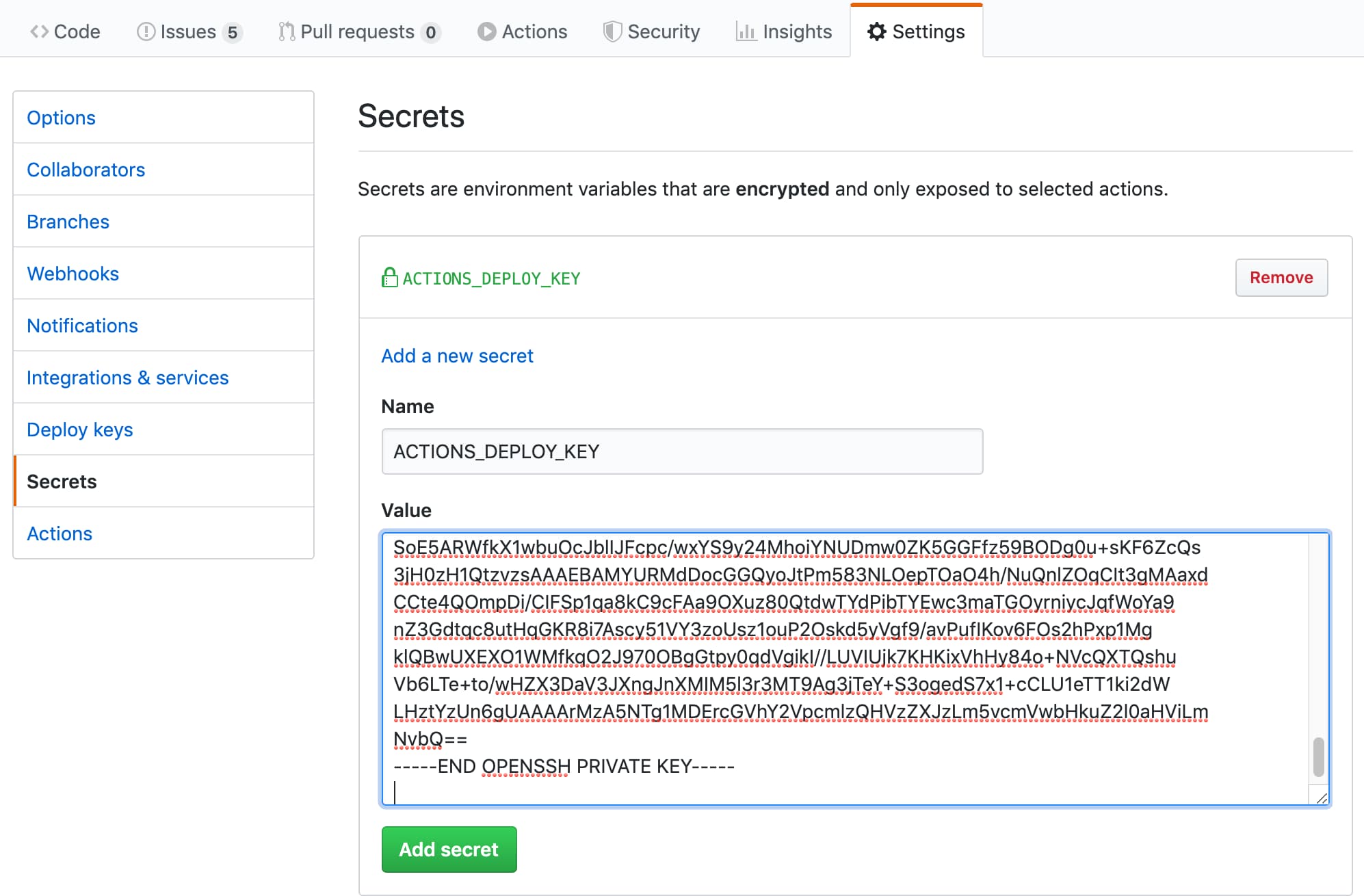 | 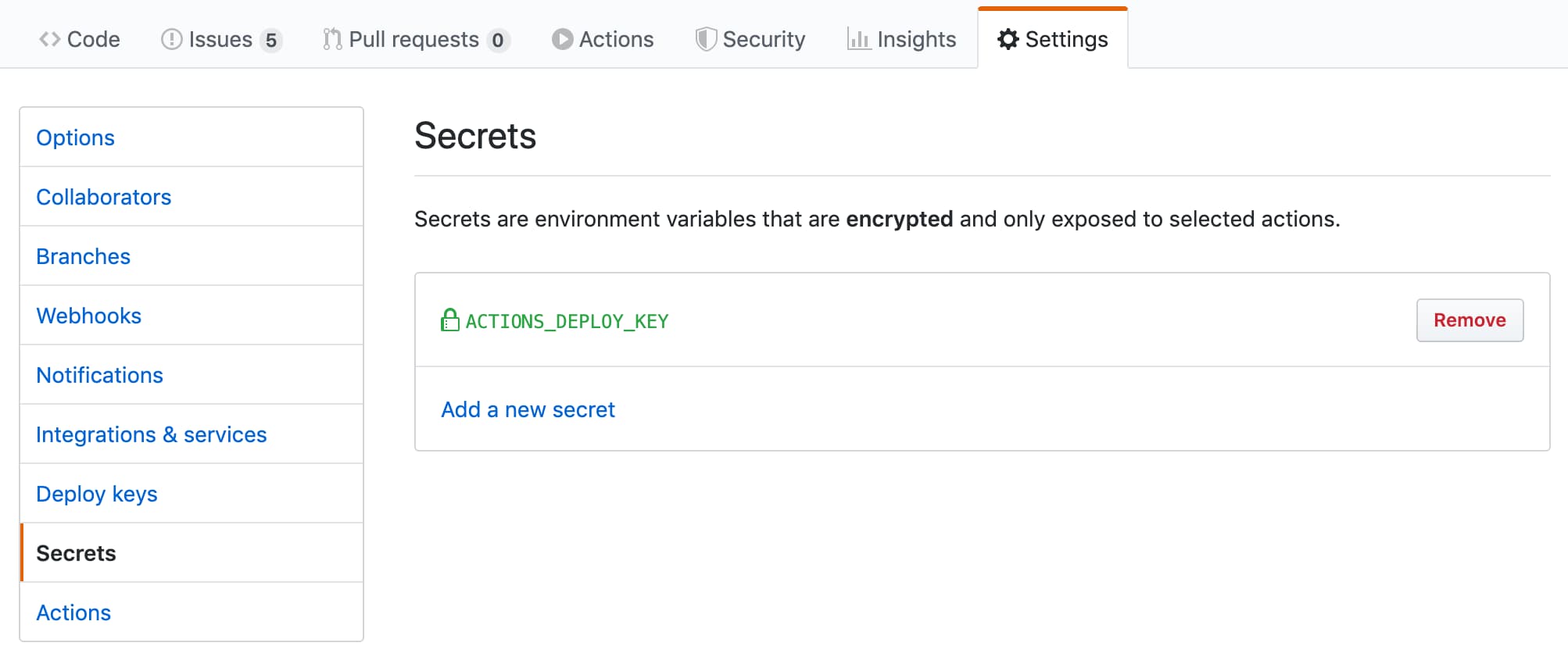 |
⭐️ First Deployment with GITHUB_TOKEN
The GITHUB_TOKEN has limitations for the first deployment so we have to select the GitHub Pages branch on the repository settings tab. After that, do the second deployment like the following pictures.
| First deployment failed | Go to the settings tab |
|---|---|
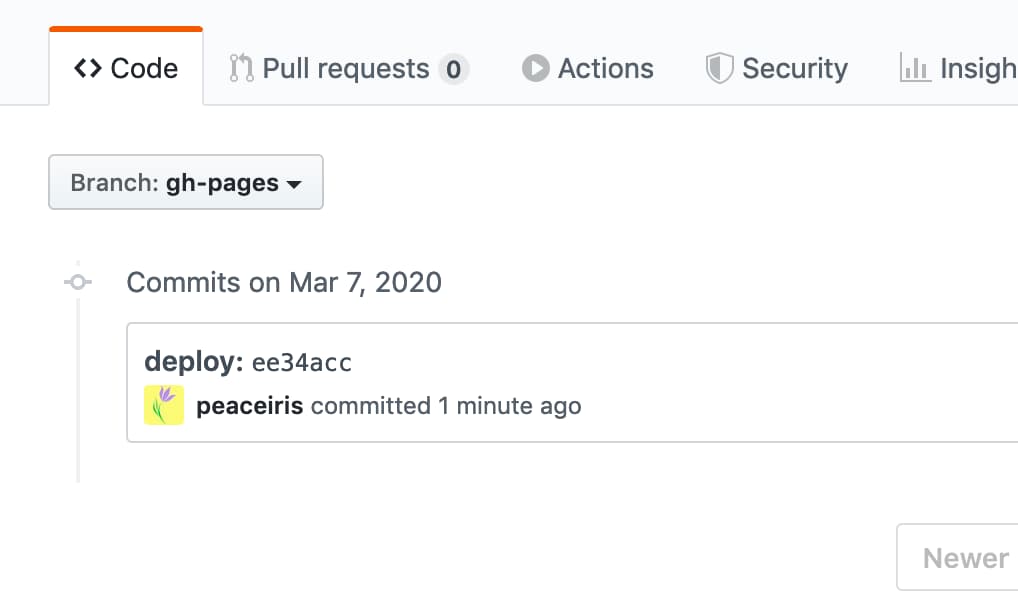 |  |
| Select branch | Deploying again and succeed |
|---|---|
 | |
If the action fails to push the commit or tag with the following error:
txt/usr/bin/git push origin gh-pages remote: Write access to repository not granted. fatal: unable to access 'https://github.com/username/repository.git/': The requested URL returned error: 403 Error: Action failed with "The process '/usr/bin/git' failed with exit code 128"
Please add the write permission to the permissions.contents in a workflow/job.
yamlpermissions: contents: write
Alternatively, you can configure the default GITHUB_TOKEN permissions by selecting read and write permissions.
⭐️ Use the latest and specific release
We recommend you to use the latest and specific release of this action for stable CI/CD.
It is useful to watch this repository (release only) to check the latest release of this action.
For continuous updating, we can use the GitHub native Dependabot.
Here is an example configuration of the bot. The config file is located in .github/dependabot.yml.
yamlversion: 2 updates: - package-ecosystem: "github-actions" directory: "/" schedule: interval: "daily" labels: - "CI/CD" commit-message: prefix: ci
See the official documentation for more details about the Dependabot: Keeping your dependencies updated automatically - GitHub Docs
⭐️ Schedule and Manual Deployment
For deploying regularly, we can set the on.schedule workflow trigger.
See Scheduled events | Events that trigger workflows - GitHub Docs
For deploying manually, we can set the on.workflow_dispatch workflow trigger.
See Manual events workflow_dispatch | Events that trigger workflows - GitHub Docs
yamlname: GitHub Pages on: push: branches: - main schedule: - cron: "22 22 * * *" workflow_dispatch: jobs: deploy: runs-on: ubuntu-22.04 permissions: contents: write concurrency: group: ${{ github.workflow }}-${{ github.ref }} steps: ...
⭐️ Release Strategy
Our project builds and provides build assets only when creating a release. This is to prevent the user from executing this action with a specific branch (like main). For example, if we maintain build assets in the main branch and users use this action as follows, a major release including breaking changes will break the CI workflow of the users silently.
yaml- uses: peaceiris/actions-gh-pages@main # Bad example! with: github_token: ${{ secrets.GITHUB_TOKEN }} publish_dir: ./public
In this project, a major tag (e.g. v3) is guaranteed to contain no breaking changes. But, we recommend using a tag or a commit hash for the stability of your workflows.
yaml- uses: peaceiris/actions-gh-pages@v4.0.0 # tag: Better with: github_token: ${{ secrets.GITHUB_TOKEN }} publish_dir: ./public
yaml- uses: peaceiris/actions-gh-pages@373f7f263a76c20808c831209c920827a82a2847 # commit hash of v3.9.3: Best! with: github_token: ${{ secrets.GITHUB_TOKEN }} publish_dir: ./public
For verifying the release asset, we can use the following commands.
<div align="right"> <a href="#table-of-contents">Back to TOC ☝️</a> </div>shgit clone https://github.com/peaceiris/actions-gh-pages.git cd ./actions-gh-pages git checkout v3.9.3 nvm install nvm use npm i -g npm npm ci npm run build git diff ./lib/index.js # We will get zero exit code
Examples
⭐️ Static Site Generators with Node.js
hexo, vuepress, react-static, gridsome, create-react-app and so on.
Please check where your output directory is before pushing your workflow.
e.g. create-react-app requires publish_dir to be set to ./build
Premise: Dependencies are managed by package.json and package-lock.json
yamlname: GitHub Pages on: push: branches: - main pull_request: jobs: deploy: runs-on: ubuntu-22.04 permissions: contents: write concurrency: group: ${{ github.workflow }}-${{ github.ref }} steps: - uses: actions/checkout@v4 - name: Setup Node uses: actions/setup-node@v4 with: node-version: '24' - name: Cache dependencies uses: actions/cache@v4 with: path: ~/.npm key: ${{ runner.os }}-node-${{ hashFiles('**/package-lock.json') }} restore-keys: | ${{ runner.os }}-node- - run: npm ci - run: npm run build - name: Deploy uses: peaceiris/actions-gh-pages@v4 if: github.ref == 'refs/heads/main' with: github_token: ${{ secrets.GITHUB_TOKEN }} publish_dir: ./public
⭐️ Gatsby
An example for Gatsby (Gatsby.js) project with gatsby-starter-blog
yamlname: GitHub Pages on: push: branches: - main pull_request: jobs: deploy: runs-on: ubuntu-22.04 permissions: contents: write concurrency: group: ${{ github.workflow }}-${{ github.ref }} steps: - uses: actions/checkout@v4 - name: Setup Node uses: actions/setup-node@v4 with: node-version: '24' - name: Cache dependencies uses: actions/cache@v4 with: path: ~/.npm key: ${{ runner.os }}-node-${{ hashFiles('**/package-lock.json') }} restore-keys: | ${{ runner.os }}-node- - run: npm ci - run: npm run format - run: npm run test - run: npm run build - name: Deploy uses: peaceiris/actions-gh-pages@v4 if: github.ref == 'refs/heads/main' with: github_token: ${{ secrets.GITHUB_TOKEN }} publish_dir: ./public
⭐️ React and Next
An example for Next.js (React.js) project with create-next-app
yamlname: GitHub Pages on: push: branches: - main pull_request: jobs: deploy: runs-on: ubuntu-22.04 permissions: contents: write concurrency: group: ${{ github.workflow }}-${{ github.ref }} steps: - uses: actions/checkout@v4 - name: Setup Node uses: actions/setup-node@v4 with: node-version: '24' - name: Get yarn cache id: yarn-cache run: echo "YARN_CACHE_DIR=$(yarn cache dir)" >> "${GITHUB_OUTPUT}" - name: Cache dependencies uses: actions/cache@v4 with: path: ${{ steps.yarn-cache.outputs.YARN_CACHE_DIR }} key: ${{ runner.os }}-yarn-${{ hashFiles('**/yarn.lock') }} restore-keys: | ${{ runner.os }}-yarn- - run: yarn install --frozen-lockfile - run: yarn build - run: yarn export - name: Deploy uses: peaceiris/actions-gh-pages@v4 if: github.ref == 'refs/heads/main' with: github_token: ${{ secrets.GITHUB_TOKEN }} publish_dir: ./out
⭐️ Vue and Nuxt
An example for Nuxt.js (Vue.js) project with create-nuxt-app
yamlname: GitHub Pages on: push: branches: - main pull_request: jobs: deploy: runs-on: ubuntu-22.04 permissions: contents: write concurrency: group: ${{ github.workflow }}-${{ github.ref }} steps: - uses: actions/checkout@v4 - name: Setup Node uses: actions/setup-node@v4 with: node-version: '24' - name: Cache dependencies uses: actions/cache@v4 with: path: ~/.npm key: ${{ runner.os }}-node-${{ hashFiles('**/package-lock.json') }} restore-keys: | ${{ runner.os }}-node- - run: npm ci - run: npm test - run: npm run generate - name: deploy uses: peaceiris/actions-gh-pages@v4 if: github.ref == 'refs/heads/main' with: github_token: ${{ secrets.GITHUB_TOKEN }} publish_dir: ./dist
⭐️ Docusaurus
An example workflow for Docusaurus.
npx @docusaurus/init@next init website classic is useful to create a new Docusaurus project.
yaml# .github/workflows/deploy.yml name: GitHub Pages on: push: branches: - main paths: - '.github/workflows/deploy.yml' - 'website/**' pull_request: jobs: deploy: runs-on: ubuntu-22.04 permissions: contents: write concurrency: group: ${{ github.workflow }}-${{ github.ref }} defaults: run: working-directory: website steps: - uses: actions/checkout@v4 - name: Setup Node uses: actions/setup-node@v4 with: node-version: '24' - name: Get yarn cache id: yarn-cache run: echo "YARN_CACHE_DIR=$(yarn cache dir)" >> "${GITHUB_OUTPUT}" - name: Cache dependencies uses: actions/cache@v4 with: path: ${{ steps.yarn-cache.outputs.YARN_CACHE_DIR }} key: ${{ runner.os }}-website-${{ hashFiles('**/yarn.lock') }} restore-keys: | ${{ runner.os }}-website- - run: yarn install --frozen-lockfile - run: yarn build - name: Deploy uses: peaceiris/actions-gh-pages@v4 if: github.ref == 'refs/heads/main' with: github_token: ${{ secrets.GITHUB_TOKEN }} publish_dir: ./website/build
⭐️ Static Site Generators with Python
pelican, MkDocs, sphinx, and so on.
Premise: Dependencies are managed by requirements.txt
yamlname: GitHub Pages on: push: branches: - main pull_request: jobs: deploy: runs-on: ubuntu-22.04 permissions: contents: write concurrency: group: ${{ github.workflow }}-${{ github.ref }} steps: - uses: actions/checkout@v4 - name: Setup Python uses: actions/setup-python@v5 with: python-version: '3.13' - name: Upgrade pip run: | # install pip=>20.1 to use "pip cache dir" python3 -m pip install --upgrade pip - name: Get pip cache dir id: pip-cache run: echo "dir=$(pip cache dir)" >> $GITHUB_OUTPUT - name: Cache dependencies uses: actions/cache@v4 with: path: ${{ steps.pip-cache.outputs.dir }} key: ${{ runner.os }}-pip-${{ hashFiles('**/requirements.txt') }} restore-keys: | ${{ runner.os }}-pip- - name: Install dependencies run: python3 -m pip install -r ./requirements.txt - run: mkdocs build - name: Deploy uses: peaceiris/actions-gh-pages@v4 if: github.ref == 'refs/heads/main' with: github_token: ${{ secrets.GITHUB_TOKEN }} publish_dir: ./site
⭐️ mdBook (Rust)
An example GitHub Actions workflow to deploy rust-lang/mdBook site to GitHub Pages.
yamlname: GitHub Pages on: push: branches: - main pull_request: jobs: deploy: runs-on: ubuntu-22.04 permissions: contents: write concurrency: group: ${{ github.workflow }}-${{ github.ref }} steps: - uses: actions/checkout@v4 - name: Setup mdBook uses: peaceiris/actions-mdbook@v1 with: mdbook-version: '0.4.8' # mdbook-version: 'latest' - run: mdbook build - name: Deploy uses: peaceiris/actions-gh-pages@v4 if: github.ref == 'refs/heads/main' with: github_token: ${{ secrets.GITHUB_TOKEN }} publish_dir: ./book
Hint: you may want to publish your rustdocs. And use relative links to it from the md docs, and have them checked by mdbook.
Then, according to the doc, you may put ./target/doc/
to your ./book/src dir before you mdbook build and then it will end up in ./book/html/ and in your Github Pages.
⭐️ Flutter Web
An example workflow for Flutter web project.
yamlname: GitHub Pages on: push: branches: - main pull_request: jobs: deploy: runs-on: ubuntu-22.04 permissions: contents: write concurrency: group: ${{ github.workflow }}-${{ github.ref }} steps: - uses: actions/checkout@v4 - name: Setup Flutter run: | git clone https://github.com/flutter/flutter.git --depth 1 -b beta _flutter echo "${GITHUB_WORKSPACE}/_flutter/bin" >> ${GITHUB_PATH} - name: Install run: | flutter config --enable-web flutter pub get - name: Build run: flutter build web - name: Deploy uses: peaceiris/actions-gh-pages@v4 if: github.ref == 'refs/heads/main' with: github_token: ${{ secrets.GITHUB_TOKEN }} publish_dir: ./build/web
⭐️ Elm
An example workflow for Elm.
yamlname: GitHub Pages on: push: branches: - main pull_request: jobs: deploy: runs-on: ubuntu-22.04 permissions: contents: write concurrency: group: ${{ github.workflow }}-${{ github.ref }} steps: - uses: actions/checkout@v4 - name: Setup Node uses: actions/setup-node@v4 with: node-version: '24' - name: Setup Elm run: npm install elm --global - name: Make run: elm make --optimize src/Main.elm - name: Move files run: | mkdir ./public mv ./index.html ./public/ # If you have non-minimal setup with some assets and separate html/js files, # provide --output=<output-file> option for `elm make` and remove this step - name: Deploy uses: peaceiris/actions-gh-pages@v4 if: github.ref == 'refs/heads/main' with: github_token: ${{ secrets.GITHUB_TOKEN }} publish_dir: ./public
⭐️ Swift Publish
An example workflow for JohnSundell/Publish.
<div align="right"> <a href="#table-of-contents">Back to TOC ☝️</a> </div>yamlname: GitHub Pages on: push: branches: - main pull_request: jobs: deploy: runs-on: macos-latest concurrency: group: ${{ github.workflow }}-${{ github.ref }} steps: - uses: actions/checkout@v4 - uses: actions/cache@v4 with: path: | ~/Publish_build .build key: ${{ runner.os }}-spm-${{ hashFiles('**/Package.resolved') }} restore-keys: | ${{ runner.os }}-spm- - name: Setup JohnSundell/Publish run: | cd ${HOME} export PUBLISH_VERSION="0.7.0" git clone https://github.com/JohnSundell/Publish.git cd ./Publish && git checkout ${PUBLISH_VERSION} mv ~/Publish_build .build || true swift build -c release cp -r .build ~/Publish_build || true echo "${HOME}/Publish/.build/release" >> ${GITHUB_PATH} - run: publish-cli generate - name: Deploy to GitHub Pages uses: peaceiris/actions-gh-pages@v4 if: github.ref == 'refs/heads/main' with: github_token: ${{ secrets.GITHUB_TOKEN }} publish_dir: ./Output
License
Maintainer
<div align="right"> <a href="#table-of-contents">Back to TOC ☝️</a> </div>Contributors
Showing top 12 contributors by commit count.

![renovate[bot]](https://avatars.githubusercontent.com/in/2740?v=4)
![dependabot[bot]](https://avatars.githubusercontent.com/in/29110?v=4)
![dependabot-preview[bot]](https://avatars.githubusercontent.com/in/2141?v=4)
![imgbot[bot]](https://avatars.githubusercontent.com/in/4706?v=4)


Related Repositories

sdras/awesome-actions
A curated list of awesome actions to use on GitHub

actions/starter-workflows
Accelerating new GitHub Actions workflows

super-linter/super-linter
Combination of multiple linters to run as a GitHub Action or standalone

P3TERX/Actions-OpenWrt
A template for building OpenWrt with GitHub Actions | 使用 GitHub Actions 在线云编译 OpenWrt 固件

SamKirkland/FTP-Deploy-Action
Deploys a GitHub project to a FTP server using GitHub actions
actions/github-script
Write workflows scripting the GitHub API in JavaScript