Plexe
✨ Build a machine learning model from a prompt
**plexe** is a ✨ Build a machine learning model from a prompt The project is written primarily in Python, distributed under the Apache License 2.0 license, first published in 2025. It has gained significant community traction with 2,582 stars and 256 forks on GitHub. Key topics include: agentic-ai, agents, ai, machine-learning, ml.
plexe ✨


Build machine learning models using natural language.
Quickstart |
Features |
Installation |
Documentation
plexe lets you create machine learning models by describing them in plain language. Simply explain what you want,
provide a dataset, and the AI-powered system builds a fully functional model through an automated agentic approach.
Also available as a managed cloud service.
Watch the demo on YouTube:
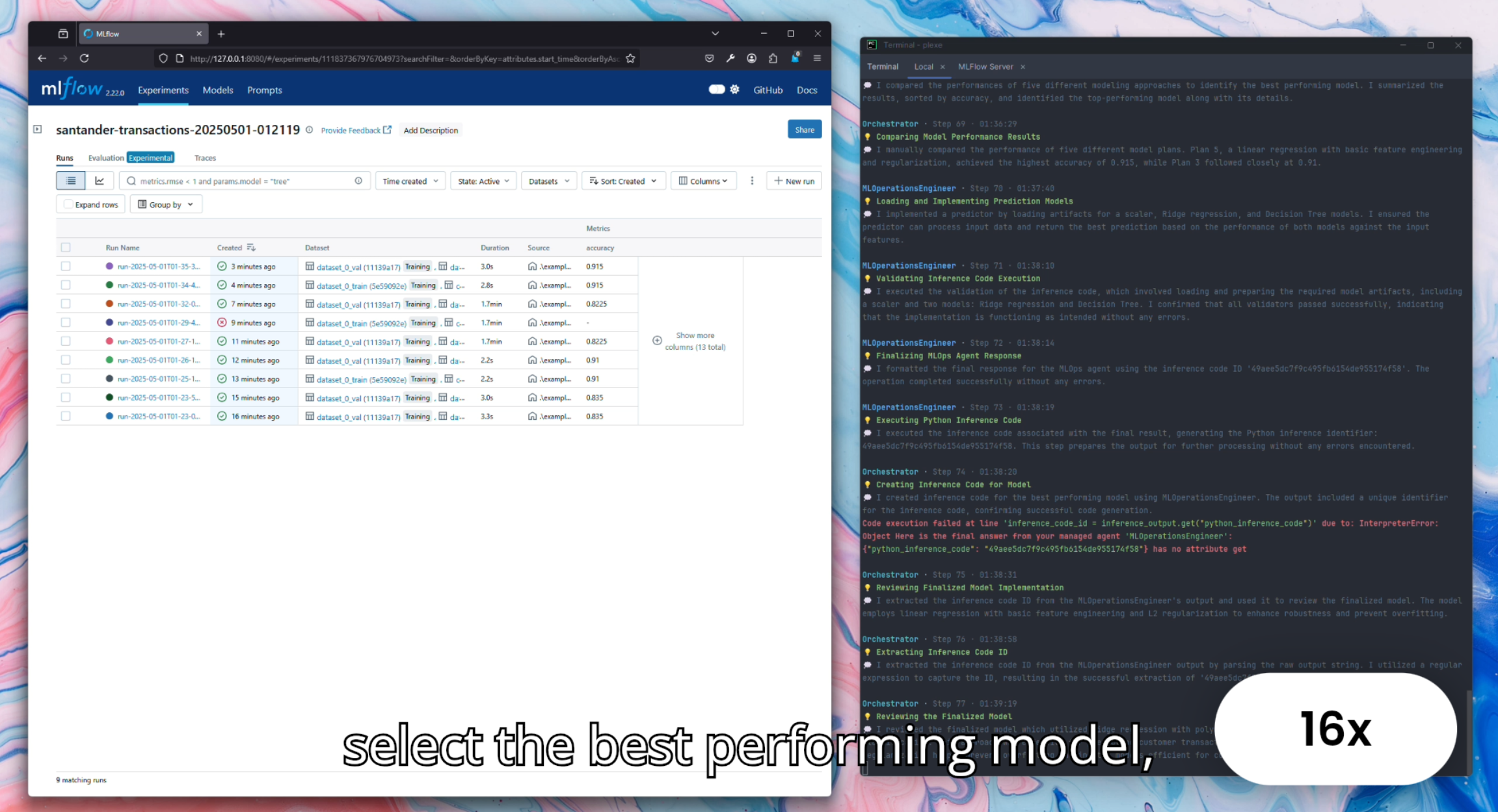
1. Quickstart
Installation
bashpip install plexe export OPENAI_API_KEY=<your-key> export ANTHROPIC_API_KEY=<your-key>
Using plexe
Provide a tabular dataset (Parquet, CSV, ORC, or Avro) and a natural language intent:
bashpython -m plexe.main \ --train-dataset-uri data.parquet \ --intent "predict whether a passenger was transported" \ --max-iterations 5
pythonfrom plexe.main import main from pathlib import Path best_solution, metrics, report = main( intent="predict whether a passenger was transported", data_refs=["train.parquet"], max_iterations=5, work_dir=Path("./workdir"), ) print(f"Performance: {best_solution.performance:.4f}")
2. Features
2.1. 🤖 Multi-Agent Architecture
The system uses 14 specialized AI agents across a 6-phase workflow to:
- Analyze your data and identify the ML task
- Select the right evaluation metric
- Search for the best model through hypothesis-driven iteration
- Evaluate model performance and robustness
- Package the model for deployment
2.2. 🎯 Automated Model Building
Build complete models with a single call. Plexe supports XGBoost, CatBoost, LightGBM, Keras, and PyTorch for tabular data:
pythonbest_solution, metrics, report = main( intent="predict house prices based on property features", data_refs=["housing.parquet"], max_iterations=10, # Search iterations allowed_model_types=["xgboost"], # Or let plexe choose enable_final_evaluation=True, # Evaluate on held-out test set )
Run python -m plexe.main --help for all CLI options.
The output is a self-contained model package at work_dir/model/ (also archived as model.tar.gz).
The package has no dependency on plexe — build the model with plexe, deploy it anywhere:
model/
├── artifacts/          # Trained model + feature pipeline (pickle)
├── src/                # Inference predictor, pipeline code, training template
├── schemas/            # Input/output JSON schemas
├── config/             # Hyperparameters
├── evaluation/         # Metrics and detailed analysis reports
├── model.yaml          # Model metadata
└── README.md           # Usage instructions with example code
2.3. 🐳 Batteries-Included Docker Images
Run plexe with everything pre-configured — PySpark, Java, and all dependencies included.
A Makefile is provided for common workflows:
bashmake build # Build the Docker image make test-quick # Fast sanity check (~1 iteration) make run-titanic # Run on Spaceship Titanic dataset
Or run directly:
bashdocker run --rm \ -e OPENAI_API_KEY=$OPENAI_API_KEY \ -e ANTHROPIC_API_KEY=$ANTHROPIC_API_KEY \ -v $(pwd)/data:/data -v $(pwd)/workdir:/workdir \ plexe:py3.12 python -m plexe.main \ --train-dataset-uri /data/dataset.parquet \ --intent "predict customer churn" \ --work-dir /workdir \ --spark-mode local
A config.yaml in the project root is automatically mounted. A Databricks Connect image
is also available: docker build --target databricks .
2.4. ⚙️ YAML Configuration
Customize LLM routing, search parameters, Spark settings, and more via a config file:
yaml# config.yaml max_search_iterations: 5 allowed_model_types: [xgboost, catboost] spark_driver_memory: "4g" hypothesiser_llm: "openai/gpt-5-mini" feature_processor_llm: "anthropic/claude-sonnet-4-5-20250929"
bashCONFIG_FILE=config.yaml python -m plexe.main ...
See config.yaml.template for all available options.
2.5. 🌐 Multi-Provider LLM Support
Plexe uses LLMs via LiteLLM, so you can use any supported provider:
yaml# Route different agents to different providers hypothesiser_llm: "openai/gpt-5-mini" feature_processor_llm: "anthropic/claude-sonnet-4-5-20250929" model_definer_llm: "ollama/llama3"
[!NOTE]
Plexe should work with most LiteLLM providers, but we actively test only withopenai/*andanthropic/*
models. If you encounter issues with other providers, please let us know.
2.6. 📊 Experiment Dashboard
Visualize experiment results, search trees, and evaluation reports with the built-in Streamlit dashboard:
bashpython -m plexe.viz --work-dir ./workdir
2.7. 🔌 Extensibility
Connect plexe to custom storage, tracking, and deployment infrastructure via the WorkflowIntegration interface:
pythonmain(intent="...", data_refs=[...], integration=MyCustomIntegration())
See plexe/integrations/base.py for the full interface.
3. Installation
3.1. Installation Options
bashpip install plexe # Core (XGBoost, Keras, scikit-learn)
You can add optional dependencies either by framework or by task grouping:
- Framework extras:
catboost,lightgbm,pytorch - Task extras:
tabular(CatBoost + LightGBM),vision(PyTorch) - Platform extras:
pyspark,aws
Examples:
bashpip install "plexe[tabular,pyspark]" # tabular stack + local PySpark pip install "plexe[pytorch,aws]" # explicit framework + S3 support
Requires Python >= 3.10, < 3.13.
3.2. API Keys
bashexport OPENAI_API_KEY=<your-key> export ANTHROPIC_API_KEY=<your-key>
See LiteLLM providers for all supported providers.
4. Documentation
For full documentation, visit docs.plexe.ai.
5. Contributing
See CONTRIBUTING.md for guidelines. Join our Discord to connect with the team.
6. License
7. Citation
If you use Plexe in your research, please cite it as follows:
bibtex@software{plexe2025, author = {De Bernardi, Marcello AND Dubey, Vaibhav}, title = {Plexe: Build machine learning models using natural language.}, year = {2025}, publisher = {GitHub}, howpublished = {\url{https://github.com/plexe-ai/plexe}}, }
Contributors
Showing top 9 contributors by commit count.


