

Copulas
A library to model multivariate data using copulas.
This repository is part of The Synthetic Data Vault Project, a project from DataCebo. The project is written primarily in Python, distributed under the Other license, first published in 2017. Key topics include: copulas, data-generation, generative-ai, generative-model, machine-learning.





Overview
Copulas is a Python library for modeling multivariate distributions and sampling from them
using copula functions.
Given a table of numerical data, use Copulas to learn the distribution and
generate new synthetic data following the same statistical properties.
Key Features:
-
Model multivariate data. Choose from a variety of univariate
distributions and copulas – including Archimedian Copulas, Gaussian Copulas and Vine Copulas. -
Compare real and synthetic data visually after building your model. Visualizations
are available as 1D histograms, 2D scatterplots and 3D scatterplots. -
Access & manipulate learned parameters. With complete access to the internals
of the model, set or tune parameters to your choosing.
Install
Install the Copulas library using pip or conda.
bashpip install copulas
bashconda install -c conda-forge copulas
Usage
Get started using a demo dataset. This dataset contains 3 numerical columns.
<img src="docs/images/copulas_sample_dataset.png" width="300">pythonfrom copulas.datasets import sample_trivariate_xyz real_data = sample_trivariate_xyz() real_data.head()
Model the data using a copula and use it to create synthetic data.
The Copulas library offers many options including Gaussian Copula,
Vine Copulas and Archimedian Copulas.
pythonfrom copulas.multivariate import GaussianMultivariate copula = GaussianMultivariate() copula.fit(real_data) synthetic_data = copula.sample(len(real_data))
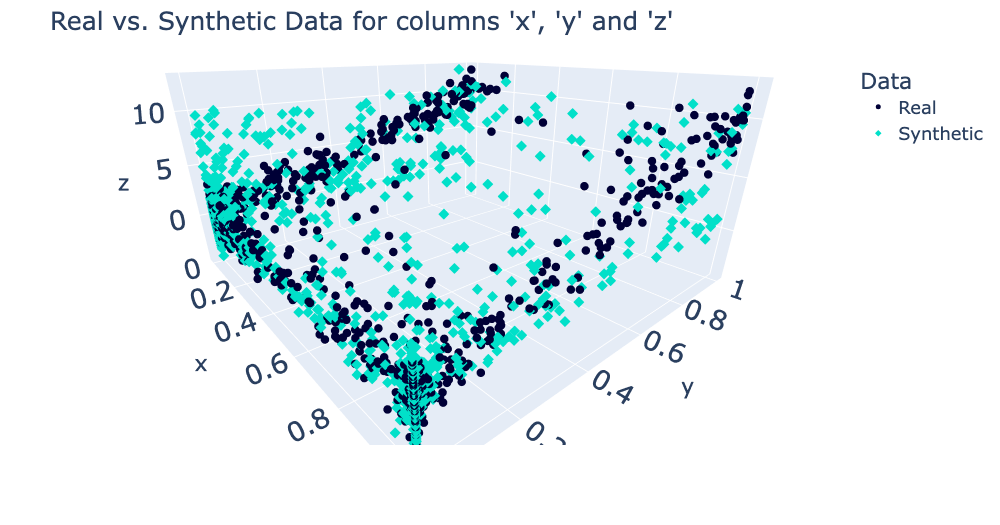
Visualize the real and synthetic data side-by-side. Let's do this in 3D so see our full dataset.
pythonfrom copulas.visualization import compare_3d compare_3d(real_data, synthetic_data)
Tutorials
Click below to run the code yourself on a Colab Notebook and discover new features.

Community & Support
Learn more about Copulas library from our documentation site.
Questions or issues? Join our forum
to discuss Copulas features, ask questions, and receive help.
If you find a bug or have a feature request, you can also
open an issue on our forum.
Interested in contributing to Copulas? Read our
Contribution Guide to get started.
Credits
The Copulas open source project first started at the Data to AI Lab at MIT in 2018.
Thank you to our team of contributors who have built and maintained the library over the years!
<div align="center"> <a href="https://datacebo.com"><img align="center" width=40% src="https://github.com/sdv-dev/SDV/blob/stable/docs/images/DataCebo.png"></img></a> </div> <br/> <br/>
The Synthetic Data Vault Project was first created at MIT's Data to AI Lab in 2016. After 4 years of research and traction with enterprise, we
created DataCebo in 2020 with the goal of growing the project.
Today, DataCebo is the proud developer of SDV, the largest ecosystem for
synthetic data generation & evaluation. It is home to multiple libraries that support synthetic
data, including:
- 🔄 Data discovery & transformation. Reverse the transforms to reproduce realistic data.
- 🧠 Multiple machine learning models -- ranging from Copulas to Deep Learning -- to create tabular,
multi table and time series data. - 📊 Measuring quality and privacy of synthetic data, and comparing different synthetic data
generation models.
Get started using the SDV package -- a fully
integrated solution and your one-stop shop for synthetic data. Or, use the standalone libraries
for specific needs.
Contributors
Showing top 12 contributors by commit count.


Related Repositories

rust-dd/stochastic-rs
High-performance quantitative finance in Rust — 120+ stochastic processes, option pricing, calibration, fixed income, risk & copulas, with SIMD/GPU acceleration and Python bindings.

DanielBok/copulae
Multivariate data modelling with Copulas in Python

ServiceNow/TACTiS
TACTiS-2: Better, Faster, Simpler Attentional Copulas for Multivariate Time Series, from ServiceNow Research