

Podinfo
Go microservice template for Kubernetes
Podinfo is a tiny web application made with Go that showcases best practices of running microservices in Kubernetes. Podinfo is used by CNCF projects like [Flux](https://github.com/fluxcd/flux2) and [Flagger](https://github.com/fluxcd/flagger) for end-to-end testing and workshops. The project is written primarily in Go, distributed under the Apache License 2.0 license, first published in 2018. It has gained significant community traction with 5,925 stars and 1,871 forks on GitHub. Key topics include: cuelang, e2e-testing, gitops, golang, helm.
podinfo





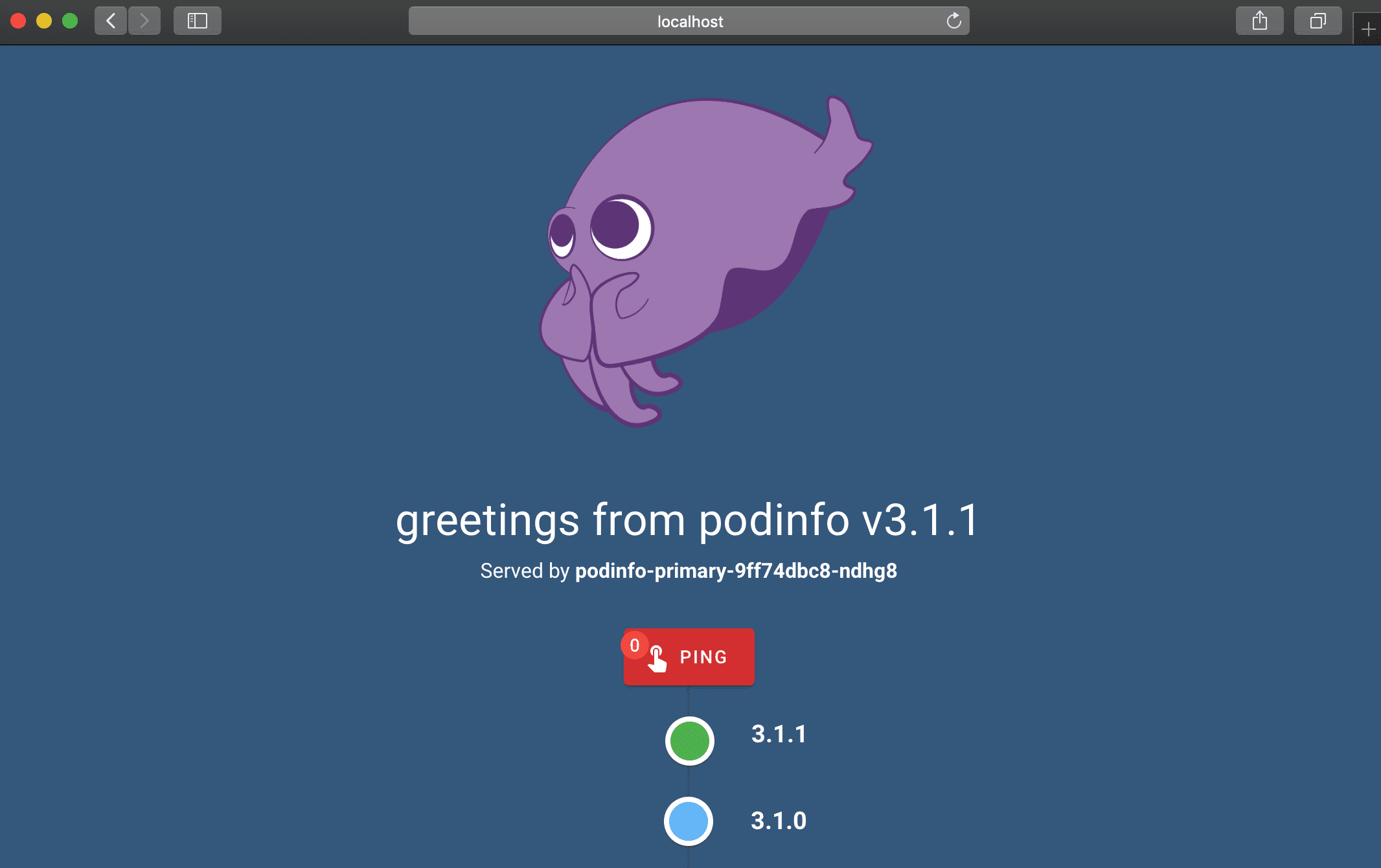
Podinfo is a tiny web application made with Go that showcases best practices of running microservices in Kubernetes.
Podinfo is used by CNCF projects like Flux and Flagger
for end-to-end testing and workshops.
Specifications:
- Health checks (readiness and liveness)
- Graceful shutdown on interrupt signals
- File watcher for secrets and configmaps
- Instrumented with Prometheus and Open Telemetry
- Structured logging with zap
- 12-factor app with viper
- Fault injection (random errors and latency)
- Swagger docs
- Timoni, Helm and Kustomize installers
- End-to-End testing with Kubernetes Kind and Helm
- Multi-arch container image with Docker buildx and GitHub Actions
- Container image signing with Sigstore cosign
- SBOMs and SLSA Provenance embedded in the container image
- CVE scanning with govulncheck
Web API:
GET /prints runtime informationGET /versionprints podinfo version and git commit hashGET /metricsreturn HTTP requests duration and Go runtime metricsGET /healthzused by Kubernetes liveness probeGET /readyzused by Kubernetes readiness probePOST /readyz/enablesignals the Kubernetes LB that this instance is ready to receive trafficPOST /readyz/disablesignals the Kubernetes LB to stop sending requests to this instancePOST /fault_injection/enablemakes this instance respond with HTTP 500 to all application endpoints (probes, metrics, pprof and the/fault_injection/*control endpoints stay healthy) — useful for testing client-side circuit breakers / outlier detection against a single "sick" replicaPOST /fault_injection/disablerestores normal responsesGET /fault_injection/statusreturns the current fault injection state (enabledordisabled)GET /status/{code}returns the status codeGET /paniccrashes the process with exit code 255POST /echoforwards the call to the backend service and echos the posted contentGET /envreturns the environment variables as a JSON arrayGET /headersreturns a JSON with the request HTTP headersGET /delay/{seconds}waits for the specified periodPOST /tokenissues a JWT token valid for one minuteJWT=$(curl -sd 'anon' podinfo:9898/token | jq -r .token)GET /token/validatevalidates the JWT tokencurl -H "Authorization: Bearer $JWT" podinfo:9898/token/validateGET /configsreturns a JSON with configmaps and/or secrets mounted in theconfigvolumePOST/PUT /cache/{key}saves the posted content to RedisGET /cache/{key}returns the content from Redis if the key existsDELETE /cache/{key}deletes the key from Redis if existsPOST /storewrites the posted content to disk at /data/hash and returns the SHA1 hash of the contentGET /store/{hash}returns the content of the file /data/hash if existsGET /ws/echoechos content via websocketspodcli ws ws://localhost:9898/ws/echoGET /chunked/{seconds}usestransfer-encodingtypechunkedto give a partial response and then waits for the specified periodGET /swagger.jsonreturns the API Swagger docs, used for Linkerd service profiling and Gloo routes discovery
gRPC API:
/grpc.health.v1.Health/Checkhealth checking/grpc.EchoService/Echoechos the received content/grpc.VersionService/Versionreturns podinfo version and Git commit hash/grpc.DelayService/Delayreturns a successful response after the given seconds in the body of gRPC request/grpc.EnvService/Envreturns environment variables as a JSON array/grpc.HeaderService/Headerreturns the headers present in the gRPC request. Any custom header can also be given as a part of request and that can be returned using this API/grpc.InfoService/Inforeturns the runtime information/grpc.PanicService/Paniccrashes the process with gRPC status code as '1 CANCELLED'/grpc.StatusService/Statusreturns the gRPC Status code given in the request body/grpc.TokenService/TokenGenerateissues a JWT token valid for one minute/grpc.TokenService/TokenValidatevalidates the JWT token
Web UI:
To access the Swagger UI open <podinfo-host>/swagger/index.html in a browser.
Guides
- Getting started with Timoni
- Getting started with Flux
- Progressive Deliver with Flagger and Linkerd
- Automated canary deployments with Kubernetes Gateway API
Install
To install Podinfo on Kubernetes the minimum required version is Kubernetes v1.23.
Timoni
Install with Timoni:
bashtimoni -n default apply podinfo oci://ghcr.io/stefanprodan/modules/podinfo
Helm
Install from github.io:
bashhelm repo add podinfo https://stefanprodan.github.io/podinfo helm upgrade --install --wait frontend \ --namespace test \ --set replicaCount=2 \ --set backend=http://backend-podinfo:9898/echo \ podinfo/podinfo helm test frontend --namespace test helm upgrade --install --wait backend \ --namespace test \ --set redis.enabled=true \ podinfo/podinfo
Install from ghcr.io:
bashhelm upgrade --install --wait podinfo --namespace default \ oci://ghcr.io/stefanprodan/charts/podinfo
Kustomize
bashkubectl apply -k github.com/stefanprodan/podinfo//kustomize
Docker
bashdocker run -dp 9898:9898 stefanprodan/podinfo
Continuous Delivery
In order to install podinfo on a Kubernetes cluster and keep it up to date with the latest
release in an automated manner, you can use Flux.
Install the Flux CLI on MacOS and Linux using Homebrew:
shbrew install fluxcd/tap/flux
Install the Flux controllers needed for Helm operations:
shflux install \ --namespace=flux-system \ --network-policy=false \ --components=source-controller,helm-controller
Add podinfo's Helm repository to your cluster and
configure Flux to check for new chart releases every ten minutes:
shflux create source helm podinfo \ --namespace=default \ --url=https://stefanprodan.github.io/podinfo \ --interval=10m
Create a podinfo-values.yaml file locally:
shcat > podinfo-values.yaml <<EOL replicaCount: 2 resources: limits: memory: 256Mi requests: cpu: 100m memory: 64Mi EOL
Create a Helm release for deploying podinfo in the default namespace:
shflux create helmrelease podinfo \ --namespace=default \ --source=HelmRepository/podinfo \ --release-name=podinfo \ --chart=podinfo \ --chart-version=">5.0.0" \ --values=podinfo-values.yaml
Based on the above definition, Flux will upgrade the release automatically
when a new version of podinfo is released. If the upgrade fails, Flux
can rollback
to the previous working version.
You can check what version is currently deployed with:
shflux get helmreleases -n default
To delete podinfo's Helm repository and release from your cluster run:
shflux -n default delete source helm podinfo flux -n default delete helmrelease podinfo
If you wish to manage the lifecycle of your applications in a GitOps manner, check out
this workflow example
for multi-env deployments with Flux, Kustomize and Helm.
Contributors
Showing top 12 contributors by commit count.
![dependabot[bot]](https://avatars.githubusercontent.com/in/29110?v=4)


Related Repositories

stefanprodan/timoni
Timoni is a package manager for Kubernetes, powered by CUE and inspired by Helm.

mmorejon/microservices-docker-go-mongodb
Example of Microservices in Go with Docker, Kubernetes and MongoDB

hofstadter-io/hof
A developer experience centered on CUE. Unifies schemas, data models, deterministic and agentic code generation, workflow and task engine, dagger powered environments, coding assistant, and vscode extension; woven together on the CUE lattice. Squint harder if you can't see the cube :]

grafana/thema
A CUE-based framework for portable, evolvable schema

nix-community/nixago
Generate configuration files using Nix [maintainer=@jmgilman]
stefanprodan/flux-aio
Flux All-In-One distribution made with Timoni