

CuratedAtlasQueryR
Tidy R query API for the harmonised and curated CELLxGENE single-cell atlas.
`CuratedAtlasQuery` is a query interface that allow the programmatic exploration and retrieval of the harmonised, curated and reannotated CELLxGENE single-cell human cell atlas. Data can be retrieved at cell, sample, or dataset levels based on filtering criteria. The project is written primarily in R, distributed under the GNU General Public License v3.0 license, first published in 2022. Key topics include: database, duckdb, hdf5, human-cell-atlas, single-cell.
CuratedAtlasQueryR
<!-- badges: start -->
CuratedAtlasQuery is a query interface that allow the programmatic
exploration and retrieval of the harmonised, curated and reannotated
CELLxGENE single-cell human cell atlas. Data can be retrieved at cell,
sample, or dataset levels based on filtering criteria.
Harmonised data is stored in the ARDC Nectar Research Cloud, and most
CuratedAtlasQuery functions interact with Nectar via web requests, so
a network connection is required for most functionality.
<img src="man/figures/svcf_logo.jpeg" width="155x" height="58px" /><img src="man/figures/czi_logo.png" width="129px" height="58px" /><img src="man/figures/bioconductor_logo.jpg" width="202px" height="58px" /><img src="man/figures/vca_logo.png" width="219px" height="58px" /><img src="man/figures/nectar_logo.png" width="180px" height="58px" />
Usage
The API has delivered more than 15Tb of data to the community in the first year. Thanks!
<img src="man/figures/downloads.png" width="40%" />Query interface
Installation
rdevtools::install_github("stemangiola/CuratedAtlasQueryR")
Load the package
rlibrary(CuratedAtlasQueryR)
Load and explore the metadata
Load the metadata
r# Note: in real applications you should use the default value of remote_url metadata <- get_metadata(remote_url = METADATA_URL) metadata #> # Source: table</vast/scratch/users/milton.m/cache/R/CuratedAtlasQueryR/metadata.0.2.3.parquet> [?? x 56] #> # Database: DuckDB 0.7.1 [unknown@Linux 3.10.0-1160.88.1.el7.x86_64:R 4.2.1/:memory:] #> cell_ sample_ cell_…¹ cell_…² confi…³ cell_…⁴ cell_…⁵ cell_…⁶ sampl…⁷ _samp…⁸ #> <chr> <chr> <chr> <chr> <dbl> <chr> <chr> <chr> <chr> <chr> #> 1 8387… 7bd7b8… natura… immune… 5 cd8 tem gmp natura… 842ce7… Q59___… #> 2 1768… 7bd7b8… natura… immune… 5 cd8 tem cd8 tcm natura… 842ce7… Q59___… #> 3 6329… 7bd7b8… natura… immune… 5 cd8 tem clp termin… 842ce7… Q59___… #> 4 5027… 7bd7b8… natura… immune… 5 cd8 tem clp natura… 842ce7… Q59___… #> 5 7956… 7bd7b8… natura… immune… 5 cd8 tem clp natura… 842ce7… Q59___… #> 6 4305… 7bd7b8… natura… immune… 5 cd8 tem clp termin… 842ce7… Q59___… #> 7 2126… 933f96… natura… ilc 1 nk nk natura… c250bf… AML3__… #> 8 3114… 933f96… natura… immune… 5 mait nk natura… c250bf… AML3__… #> 9 1407… 933f96… natura… immune… 5 mait clp natura… c250bf… AML3__… #> 10 2911… 933f96… natura… nk 5 nk clp natura… c250bf… AML3__… #> # … with more rows, 46 more variables: assay <chr>, #> # assay_ontology_term_id <chr>, file_id_db <chr>, #> # cell_type_ontology_term_id <chr>, development_stage <chr>, #> # development_stage_ontology_term_id <chr>, disease <chr>, #> # disease_ontology_term_id <chr>, ethnicity <chr>, #> # ethnicity_ontology_term_id <chr>, experiment___ <chr>, file_id <chr>, #> # is_primary_data_x <chr>, organism <chr>, organism_ontology_term_id <chr>, …
The metadata variable can then be re-used for all subsequent queries.
Explore the tissue
rmetadata |> dplyr::distinct(tissue, file_id) #> # Source: SQL [10 x 2] #> # Database: DuckDB 0.7.1 [unknown@Linux 3.10.0-1160.88.1.el7.x86_64:R 4.2.1/:memory:] #> tissue file_id #> <chr> <chr> #> 1 bone marrow 1ff5cbda-4d41-4f50-8c7e-cbe4a90e38db #> 2 lung parenchyma 6661ab3a-792a-4682-b58c-4afb98b2c016 #> 3 respiratory airway 6661ab3a-792a-4682-b58c-4afb98b2c016 #> 4 nose 6661ab3a-792a-4682-b58c-4afb98b2c016 #> 5 renal pelvis dc9d8cdd-29ee-4c44-830c-6559cb3d0af6 #> 6 kidney dc9d8cdd-29ee-4c44-830c-6559cb3d0af6 #> 7 renal medulla dc9d8cdd-29ee-4c44-830c-6559cb3d0af6 #> 8 cortex of kidney dc9d8cdd-29ee-4c44-830c-6559cb3d0af6 #> 9 kidney blood vessel dc9d8cdd-29ee-4c44-830c-6559cb3d0af6 #> 10 lung a2796032-d015-40c4-b9db-835207e5bd5b
Download single-cell RNA sequencing counts
Query raw counts
rsingle_cell_counts = metadata |> dplyr::filter( ethnicity == "African" & stringr::str_like(assay, "%10x%") & tissue == "lung parenchyma" & stringr::str_like(cell_type, "%CD4%") ) |> get_single_cell_experiment() #> ℹ Realising metadata. #> ℹ Synchronising files #> ℹ Downloading 0 files, totalling 0 GB #> ℹ Reading files. #> ℹ Compiling Single Cell Experiment. single_cell_counts #> # A SingleCellExperiment-tibble abstraction: 1,571 × 57 #> # [90mFeatures=36229 | Cells=1571 | Assays=counts[0m #> .cell sample_ cell_…¹ cell_…² confi…³ cell_…⁴ cell_…⁵ cell_…⁶ sampl…⁷ X_sam…⁸ #> <chr> <chr> <chr> <chr> <dbl> <chr> <chr> <chr> <chr> <chr> #> 1 AGCG… 11a7dc… CD4-po… cd4 th1 3 cd4 tcm cd8 t th1 10b339… Donor_… #> 2 TCAG… 11a7dc… CD4-po… cd4 th… 3 cd4 tcm cd4 tem th1/th… 10b339… Donor_… #> 3 TTTA… 11a7dc… CD4-po… cd4 th… 3 cd4 tcm cd4 tcm th17 10b339… Donor_… #> 4 ACAC… 11a7dc… CD4-po… immune… 5 cd4 tcm plasma th1/th… 10b339… Donor_… #> 5 CAAG… 11a7dc… CD4-po… immune… 1 cd4 tcm cd4 tcm mait 10b339… Donor_… #> 6 CTGT… 14a078… CD4-po… cd4 th… 3 cd4 tcm cd4 tem th1/th… 8f71c5… VUHD85… #> 7 ACGT… 14a078… CD4-po… treg 5 cd4 tcm tregs t regu… 8f71c5… VUHD85… #> 8 CATA… 14a078… CD4-po… immune… 5 nk cd8 tem mait 8f71c5… VUHD85… #> 9 ACTT… 14a078… CD4-po… mait 5 mait cd8 tem mait 8f71c5… VUHD85… #> 10 TGCG… 14a078… CD4-po… cd4 th1 3 cd4 tcm cd4 tem th1 8f71c5… VUHD85… #> # … with 1,561 more rows, 47 more variables: assay <chr>, #> # assay_ontology_term_id <chr>, file_id_db <chr>, #> # cell_type_ontology_term_id <chr>, development_stage <chr>, #> # development_stage_ontology_term_id <chr>, disease <chr>, #> # disease_ontology_term_id <chr>, ethnicity <chr>, #> # ethnicity_ontology_term_id <chr>, experiment___ <chr>, file_id <chr>, #> # is_primary_data_x <chr>, organism <chr>, organism_ontology_term_id <chr>, …
Query counts scaled per million
This is helpful if just few genes are of interest, as they can be
compared across samples.
rsingle_cell_counts = metadata |> dplyr::filter( ethnicity == "African" & stringr::str_like(assay, "%10x%") & tissue == "lung parenchyma" & stringr::str_like(cell_type, "%CD4%") ) |> get_single_cell_experiment(assays = "cpm") #> ℹ Realising metadata. #> ℹ Synchronising files #> ℹ Downloading 0 files, totalling 0 GB #> ℹ Reading files. #> ℹ Compiling Single Cell Experiment. single_cell_counts #> # A SingleCellExperiment-tibble abstraction: 1,571 × 57 #> # [90mFeatures=36229 | Cells=1571 | Assays=cpm[0m #> .cell sample_ cell_…¹ cell_…² confi…³ cell_…⁴ cell_…⁵ cell_…⁶ sampl…⁷ X_sam…⁸ #> <chr> <chr> <chr> <chr> <dbl> <chr> <chr> <chr> <chr> <chr> #> 1 AGCG… 11a7dc… CD4-po… cd4 th1 3 cd4 tcm cd8 t th1 10b339… Donor_… #> 2 TCAG… 11a7dc… CD4-po… cd4 th… 3 cd4 tcm cd4 tem th1/th… 10b339… Donor_… #> 3 TTTA… 11a7dc… CD4-po… cd4 th… 3 cd4 tcm cd4 tcm th17 10b339… Donor_… #> 4 ACAC… 11a7dc… CD4-po… immune… 5 cd4 tcm plasma th1/th… 10b339… Donor_… #> 5 CAAG… 11a7dc… CD4-po… immune… 1 cd4 tcm cd4 tcm mait 10b339… Donor_… #> 6 CTGT… 14a078… CD4-po… cd4 th… 3 cd4 tcm cd4 tem th1/th… 8f71c5… VUHD85… #> 7 ACGT… 14a078… CD4-po… treg 5 cd4 tcm tregs t regu… 8f71c5… VUHD85… #> 8 CATA… 14a078… CD4-po… immune… 5 nk cd8 tem mait 8f71c5… VUHD85… #> 9 ACTT… 14a078… CD4-po… mait 5 mait cd8 tem mait 8f71c5… VUHD85… #> 10 TGCG… 14a078… CD4-po… cd4 th1 3 cd4 tcm cd4 tem th1 8f71c5… VUHD85… #> # … with 1,561 more rows, 47 more variables: assay <chr>, #> # assay_ontology_term_id <chr>, file_id_db <chr>, #> # cell_type_ontology_term_id <chr>, development_stage <chr>, #> # development_stage_ontology_term_id <chr>, disease <chr>, #> # disease_ontology_term_id <chr>, ethnicity <chr>, #> # ethnicity_ontology_term_id <chr>, experiment___ <chr>, file_id <chr>, #> # is_primary_data_x <chr>, organism <chr>, organism_ontology_term_id <chr>, …
Extract only a subset of genes
rsingle_cell_counts = metadata |> dplyr::filter( ethnicity == "African" & stringr::str_like(assay, "%10x%") & tissue == "lung parenchyma" & stringr::str_like(cell_type, "%CD4%") ) |> get_single_cell_experiment(assays = "cpm", features = "PUM1") #> ℹ Realising metadata. #> ℹ Synchronising files #> ℹ Downloading 0 files, totalling 0 GB #> ℹ Reading files. #> ℹ Compiling Single Cell Experiment. single_cell_counts #> # A SingleCellExperiment-tibble abstraction: 1,571 × 57 #> # [90mFeatures=1 | Cells=1571 | Assays=cpm[0m #> .cell sample_ cell_…¹ cell_…² confi…³ cell_…⁴ cell_…⁵ cell_…⁶ sampl…⁷ X_sam…⁸ #> <chr> <chr> <chr> <chr> <dbl> <chr> <chr> <chr> <chr> <chr> #> 1 AGCG… 11a7dc… CD4-po… cd4 th1 3 cd4 tcm cd8 t th1 10b339… Donor_… #> 2 TCAG… 11a7dc… CD4-po… cd4 th… 3 cd4 tcm cd4 tem th1/th… 10b339… Donor_… #> 3 TTTA… 11a7dc… CD4-po… cd4 th… 3 cd4 tcm cd4 tcm th17 10b339… Donor_… #> 4 ACAC… 11a7dc… CD4-po… immune… 5 cd4 tcm plasma th1/th… 10b339… Donor_… #> 5 CAAG… 11a7dc… CD4-po… immune… 1 cd4 tcm cd4 tcm mait 10b339… Donor_… #> 6 CTGT… 14a078… CD4-po… cd4 th… 3 cd4 tcm cd4 tem th1/th… 8f71c5… VUHD85… #> 7 ACGT… 14a078… CD4-po… treg 5 cd4 tcm tregs t regu… 8f71c5… VUHD85… #> 8 CATA… 14a078… CD4-po… immune… 5 nk cd8 tem mait 8f71c5… VUHD85… #> 9 ACTT… 14a078… CD4-po… mait 5 mait cd8 tem mait 8f71c5… VUHD85… #> 10 TGCG… 14a078… CD4-po… cd4 th1 3 cd4 tcm cd4 tem th1 8f71c5… VUHD85… #> # … with 1,561 more rows, 47 more variables: assay <chr>, #> # assay_ontology_term_id <chr>, file_id_db <chr>, #> # cell_type_ontology_term_id <chr>, development_stage <chr>, #> # development_stage_ontology_term_id <chr>, disease <chr>, #> # disease_ontology_term_id <chr>, ethnicity <chr>, #> # ethnicity_ontology_term_id <chr>, experiment___ <chr>, file_id <chr>, #> # is_primary_data_x <chr>, organism <chr>, organism_ontology_term_id <chr>, …
Extract the counts as a Seurat object
This convert the H5 SingleCellExperiment to Seurat so it might take long
time and occupy a lot of memory depending on how many cells you are
requesting.
rsingle_cell_counts_seurat = metadata |> dplyr::filter( ethnicity == "African" & stringr::str_like(assay, "%10x%") & tissue == "lung parenchyma" & stringr::str_like(cell_type, "%CD4%") ) |> get_seurat() #> ℹ Realising metadata. #> ℹ Synchronising files #> ℹ Downloading 0 files, totalling 0 GB #> ℹ Reading files. #> ℹ Compiling Single Cell Experiment. single_cell_counts_seurat #> An object of class Seurat #> 36229 features across 1571 samples within 1 assay #> Active assay: originalexp (36229 features, 0 variable features)
Save your SingleCellExperiment
The returned SingleCellExperiment can be saved with two modalities, as
.rds or as HDF5.
Saving as RDS (fast saving, slow reading)
Saving as .rds has the advantage of being fast, andd the .rds file
occupies very little disk space as it only stores the links to the files
in your cache.
However it has the disadvantage that for big SingleCellExperiment
objects, which merge a lot of HDF5 from your
get_single_cell_experiment, the display and manipulation is going to
be slow. In addition, an .rds saved in this way is not portable: you
will not be able to share it with other users.
rsingle_cell_counts |> saveRDS("single_cell_counts.rds")
Saving as HDF5 (slow saving, fast reading)
Saving as .hdf5 executes any computation on the SingleCellExperiment
and writes it to disk as a monolithic HDF5. Once this is done,
operations on the SingleCellExperiment will be comparatively very
fast. The resulting .hdf5 file will also be totally portable and
sharable.
However this .hdf5 has the disadvantage of being larger than the
corresponding .rds as it includes a copy of the count information, and
the saving process is going to be slow for large objects.
rsingle_cell_counts |> HDF5Array::saveHDF5SummarizedExperiment("single_cell_counts", replace = TRUE)
Visualise gene transcription
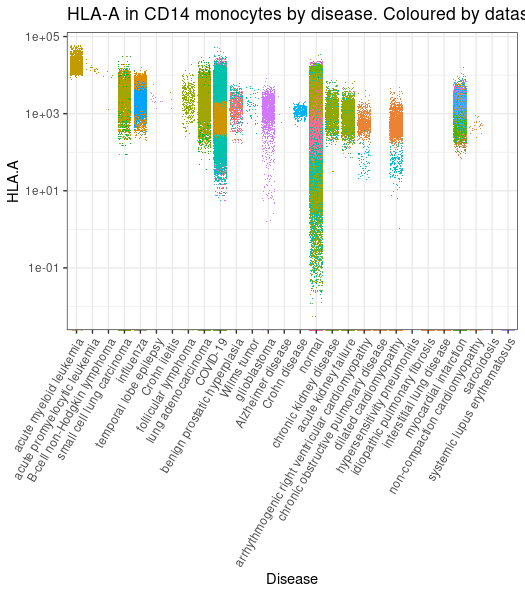
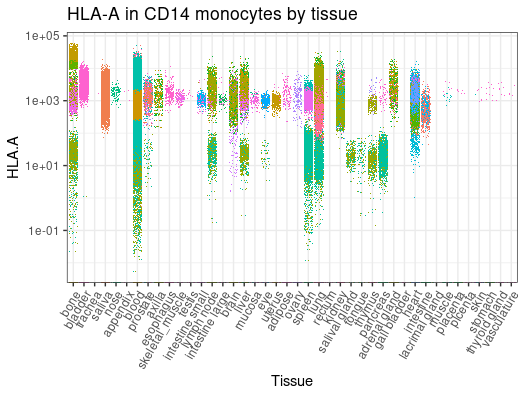
We can gather all CD14 monocytes cells and plot the distribution of
HLA-A across all tissues
#> ℹ Realising metadata.
#> ℹ Synchronising files
#> ℹ Downloading 0 files, totalling 0 GB
#> ℹ Reading files.
#> ℹ Compiling Single Cell Experiment.
rlibrary(tidySingleCellExperiment) library(ggplot2) counts |> ggplot(aes( disease, `HLA.A`,color = file_id)) + geom_jitter(shape=".")
 <!-- -->
rmetadata |> # Filter and subset dplyr::filter(cell_type_harmonised=="nk") |> # Get counts per million for HCA-A gene get_single_cell_experiment(assays = "cpm", features = "HLA-A") |> # Plot (styling code have been omitted) tidySingleCellExperiment::join_features("HLA-A", shape = "wide") |> ggplot(aes(tissue_harmonised, `HLA.A`,color = file_id)) + geom_jitter(shape=".") #> ℹ Realising metadata. #> ℹ Synchronising files #> ℹ Downloading 0 files, totalling 0 GB #> ℹ Reading files. #> ℹ Compiling Single Cell Experiment.
 <!-- -->
Obtain Unharmonised Metadata
Various metadata fields are not common between datasets, so it does
not make sense for these to live in the main metadata table. However, we
can obtain it using the get_unharmonised_metadata() function. This
function returns a data frame with one row per dataset, including the
unharmonised column which contains unharmnised metadata as a nested
data frame.
rharmonised <- metadata |> dplyr::filter(tissue == "kidney blood vessel") unharmonised <- get_unharmonised_metadata(harmonised) unharmonised #> # A tibble: 1 × 2 #> file_id unharmonised #> <chr> <list> #> 1 dc9d8cdd-29ee-4c44-830c-6559cb3d0af6 <tbl_dck_[,14]>
Notice that the columns differ between each dataset’s data frame:
rdplyr::pull(unharmonised) |> head(2) #> [[1]] #> # Source: SQL [?? x 14] #> # Database: DuckDB 0.7.1 [unknown@Linux 3.10.0-1160.88.1.el7.x86_64:R 4.2.1/:memory:] #> cell_ file_id donor…¹ donor…² libra…³ mappe…⁴ sampl…⁵ suspe…⁶ suspe…⁷ autho…⁸ #> <chr> <chr> <chr> <chr> <chr> <chr> <chr> <chr> <chr> <chr> #> 1 4602… dc9d8c… 27 mon… a8536b… 5ddaea… GENCOD… 61bf84… cell d8a44f… Pelvic… #> 2 4602… dc9d8c… 27 mon… a8536b… 5ddaea… GENCOD… 61bf84… cell d8a44f… Pelvic… #> 3 4602… dc9d8c… 27 mon… a8536b… 5ddaea… GENCOD… 61bf84… cell d8a44f… Pelvic… #> 4 4602… dc9d8c… 27 mon… a8536b… 5ddaea… GENCOD… 61bf84… cell d8a44f… Pelvic… #> 5 4602… dc9d8c… 27 mon… a8536b… 5ddaea… GENCOD… 61bf84… cell d8a44f… Pelvic… #> 6 4602… dc9d8c… 27 mon… a8536b… 5ddaea… GENCOD… 61bf84… cell d8a44f… Pelvic… #> 7 4602… dc9d8c… 27 mon… a8536b… 5ddaea… GENCOD… 61bf84… cell d8a44f… Pelvic… #> 8 4602… dc9d8c… 27 mon… a8536b… 5ddaea… GENCOD… 61bf84… cell d8a44f… Pelvic… #> 9 4602… dc9d8c… 27 mon… a8536b… 5ddaea… GENCOD… 61bf84… cell d8a44f… Pelvic… #> 10 4602… dc9d8c… 27 mon… a8536b… 5ddaea… GENCOD… 61bf84… cell d8a44f… Pelvic… #> # … with more rows, 4 more variables: reported_diseases <chr>, #> # Experiment <chr>, Project <chr>, broad_celltype <chr>, and abbreviated #> # variable names ¹donor_age, ²donor_uuid, ³library_uuid, #> # ⁴mapped_reference_annotation, ⁵sample_uuid, ⁶suspension_type, #> # ⁷suspension_uuid, ⁸author_cell_type
Cell metadata
Dataset-specific columns (definitions available at
cellxgene.cziscience.com)
cell_count, collection_id, created_at.x, created_at.y,
dataset_deployments, dataset_id, file_id, filename, filetype,
is_primary_data.y, is_valid, linked_genesets,
mean_genes_per_cell, name, published, published_at,
revised_at, revision, s3_uri, schema_version, tombstone,
updated_at.x, updated_at.y, user_submitted, x_normalization
Sample-specific columns (definitions available at
cellxgene.cziscience.com)
sample_, sample_name, age_days, assay, assay_ontology_term_id,
development_stage, development_stage_ontology_term_id, ethnicity,
ethnicity_ontology_term_id, experiment___, organism,
organism_ontology_term_id, sample_placeholder, sex,
sex_ontology_term_id, tissue, tissue_harmonised,
tissue_ontology_term_id, disease, disease_ontology_term_id,
is_primary_data.x
Cell-specific columns (definitions available at
cellxgene.cziscience.com)
cell_, cell_type, cell_type_ontology_term_idm,
cell_type_harmonised, confidence_class,
cell_annotation_azimuth_l2, cell_annotation_blueprint_singler
Through harmonisation and curation we introduced custom column, not
present in the original CELLxGENE metadata
tissue_harmonised: a coarser tissue name for better filteringage_days: the number of days corresponding to the agecell_type_harmonised: the consensus call identity (for immune cells)
using the original and three novel annotations using Seurat Azimuth
and SingleRconfidence_class: an ordinal class of how confident
cell_type_harmonisedis. 1 is complete consensus, 2 is 3 out of four
and so on.cell_annotation_azimuth_l2: Azimuth cell annotationcell_annotation_blueprint_singler: SingleR cell annotation using
Blueprint referencecell_annotation_blueprint_monaco: SingleR cell annotation using
Monaco referencesample_id_db: Sample subdivision for internal usefile_id_db: File subdivision for internal usesample_: Sample ID.sample_name: How samples were defined
RNA abundance
The raw assay includes RNA abundance in the positive real scale (not
transformed with non-linear functions, e.g. log sqrt). Originally
CELLxGENE include a mix of scales and transformations specified in the
x_normalization column.
The cpm assay includes counts per million.
Session Info
rsessionInfo() #> R version 4.2.1 (2022-06-23) #> Platform: x86_64-pc-linux-gnu (64-bit) #> Running under: CentOS Linux 7 (Core) #> #> Matrix products: default #> BLAS: /stornext/System/data/apps/R/R-4.2.1/lib64/R/lib/libRblas.so #> LAPACK: /stornext/System/data/apps/R/R-4.2.1/lib64/R/lib/libRlapack.so #> #> locale: #> [1] LC_CTYPE=en_US.UTF-8 LC_NUMERIC=C #> [3] LC_TIME=en_US.UTF-8 LC_COLLATE=en_US.UTF-8 #> [5] LC_MONETARY=en_US.UTF-8 LC_MESSAGES=en_US.UTF-8 #> [7] LC_PAPER=en_US.UTF-8 LC_NAME=C #> [9] LC_ADDRESS=C LC_TELEPHONE=C #> [11] LC_MEASUREMENT=en_US.UTF-8 LC_IDENTIFICATION=C #> #> attached base packages: #> [1] stats4 stats graphics grDevices utils datasets methods #> [8] base #> #> other attached packages: #> [1] tidySingleCellExperiment_1.6.3 SingleCellExperiment_1.18.1 #> [3] SummarizedExperiment_1.26.1 Biobase_2.56.0 #> [5] GenomicRanges_1.48.0 GenomeInfoDb_1.32.4 #> [7] IRanges_2.30.1 S4Vectors_0.34.0 #> [9] BiocGenerics_0.42.0 MatrixGenerics_1.8.1 #> [11] matrixStats_0.63.0 ttservice_0.2.2 #> [13] ggplot2_3.4.1 CuratedAtlasQueryR_0.99.1 #> #> loaded via a namespace (and not attached): #> [1] plyr_1.8.8 igraph_1.4.1 lazyeval_0.2.2 #> [4] sp_1.5-1 splines_4.2.1 listenv_0.9.0 #> [7] scattermore_0.8 digest_0.6.31 htmltools_0.5.4 #> [10] fansi_1.0.3 magrittr_2.0.3 tensor_1.5 #> [13] cluster_2.1.3 ROCR_1.0-11 globals_0.16.2 #> [16] duckdb_0.7.1-1 spatstat.sparse_3.0-0 colorspace_2.0-3 #> [19] blob_1.2.3 ggrepel_0.9.2 xfun_0.36 #> [22] dplyr_1.1.0 RCurl_1.98-1.9 jsonlite_1.8.4 #> [25] progressr_0.13.0 spatstat.data_3.0-0 survival_3.3-1 #> [28] zoo_1.8-11 glue_1.6.2 polyclip_1.10-4 #> [31] gtable_0.3.1 zlibbioc_1.42.0 XVector_0.36.0 #> [34] leiden_0.4.3 DelayedArray_0.22.0 Rhdf5lib_1.18.2 #> [37] future.apply_1.10.0 HDF5Array_1.24.2 abind_1.4-5 #> [40] scales_1.2.1 DBI_1.1.3 spatstat.random_3.0-1 #> [43] miniUI_0.1.1.1 Rcpp_1.0.10 viridisLite_0.4.1 #> [46] xtable_1.8-4 reticulate_1.26 htmlwidgets_1.6.0 #> [49] httr_1.4.4 RColorBrewer_1.1-3 ellipsis_0.3.2 #> [52] Seurat_4.3.0 ica_1.0-3 farver_2.1.1 #> [55] pkgconfig_2.0.3 dbplyr_2.3.0 sass_0.4.4 #> [58] uwot_0.1.14 deldir_1.0-6 utf8_1.2.2 #> [61] labeling_0.4.2 tidyselect_1.2.0 rlang_1.0.6 #> [64] reshape2_1.4.4 later_1.3.0 munsell_0.5.0 #> [67] tools_4.2.1 cachem_1.0.6 cli_3.6.0 #> [70] generics_0.1.3 ggridges_0.5.4 evaluate_0.19 #> [73] stringr_1.5.0 fastmap_1.1.0 yaml_2.3.6 #> [76] goftest_1.2-3 knitr_1.42 fitdistrplus_1.1-8 #> [79] purrr_1.0.1 RANN_2.6.1 pbapply_1.6-0 #> [82] future_1.30.0 nlme_3.1-157 mime_0.12 #> [85] compiler_4.2.1 rstudioapi_0.14 curl_4.3.3 #> [88] plotly_4.10.1 png_0.1-8 spatstat.utils_3.0-1 #> [91] tibble_3.1.8 bslib_0.4.2 stringi_1.7.12 #> [94] highr_0.10 forcats_1.0.0 lattice_0.20-45 #> [97] Matrix_1.5-3 vctrs_0.5.2 pillar_1.8.1 #> [100] lifecycle_1.0.3 rhdf5filters_1.8.0 spatstat.geom_3.0-3 #> [103] lmtest_0.9-40 jquerylib_0.1.4 RcppAnnoy_0.0.20 #> [106] data.table_1.14.6 cowplot_1.1.1 bitops_1.0-7 #> [109] irlba_2.3.5.1 httpuv_1.6.7 patchwork_1.1.2 #> [112] R6_2.5.1 promises_1.2.0.1 KernSmooth_2.23-20 #> [115] gridExtra_2.3 parallelly_1.33.0 codetools_0.2-18 #> [118] assertthat_0.2.1 MASS_7.3-57 rhdf5_2.40.0 #> [121] rprojroot_2.0.3 withr_2.5.0 SeuratObject_4.1.3 #> [124] sctransform_0.3.5 GenomeInfoDbData_1.2.8 parallel_4.2.1 #> [127] grid_4.2.1 tidyr_1.3.0 rmarkdown_2.20 #> [130] Rtsne_0.16 spatstat.explore_3.0-5 shiny_1.7.4
Contributors
Showing top 4 contributors by commit count.


Related Repositories

supabase/supabase
The Postgres development platform. Supabase gives you a dedicated Postgres database to build your web, mobile, and AI applications.

netdata/netdata
The fastest path to AI-powered full stack observability, even for lean teams.

redis/redis
For developers, who are building real-time data-driven applications, Redis is the preferred, fastest, and most feature-rich cache, data structure server, and document and vector query engine.

Asabeneh/30-Days-Of-Python
The 30 Days of Python programming challenge is a step-by-step guide to learn the Python programming language in 30 days. This challenge may take more than 100 days. Follow your own pace. These videos may help too: https://www.youtube.com/channel/UC7PNRuno1rzYPb1xLa4yktw

meilisearch/meilisearch
A lightning-fast search engine API bringing AI-powered hybrid search to your sites and applications.

etcd-io/etcd
Distributed reliable key-value store for the most critical data of a distributed system