

Suggest
Top-k Approximate String Matching.
Library for Top-k Approximate String Matching, autocomplete and spell checking. The project is written primarily in Go, distributed under the MIT License license, first published in 2017. Key topics include: autocomplete, fuzzy-search, fuzzy-string-matching, golang-library, language-model.
Suggest
Library for Top-k Approximate String Matching, autocomplete and spell checking.


The library was mostly inspired by
- http://www.chokkan.org/software/simstring/
- http://www.aaai.org/ocs/index.php/AAAI/AAAI10/paper/viewFile/1939/2234
- http://nlp.stanford.edu/IR-book/
- http://bazhenov.me/blog/2012/08/04/autocomplete.html
- http://www.aclweb.org/anthology/C10-1096
Library Usage
The library is organized into sub-packages under pkg/. Below are concrete examples for the most common use cases.
1. Approximate string search
Find the top-K most similar strings from a dictionary:
goimport ( "context" "fmt" "log" "github.com/suggest-go/suggest/pkg/suggest" "github.com/suggest-go/suggest/pkg/store" "github.com/suggest-go/suggest/pkg/metric" ) func main() { ctx := context.Background() // Load a dictionary from disk source, err := store.OpenStoreFromFile(ctx, "cars.txt") if err != nil { log.Fatalf("open store: %v", err) } defer source.Close() // Configure the suggester: Jaro-Winkler distance, top-5 results config := suggest.Config{ Source: source, Metric: metric.NewJaroWinkler(), SuggestAmount: 5, } suggester, err := suggest.New(config) if err != nil { log.Fatalf("create suggester: %v", err) } // Query results, err := suggester.Suggest(ctx, "teslla model 3") if err != nil { log.Fatalf("suggest: %v", err) } for _, r := range results { fmt.Printf(" %s (score=%.3f)\n", r.Value, r.Score) } }
2. Spellchecking
Detect and correct misspelled words based on a language model:
goimport ( "context" "fmt" "github.com/suggest-go/suggest/pkg/spellchecker" ) func main() { ctx := context.Background() // Initialize from a pre-built language model directory sc, err := spellchecker.New(ctx, "path/to/lm-folder") if err != nil { panic(err) } defer sc.Close() // Check a single word if suggestions, err := sc.Suggest(ctx, "recieve", 5); err == nil { for _, s := range suggestions { fmt.Printf(" %s\n", s.Value) } // Output: receive } }
3. Custom metric
Implement your own similarity metric by satisfying the metric.Metric interface:
goimport "github.com/suggest-go/suggest/pkg/metric" type MyMetric struct{} func (m *MyMetric) Compare(a, b string) float64 { // Return 1.0 for identical, 0.0 for unrelated // ... your custom comparison here ... return 0.0 } func (m *MyMetric) IsSimilar(a, b string, threshold float64) bool { return m.Compare(a, b) >= threshold }
Then plug it into suggest.Config{Metric: &MyMetric{}}.
4. HTTP service
The package ships with a built-in HTTP server. See cmd/suggest/service.go for an example. Quick start:
goimport ( "log" "net/http" "github.com/suggest-go/suggest/internal/http" ) func main() { handler, err := http.NewHandler("path/to/config.json") if err != nil { log.Fatal(err) } http.HandleFunc("/suggest", handler) log.Fatal(http.ListenAndServe(":8080", nil)) }
Configuration
suggest is configured via a JSON file. Minimal example:
json{ "name": "my-suggester", "source": { "type": "file", "path": "data/items.txt" }, "metric": "jaro-winkler", "suggest_amount": 5, "min_score": 0.5 }
The schema is documented in pkg/suggest/config.go.
Package Overview
| Sub-package | Purpose |
|---|---|
pkg/suggest | Core suggester engine (Top-K retrieval) |
pkg/spellchecker | Context-aware spellchecking with language models |
pkg/store | Storage backends (in-memory, file-based) |
pkg/metric | Distance metrics (Jaro-Winkler, Levenshtein, Cosine) |
pkg/dictionary | Dictionary loaders (plain text, gzip) |
pkg/index | Inverted index for fast lookup |
pkg/mph | Minimal perfect hashing |
pkg/vgram | Variable-length n-grams |
pkg/lm | Language model integration (KenLM) |
pkg/merger | Result merging & deduplication |
pkg/compression | Compact storage formats |
pkg/utils | Shared helpers |
Performance Tips
- Use
store.Memoryfor small dictionaries (<100k entries) — fastest - Use
store.Filefor large dictionaries — saves RAM - For spellchecking, use the pre-built
lm-foldershipped with the language model - For autocomplete at scale, batch queries with
SuggestBatch(ctx, queries)
Further Reading
Docs
See the documentation with examples demo and API documentation.
Demo
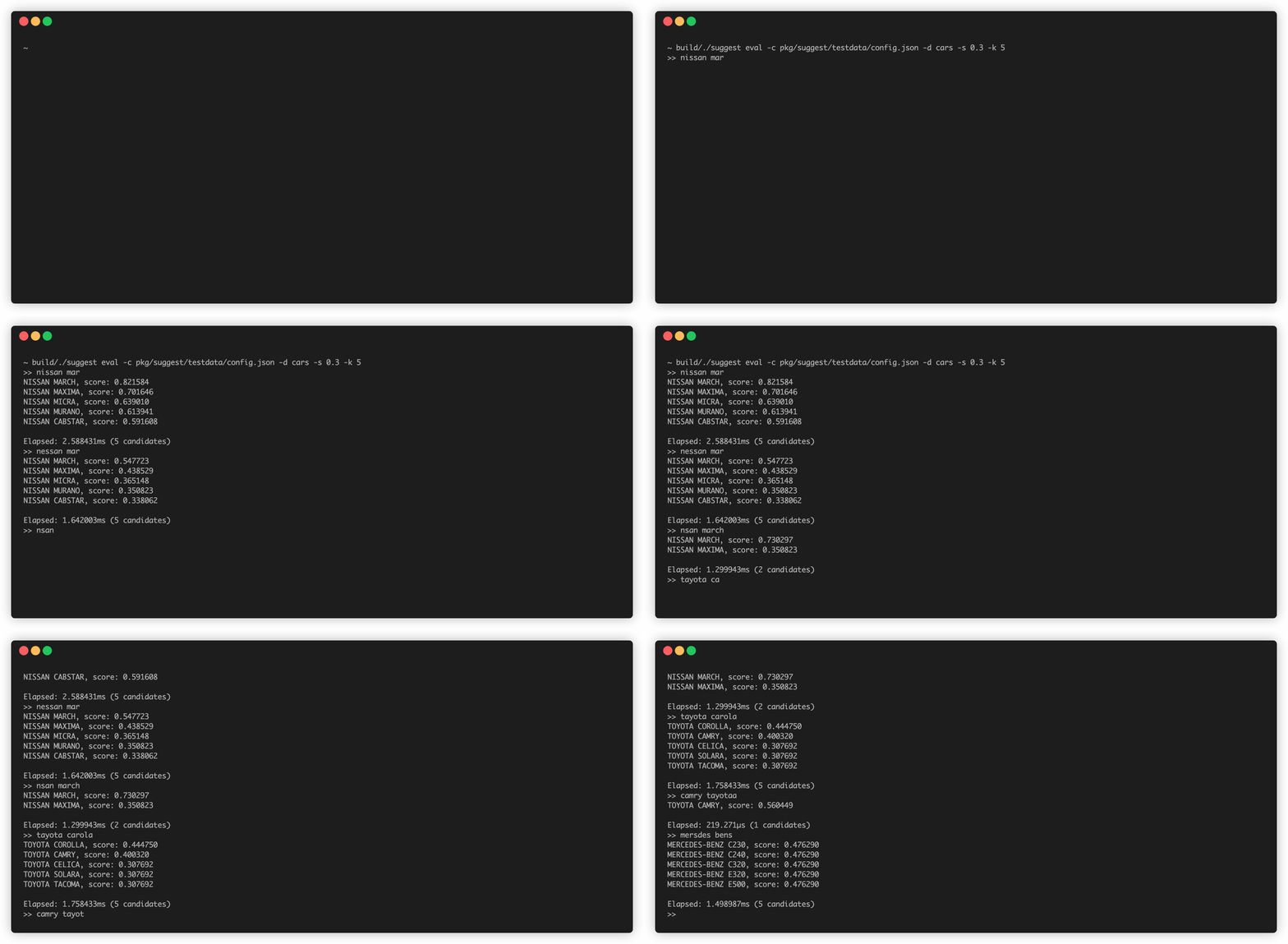
Fuzzy string search in a dictionary
The demo shows an approximate string search in a vehicle dictionary with more than 2k model names.
You can also run it locally
$ make build
$ ./build/suggest eval -c pkg/suggest/testdata/config.json -d cars -s 0.5 -k 5
or by using Docker
$ make build-docker
$ docker run -p 8080:8080 -v $(pwd)/pkg/suggest/testdata:/data/testdata suggest /data/build/suggest service-run -c /data/testdata/config.json
Spellchecker
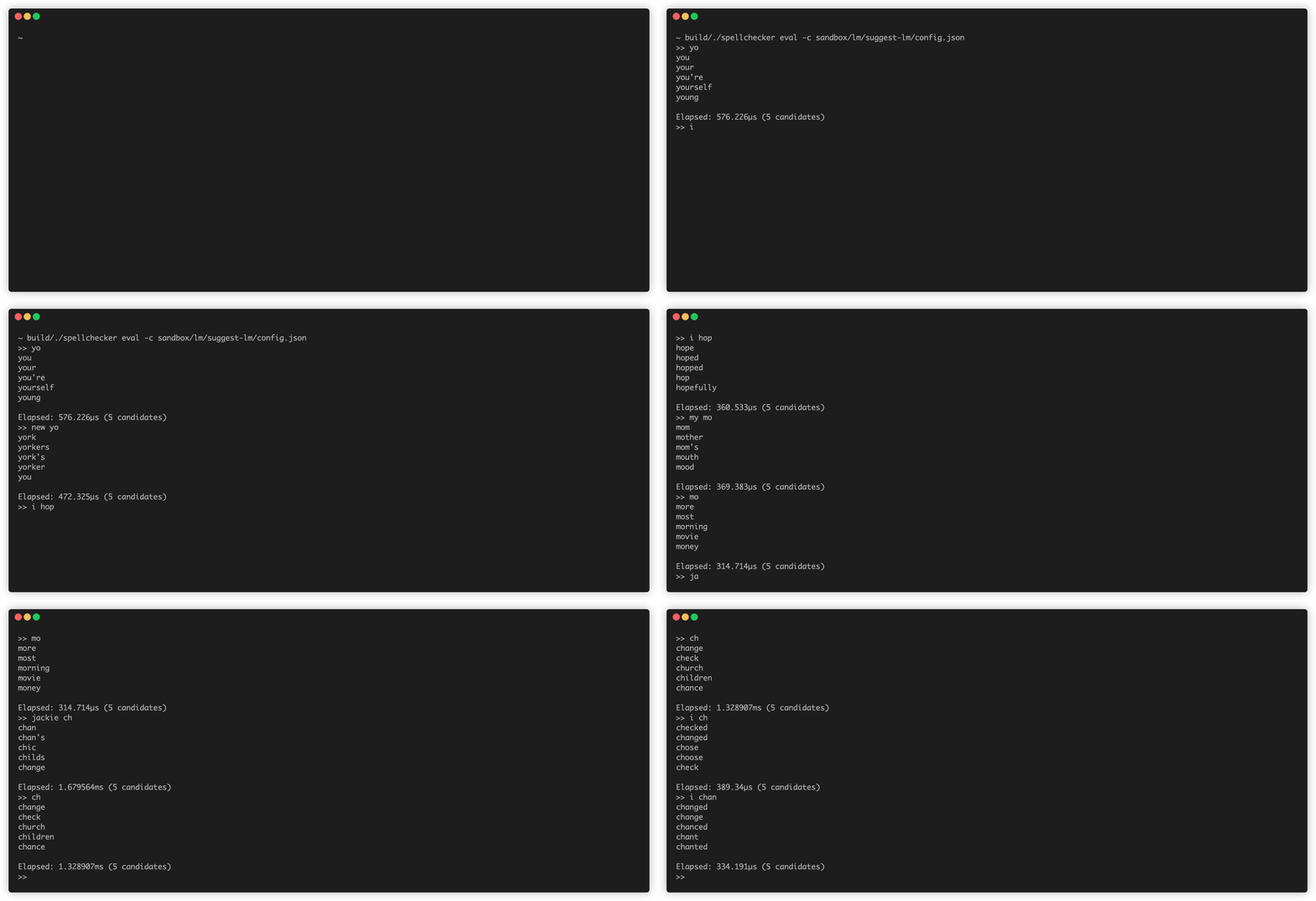
Spellchecker recognizes a misspelled word based on the context of the surrounding words.
In order to run a spellchecker demo, please do the next
- Download an English language model built on Blog Authorship Corpus
- Extract downloaded language model and perform
$ make build
$ ./build/./spellchecker eval -c lm-folder/config.json
Contributions
When contributing to this repository, please first discuss the change you wish to make via issue, email, or any other method with the owners of this repository before making a change.
Contributors
Showing top 2 contributors by commit count.


Related Repositories

zsh-users/zsh-autosuggestions
Fish-like autosuggestions for zsh

withfig/autocomplete
IDE-style autocomplete for your existing terminal & shell

dense-analysis/ale
Check syntax in Vim/Neovim asynchronously and fix files, with Language Server Protocol (LSP) support

downshift-js/downshift
🏎 A set of primitives to build simple, flexible, WAI-ARIA compliant React autocomplete, combobox or select dropdown components.

microsoft/inshellisense
IDE style command line auto complete

httpie/http-prompt
An interactive command-line HTTP and API testing client built on top of HTTPie featuring autocomplete, syntax highlighting, and more. https://twitter.com/httpie