

Jwave
A JAX-based research framework for differentiable and parallelizable acoustic simulations, on CPU, GPUs and TPUs
[Install](#install) | [Tutorials](https://ucl-bug.github.io/jwave/notebooks/ivp/homogeneous_medium.html) | [Documentation](https://ucl-bug.github.io/jwave) | [Changelog](HISTORY.md) The project is written primarily in Python, distributed under the GNU Lesser General Public License v3.0 license, first published in 2021. Key topics include: acoustics, differentiable-simulations, gpu, gpu-acceleration, jax.
j-Wave: Differentiable acoustic simulations in JAX





Install | Tutorials | Documentation | Changelog
j-Wave is a library of simulators for acoustic applications. It is heavily inspired by k-Wave—a substantial portion of j-Wave is a port of k-Wave in JAX—and it's intended to be used as a collection of modular blocks that can be easily incorporated into any machine learning pipeline.
Embracing the philosophy of JAX, j-Wave is developed with the following principles in mind:
- To be differentiable
- To be efficient through
jitcompilation - To be easily run on GPUs
- To be easily customizable
Install
Follow the instructions to install Jax with CUDA support if you wish to use your GPU.
Next, simply install jwave using pip:
bashpip install jwave
For more information, refer to the Linux installation guide.
Due to JAX's limited support on Windows, j-Wave can only be run on Windows machines using the Windows Subsystem for Linux. Please refer to the Installation on Windows guide for more details.
<br/>Example
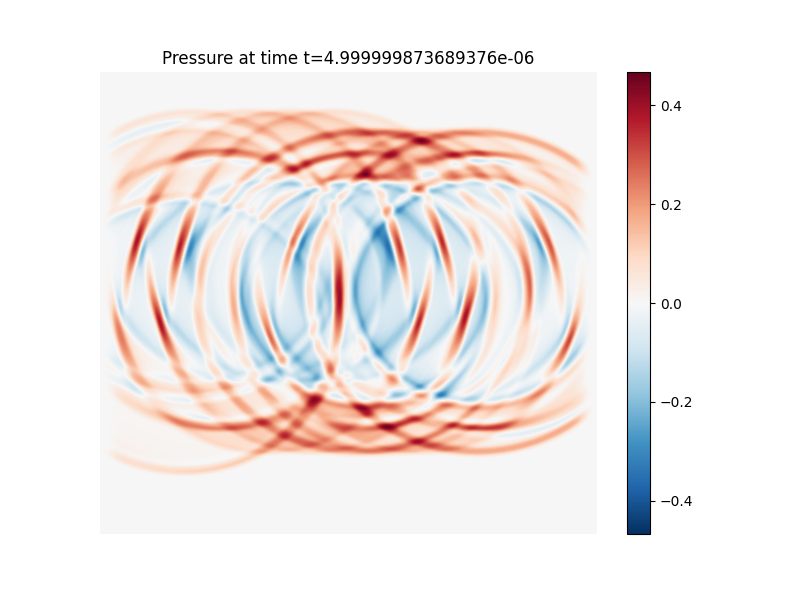
This example simulates an acoustic initial value problem, which is often used as a simple model for photoacoustic acquisitions:
pythonfrom jax import jit from jwave import FourierSeries from jwave.acoustics.time_varying import simulate_wave_propagation from jwave.geometry import Domain, Medium, TimeAxis from jwave.utils import load_image_to_numpy # Simulation parameters N, dx = (256, 256), (0.1e-3, 0.1e-3) domain = Domain(N, dx) medium = Medium(domain=domain, sound_speed=1500.) time_axis = TimeAxis.from_medium(medium, cfl=0.3, t_end=.8e-05) # Initial pressure field p0 = load_image_to_numpy("docs/assets/images/jwave.png", image_size=N)/255. p0 = FourierSeries(p0, domain) # Compile and run the simulation @jit def solver(medium, p0): return simulate_wave_propagation(medium, time_axis, p0=p0) pressure = solver(medium, p0)
Support
If you encounter any problems with the code or wish to propose new features, please feel free to open an issue. If you need general guidance, wish to discuss something, or just want to say hi, don't hesitate to leave a message in our Discord channel.
<br/>Contributing
Contributions are absolutely welcome! Most contributions start with an issue. Please don't hesitate to create issues in which you ask for features, give feedback on performances, or simply want to reach out.
To make a pull request, please look at the detailed Contributing guide for how to do it, but fundamentally keep in mind the following main guidelines:
- If you add a new feature or fix a bug:
- Make sure it is covered by tests
- Add a line in the changelog using
kacl-cli
- If you changed something in the documentation, make sure that the documentation site can be correctly build using
mkdocs serve
Citation

If you use jwave for your research, please consider citing it as:
<br/>bibtex@article{stanziola2022jwave, author={Stanziola, Antonio and Arridge, Simon R. and Cox, Ben T. and Treeby, Bradley E.}, title = {j-Wave: An open-source differentiable wave simulator}, publisher = {arXiv}, year = {2022}, }
Related Projects
ADSeismic.jl: a finite difference acoustic simulator with support for AD and JIT compilation in Julia.stride: a general optimisation framework for medical ultrasound tomography.k-wave-python: A python interface to k-wave GPU accelerated binaries
Contributors
Showing top 4 contributors by commit count.

![dependabot[bot]](https://avatars.githubusercontent.com/in/29110?v=4)


Related Repositories

praat/praat.github.io
Praat: Doing Phonetics By Computer

LCAV/pyroomacoustics
Pyroomacoustics is a package for audio signal processing for indoor applications. It was developed as a fast prototyping platform for beamforming algorithms in indoor scenarios.

ElmerCSC/elmerfem
Official git repository of Elmer FEM software

acoular/acoular
Acoustic testing and source mapping software

DavidDiazGuerra/gpuRIR
Python library for Room Impulse Response (RIR) simulation with GPU acceleration

Graphi07/room-impulse-responses
A list of publicly available room impulse response datasets and scripts to download them.