

Gifify
😻 Convert any video file to an optimized animated GIF.
I am no more using this project or providing any support to it, if you want to maintain it, ping me here: vincent.voyer@gmail.com. The project is written primarily in JavaScript, distributed under the ISC License license, first published in 2014. It has gained significant community traction with 6,322 stars and 312 forks on GitHub. Key topics include: ffmpeg, gif, gifify, gifsicle, imagemagick.
NOTE FROM AUTHOR
I am no more using this project or providing any support to it, if you want to maintain it, ping me here: vincent.voyer@gmail.com.
This project was created 4 years ago, there might be better ways to turn a video into a GIF now, use google!
/NOTE FROM AUTHOR
gifify
Convert any video file to an optimized animated GIF. Either in its full length or only a part of it.
Demo time
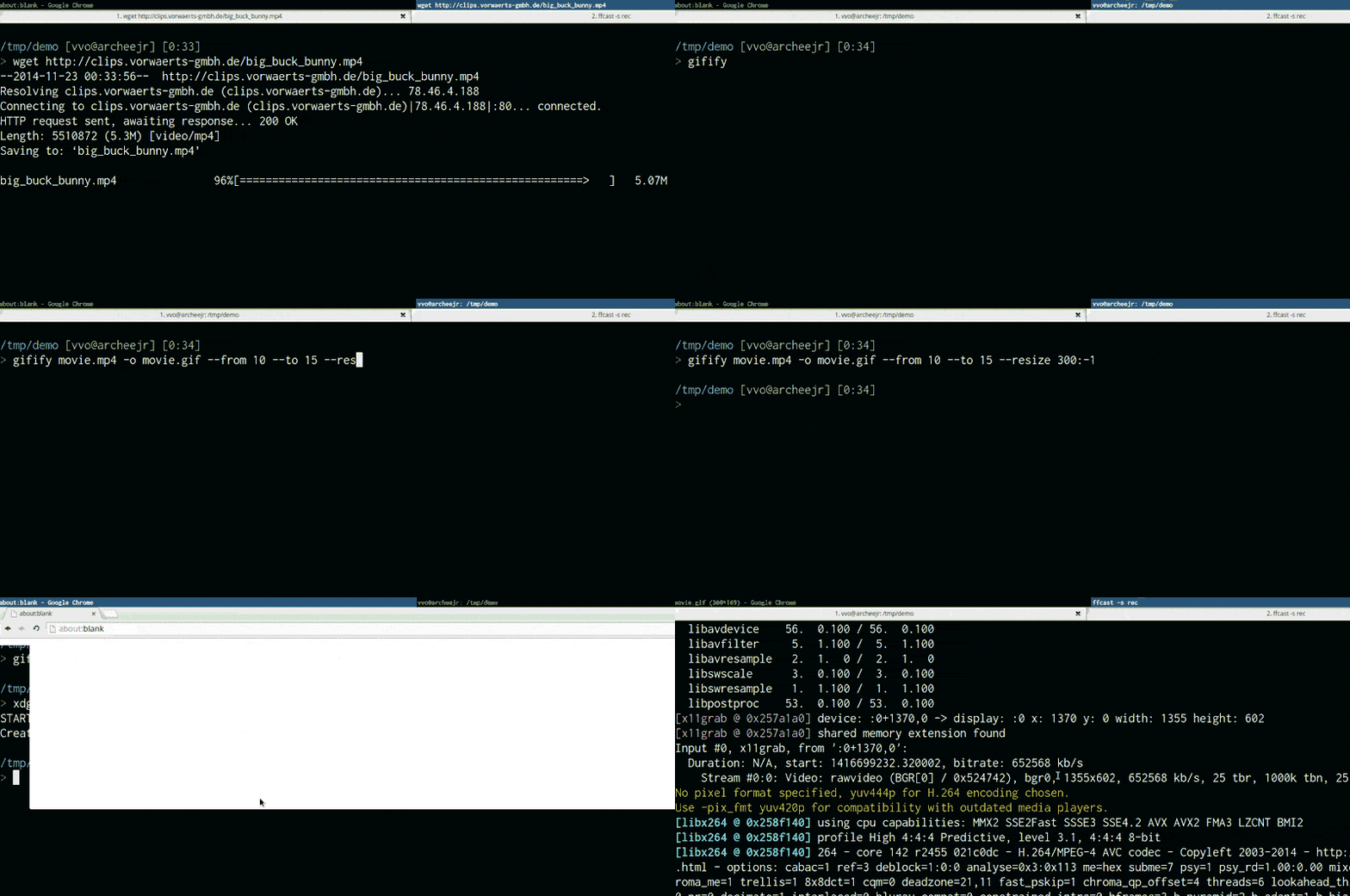
This screencast was recorded with lolilolicon/FFcast then converted to a GIF with:
shellgifify screencast.mkv -o screencast.gif --resize 800:-1
Features
- command line interface
- programmatic JavaScript (Node.JS) stream interface
- unix friendly, supports
stdin&stdout - optimized! uses pornel/giflossy to generate light GIFS
- lots of options: movie speed, fps, colors, compression, resize, reverse, from & to, subtitles
- no temp files used, everything happens in memory
- fast! Extracting a 5-second GIF from the middle of a 2-hour movie takes less than 20 seconds
Requirements
Before using gifify, please install:
- Node.js (
$ brew install node) - FFmpeg 🐓🐓🐓🐓 (
$ brew install ffmpeg) - convert, the famous ImageMagick (
$ brew install imagemagick) - pornel/giflossy, it's a gifsicle fork (waiting for gifsicle#16 to be merged) (
$ brew install giflossy)
You can also use the gifify Docker image which comes with everything installed.
Installation
shellnpm install -g gifify
Command line usage
shell> gifify -h Usage: gifify [options] [file] Options: -h, --help output usage information -V, --version output the version number --colors <n> Number of colors, up to 255, defaults to 80 --compress <n> Compression (quality) level, from 0 (no compression) to 100, defaults to 40 --from <position> Start position, hh:mm:ss or seconds, defaults to 0 --fps <n> Frames Per Second, defaults to 10 -o, --output <file> Output file, defaults to stdout --resize <W:H> Resize output, use -1 when specifying only width or height. `350:100`, `400:-1`, `-1:200` --reverse Reverses movie --speed <n> Movie speed, defaults to 1 --subtitles <filepath> Subtitle filepath to burn to the GIF --text <string> Add some text at the bottom of the movie --to <position> End position, hh:mm:ss or seconds, defaults to end of movie --no-loop Will show every frame once without looping
Programmatic usage
See the example.
jsvar fs = require('fs'); var gifify = require('gifify'); var path = require('path'); var input = path.join(__dirname, 'movie.mp4'); var output = path.join(__dirname, 'movie.gif'); var gif = fs.createWriteStream(output); var options = { resize: '200:-1', from: 30, to: 35 }; gifify(input, options).pipe(gif);
You can also pass a readable stream to gifify(stream, opts).
Readable stream input performance
Gifify supports streams both on command line (cat movie.mp4 | gifify -o out.gif) and in the programmatic API (gifify(readableStream, opts).pipe(writableStream)).
While it's super useful in some cases, if you have the file on disk already, you better do gifify movie.mp4 -o out.gif or gifify(filePath, opts).pipe(writableStream).
Why? Because piping 3.4GB when you want to cut from 40:20 to 40:22 still takes a loooooot of time and does not give you any performance benefit.
FFmpeg has to read from 0GB -> $START_BYTE_40:20 and discards it. But everything flows in your memory.
When using direct file input from command line, we pass the -i filename option to FFmpeg and then it's super fast!
Be careful when |piping.
Adding some text
You can burn some simple text into your GIF:
shellgifify back.mp4 -o back.gif --from 01:48:23.200 --to 01:48:25.300 --text "What?..What?What?"
Result:

Subtitles
You can burn subtitles into your GIF, it's that easy:
shellgifify 22.mkv -o movie.gif --subtitles 22.ass --from 1995 --to 2002 --resize 600:-1
You must create new subtitles files, the timecodes for the complete film will not work for a five seconds GIF.
Create subtitles using aegisub and augment the font size for a great effect!
Here's the 22.ass from the previous command, created with aegisub:
ass[Script Info] ; Script generated by Aegisub 3.2.1 ; http://www.aegisub.org/ Title: Default Aegisub file ScriptType: v4.00+ WrapStyle: 0 ScaledBorderAndShadow: yes YCbCr Matrix: None [Aegisub Project Garbage] [V4+ Styles] Format: Name, Fontname, Fontsize, PrimaryColour, SecondaryColour, OutlineColour, BackColour, Bold, Italic, Underline, StrikeOut, ScaleX, ScaleY, Spacing, Angle, BorderStyle, Outline, Shadow, Alignment, MarginL, MarginR, MarginV, Encoding Style: Default,Arial,20,&H00FFFFFF,&H000000FF,&H00000000,&H00000000,0,0,0,0,100,100,0,0,1,2,2,2,10,10,10,1 [Events] Format: Layer, Start, End, Style, Name, MarginL, MarginR, MarginV, Effect, Text Dialogue: 0,0:00:02.50,0:00:03.97,Default,,0,0,0,,{\fnLiberation Sans\fs40}Okay, okay. Dialogue: 0,0:00:05.00,0:00:06.90,Default,,0,0,0,,{\fnLiberation Sans\fs40}Okay. Okay.
Result extracting a GIF from 22 Jump Street:

GIF Performance
On modern hardware GIF is the slowest and most expensive video codec. Can we please allow it to be obsoleted?
https://pornel.net/efficient-gifs#sec44
YOLO!
Giflossy
Giflossy is a fork of gifsicle, gifsicle author is currently working on integrating the lossy part in gifsicle.
So in little time we will be able to directly use gifsicle and gifiscle packages.
Thanks
jclem/gifify was a great source of inspiration.
Contributors
Showing top 12 contributors by commit count.




Related Repositories

Genymobile/scrcpy
Display and control your Android device

obsproject/obs-studio
OBS Studio - Free and open source software for live streaming and screen recording

FFmpeg/FFmpeg
Mirror of https://git.ffmpeg.org/ffmpeg.git

mifi/lossless-cut
The swiss army knife of lossless video/audio editing

mpv-player/mpv
🎥 Command line media player

bilibili/ijkplayer
Android/iOS video player based on FFmpeg n3.4, with MediaCodec, VideoToolbox support.