

Go zero
A cloud-native Go microservices framework with cli tool for productivity.
go-zero is a web and rpc framework with lots of builtin engineering practices. It’s born to ensure the stability of the busy services with resilience design and has been serving sites with tens of millions of users for years. The project is written primarily in Go, distributed under the MIT License license, first published in 2020. It has gained significant community traction with 33,105 stars and 4,307 forks on GitHub. Key topics include: ai-native, ai-native-development, cloud-native, code-generation, framework.
go-zero
<p align="center"> <img align="center" width="150px" src="https://raw.githubusercontent.com/zeromicro/zero-doc/main/doc/images/go-zero.png"> </p>go-zero is a web and rpc framework with lots of builtin engineering practices. It’s born to ensure the stability of the busy services with resilience design and has been serving sites with tens of millions of users for years.
<div align=center>





🤷 What is go-zero?
English | 简体中文
<a href="https://trendshift.io/repositories/3263" target="_blank"><img src="https://trendshift.io/api/badge/repositories/3263" alt="zeromicro%2Fgo-zero | Trendshift" style="width: 250px; height: 55px;" width="250" height="55"/></a>
<a href="https://www.producthunt.com/posts/go-zero?utm_source=badge-featured&utm_medium=badge&utm_souce=badge-go-zero" target="_blank"><img src="https://api.producthunt.com/widgets/embed-image/v1/featured.svg?post_id=334030&theme=light" alt="go-zero - A web & rpc framework written in Go. | Product Hunt" style="width: 250px; height: 54px;" width="250" height="54" /></a>
go-zero (listed in CNCF Landscape: https://landscape.cncf.io/?selected=go-zero) is a web and rpc framework with lots of builtin engineering practices. It’s born to ensure the stability of the busy services with resilience design and has been serving sites with tens of millions of users for years.
go-zero contains simple API description syntax and code generation tool called goctl. You can generate Go, iOS, Android, Kotlin, Dart, TypeScript, JavaScript from .api files with goctl.
Advantages of go-zero:
- Improves the stability of the services with tens of millions of daily active users
- Builtin chained timeout control, concurrency control, rate limit, adaptive circuit breaker, adaptive load shedding, even no configuration needed
- Builtin middlewares also can be integrated into your frameworks
- Simple API syntax, one command to generate a couple of different languages
- Auto validate the request parameters from clients
- Plenty of builtin microservice management and concurrent toolkits
Backgrounds of go-zero
In early 2018, we transitioned from a Java+MongoDB monolithic architecture to microservices, choosing:
- Golang - High performance, simple syntax, excellent deployment experience, and low resource consumption
- Self-designed microservice framework - Better problem isolation, easier feature extension, and faster issue resolution
Design considerations on go-zero
go-zero follows these core design principles:
- Simplicity - Keep it simple, first principle
- High availability - Stable under high concurrency
- Resilience - Failure-oriented programming with adaptive protection
- Developer friendly - Encapsulate complexity, one way to do one thing
- Easy to extend - Flexible architecture for growth
The implementation and features of go-zero
go-zero integrates engineering best practices:
- Code generation - Powerful tools to minimize boilerplate
- Simple API - Clean interfaces, fully compatible with net/http
- High performance - Optimized for speed and efficiency
- Resilience - Built-in circuit breaker, rate limiting, load shedding, timeout control
- Service mesh - Service discovery, load balancing, call tracing
- Developer tools - Auto parameter validation, cache management, metrics and monitoring
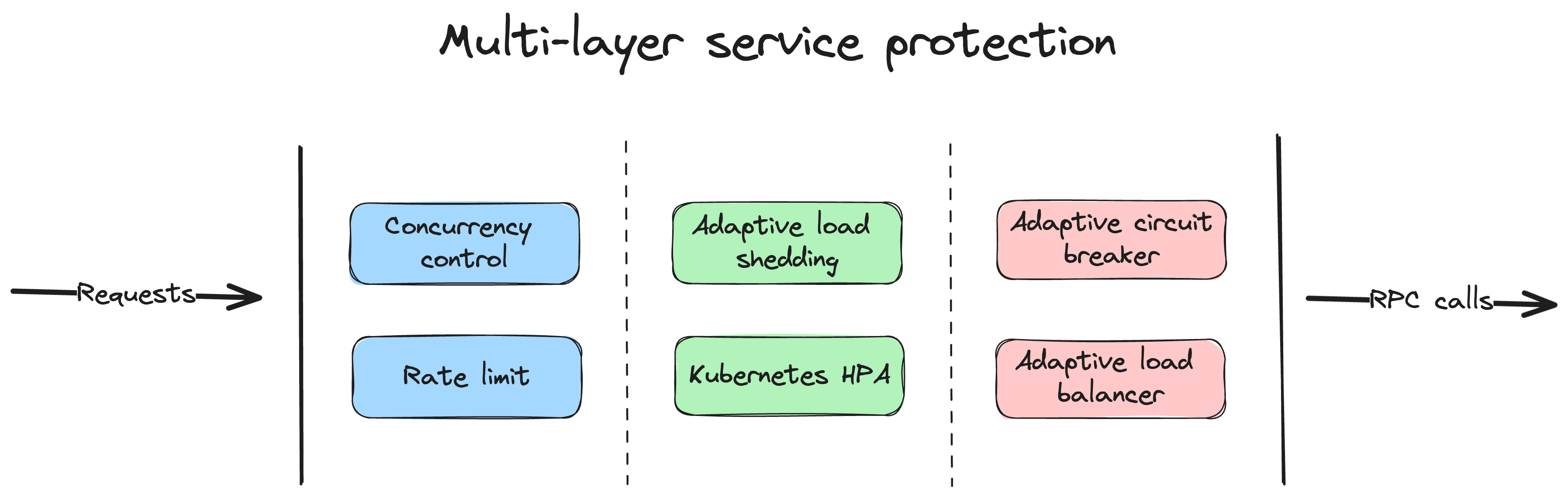
Architecture with go-zero
<img width="1067" alt="image" src="https://user-images.githubusercontent.com/1918356/171880372-5010d846-e8b1-4942-8fe2-e2bbb584f762.png">Installation
Run the following command under your project:
shellgo get -u github.com/zeromicro/go-zero
AI-Native Development
The go-zero team provides AI tooling for Claude, GitHub Copilot, Cursor to generate framework-compliant code.
Three Core Projects
ai-context - Workflow guide for AI assistants
zero-skills - Pattern library with examples
mcp-zero - Code generation tools via Model Context Protocol
Quick Setup
GitHub Copilot
bashgit submodule add https://github.com/zeromicro/ai-context.git .github/ai-context ln -s ai-context/00-instructions.md .github/copilot-instructions.md # macOS/Linux # Windows: mklink .github\copilot-instructions.md .github\ai-context\00-instructions.md git submodule update --remote .github/ai-context # Update
Cursor
bashgit submodule add https://github.com/zeromicro/ai-context.git .cursorrules git submodule update --remote .cursorrules # Update
Windsurf
bashgit submodule add https://github.com/zeromicro/ai-context.git .windsurfrules git submodule update --remote .windsurfrules # Update
Claude Desktop
bashgit clone https://github.com/zeromicro/mcp-zero.git && cd mcp-zero && go build # Configure: ~/Library/Application Support/Claude/claude_desktop_config.json # Or: claude mcp add --transport stdio mcp-zero --env GOCTL_PATH=/path/to/goctl -- /path/to/mcp-zero
How It Works
AI assistants use these tools together:
- ai-context - workflow guidance
- zero-skills - implementation patterns
- mcp-zero - real-time code generation
Example: Creating a REST API → AI reads ai-context for workflow → calls mcp-zero to generate code → references zero-skills for patterns → produces production-ready code ✅
Quick Start
-
Full examples:
-
Install goctl
shell# for Go go install github.com/zeromicro/go-zero/tools/goctl@latest # For Mac brew install goctl # docker for all platforms docker pull kevinwan/goctl # run goctl docker run --rm -it -v `pwd`:/app kevinwan/goctl --helpEnsure goctl is executable and in your $PATH.
-
Create the API file (greet.api):
gotype ( Request { Name string `path:"name,options=[you,me]"` // parameters are auto validated } Response { Message string `json:"message"` } ) service greet-api { @handler GreetHandler get /greet/from/:name(Request) returns (Response) }Generate .api template:
shellgoctl api -o greet.api -
Generate Go server code
shellgoctl api go -api greet.api -dir greetGenerated structure:
Plain├── greet │ ├── etc │ │ └── greet-api.yaml // configuration file │ ├── greet.go // main file │ └── internal │ ├── config │ │ └── config.go // configuration definition │ ├── handler │ │ ├── greethandler.go // get/put/post/delete routes are defined here │ │ └── routes.go // routes list │ ├── logic │ │ └── greetlogic.go // request logic can be written here │ ├── svc │ │ └── servicecontext.go // service context, mysql/redis can be passed in here │ └── types │ └── types.go // request/response defined here └── greet.api // api description fileRun the service:
shellcd greet go mod tidy go run greet.go -f etc/greet-api.yamlDefault port: 8888 (configurable in etc/greet-api.yaml)
Test with curl:
shellcurl -i http://localhost:8888/greet/from/youResponse:
httpHTTP/1.1 200 OK Date: Sun, 30 Aug 2020 15:32:35 GMT Content-Length: 0 -
Write business logic
- Pass dependencies (mysql, redis, etc.) via servicecontext.go
- Add logic code in the logic package per .api definition
-
Generate client code for multiple languages
shellgoctl api java -api greet.api -dir greet goctl api dart -api greet.api -dir greet ...
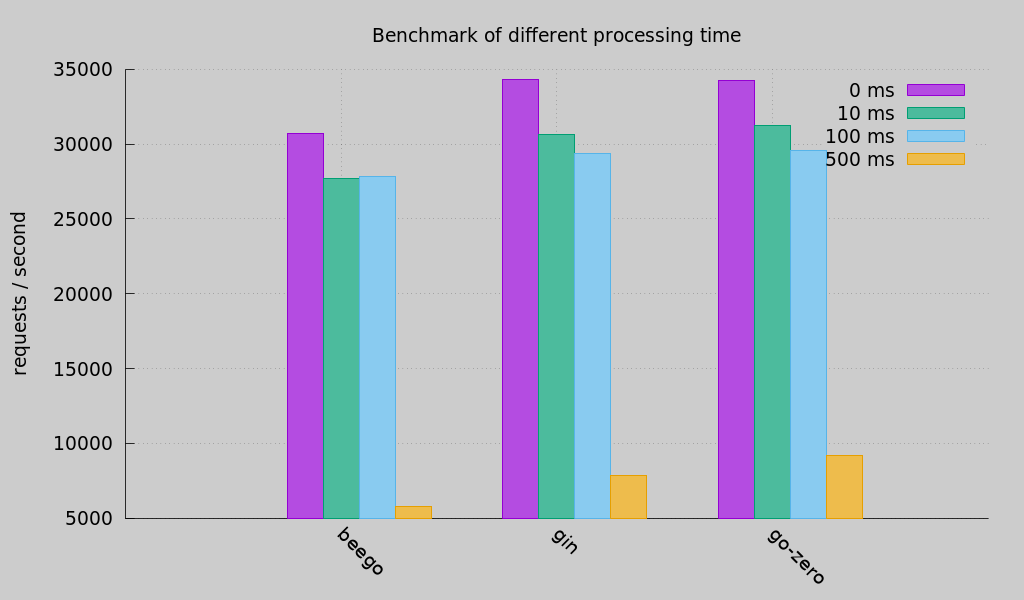
Benchmark
Documents
- Documents
- Rapid development of microservice systems
- Rapid development of microservice systems - multiple RPCs
- Examples
Chat group
Join the chat via https://discord.gg/4JQvC5A4Fe
Cloud Native Landscape
<p float="left"> <img src="https://raw.githubusercontent.com/zeromicro/zero-doc/main/doc/images/cncf-logo.svg" width="200"/> <img src="https://raw.githubusercontent.com/zeromicro/zero-doc/main/doc/images/cncf-landscape-logo.svg" width="150"/> </p>go-zero enlisted in the CNCF Cloud Native Landscape.
Give a Star! ⭐
If you like this project or are using it to learn or start your own solution, give it a star to get updates on new releases. Your support matters!
Contributors
Showing top 12 contributors by commit count.

![dependabot[bot]](https://avatars.githubusercontent.com/in/29110?v=4)


Related Repositories

rustfs/rustfs
🚀2.3x faster than MinIO for 4KB object payloads. RustFS is an open-source, S3-compatible high-performance object storage system supporting migration and coexistence with other S3-compatible platforms such as MinIO and Ceph.

goplus/xgo
XGo is a programming language that reads like plain English. But it's also incredibly powerful — it lets you leverage assets from C/C++, Go, Python, and JavaScript/TypeScript, creating a unified software engineering ecosystem. Our vision is to enable everyone to become a builder of the world.

higress-group/higress
🤖 AI Gateway | AI Native API Gateway

YaoApp/yao
✨ Build AI agents and web apps — with a single binary.

yournextstore/yournextstore
AI-Native Open-Source Next.js commerce. Powered by Stripe. Ultra fast with typesafe Commerce SDK. Built for AI development (Claude, Codex, Cursor).

TaskingAI/TaskingAI
The open source platform for AI-native application development.