

BioBombe
BioBombe: Sequentially compressed gene expression features enhances biological signatures
The repository stores data and data processing modules to sequentially compress gene expression data. The project is written primarily in Jupyter Notebook, distributed under the BSD 3-Clause "New" or "Revised" License license, first published in 2018. Key topics include: autoencoder, biobombe, compression, gene-expression, gene-sets.

Sequential Compression of Gene Expression Data Across Latent Space Dimensions
Gregory Way and Casey Greene 2018
University of Pennsylvania

The repository stores data and data processing modules to sequentially compress gene expression data.
Named after the mechanical device developed by Alan Turing and other cryptologists in World War II to decipher secret messages sent by Enigma machines, BioBombe represents an approach used to decipher hidden messages embedded in gene expression data.
We use the BioBombe approach to study different biological representations learned across compression algorithms and various latent dimensionalities.
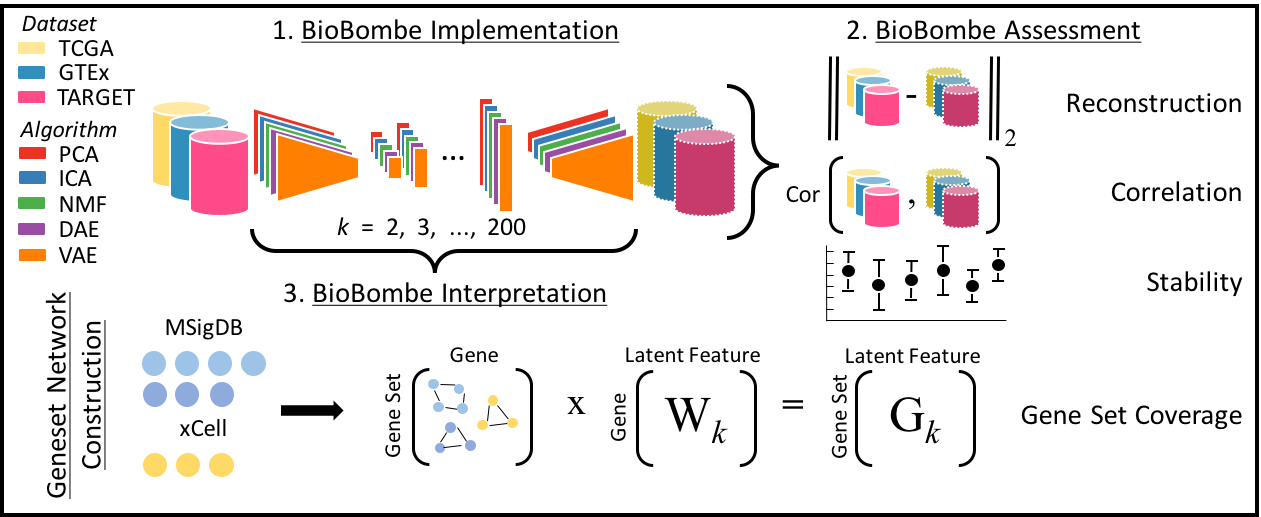
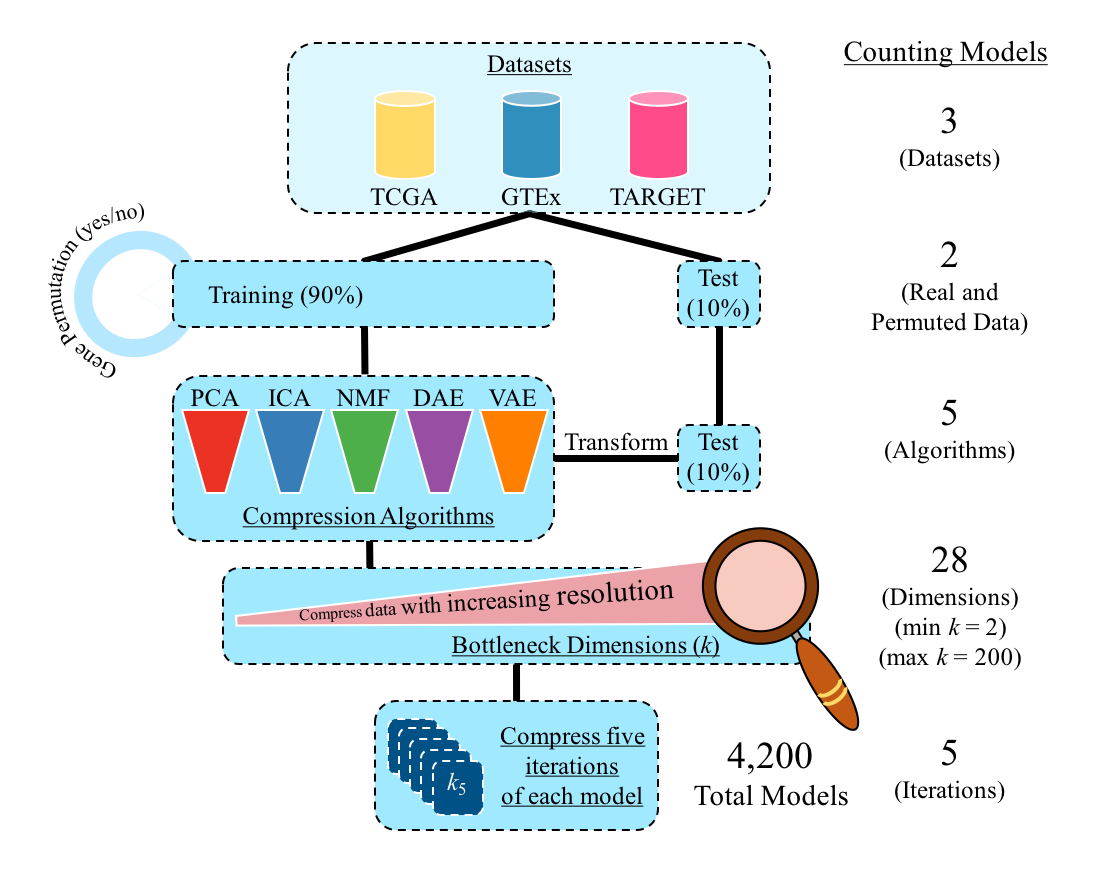
In this repository, we compress three different gene expression data sets (TCGA, GTEx, and TARGET) across 28 different latent dimensions (k) using five different algorithms (PCA, ICA, NMF, DAE, and VAE).
We evaluate each algorithm and dimension using a variety of metrics.
Our goal is to construct reproducible gene expression signatures with unsupervised learning.
Links to access data and archived results can be found here: https://greenelab.github.io/BioBombe/
Citation
Compressing gene expression data using multiple latent space dimensionalities learns complementary biological representations
Way, G.P., Zietz, M., Rubinetti, V., Himmelstein, D.S., Greene, C.S.
Genome Biology (2020) doi:10.1186/s13059-020-02021-3
Approach
Our approach is outlined below:
BioBombe Training Implementation
Our model implementation is described below.
Analysis Modules
To reproduce the results and figures of the analysis, the modules should be run in order.
| Name | Description |
|---|---|
| 0.expression-download | Download and process gene expression data to run through pipeline |
| 1.initial-k-sweep | Determine a set of optimal hyperparameters for Tybalt and ADAGE models across a representative range of k dimensions |
| 2.sequential-compression | Train various algorithms to compress gene expression data across a large range of k dimensions |
| 3.build-hetnets | Download, process, and integrate various curated gene sets into a single heterogeneous network |
| 4.analyze-components | Visualize the reconstruction and sample correlation results of the sequential compression analysis |
| 5.analyze-stability | Determine how stable compression solutions are between and across algorithms, and across dimensions |
| 6.biobombe-projection | Apply BioBombe matrix interpretation analysis and overrepresentation analyses to assign biological knowledge to compression features |
| 7.analyze-coverage | Determine the coverage, or proportion, of enriched gene sets in compressed latent space features for all models and ensembles of models |
| 8.gtex-interpret | Interpret compressed features in the GTEX data |
| 9.tcga-classify | Input compressed features from TCGA data into supervised machine learning classifiers to detect pathway aberration |
| 10.gene-expression-signatures | Identify gene expression signatures for sample sex in GTEx and TCGA data, and MYCN amplification in TARGET data |
Algorithms
See 2.sequential-compression for more details.
Computational Environment
All processing and analysis scripts were performed using the conda environment specified in environment.yml.
To build and activate this environment run:
bash# conda version 4.5.0 conda env create --force --file environment.yml conda activate biobombe
Contributors
Showing top 4 contributors by commit count.


Related Repositories

MorvanZhou/PyTorch-Tutorial
Build your neural network easy and fast, 莫烦Python中文教学

BinRoot/TensorFlow-Book
Accompanying source code for Machine Learning with TensorFlow. Refer to the book for step-by-step explanations.
MorvanZhou/Tensorflow-Tutorial
Tensorflow tutorial from basic to hard, 莫烦Python 中文AI教学

podgorskiy/ALAE
[CVPR2020] Adversarial Latent Autoencoders

NELSONZHAO/zhihu
This repo contains the source code in my personal column (https://zhuanlan.zhihu.com/zhaoyeyu), implemented using Python 3.6. Including Natural Language Processing and Computer Vision projects, such as text generation, machine translation, deep convolution GAN and other actual combat code.

golbin/TensorFlow-Tutorials
텐서플로우를 기초부터 응용까지 단계별로 연습할 수 있는 소스 코드를 제공합니다