

Rolling Bonxai
A rolling voxel grid implementation of Bonxai to handle large maps in ROS 2
**Rolling-Bonxai** is a C++ 17 implementation built on top of Bonxai:https://github.com/facontidavide/Bonxai. Memory remains a bottleneck for resource constrained robots (like drones) that have to map and navigate in very large areas. In these large areas, **the robot will likely not need other parts of the map besides some local area to do path planning/local planning**. Therefore, these storing unnecessary parts of the map in memory is wasteful. **Rolling Bonxai** implements a chunking system ... The project is written primarily in C++, first published in 2025. Key topics include: 3d-mapping, navigation, ros2.
Rolling-Bonxai
Rolling-Bonxai is a C++ 17 implementation built on top of Bonxai:https://github.com/facontidavide/Bonxai. Memory remains a bottleneck for resource constrained robots (like drones) that have to map and navigate in very large areas. In these large areas, the robot will likely not need other parts of the map besides some local area to do path planning/local planning. Therefore, these storing unnecessary parts of the map in memory is wasteful. Rolling Bonxai implements a chunking system (like in games) comprising of NxNxN voxels each. Each chunk is a Bonxai::OccupancyGrid that can be loaded/created or offloaded depending on the robot's position. Unused parts of the maps are serialized and saved to disk and loaded when required depending on a user defined policy. The underlying Bonxai library implements a compact hierarchical data structure that can store and manipulate volumetric data, discretized as Voxel Grids in a manner that is both sparse and unbounded. Star this repo if you found this useful/interesting :)
Rolling-Bonxai In Action
1. Position-based chunk eviction
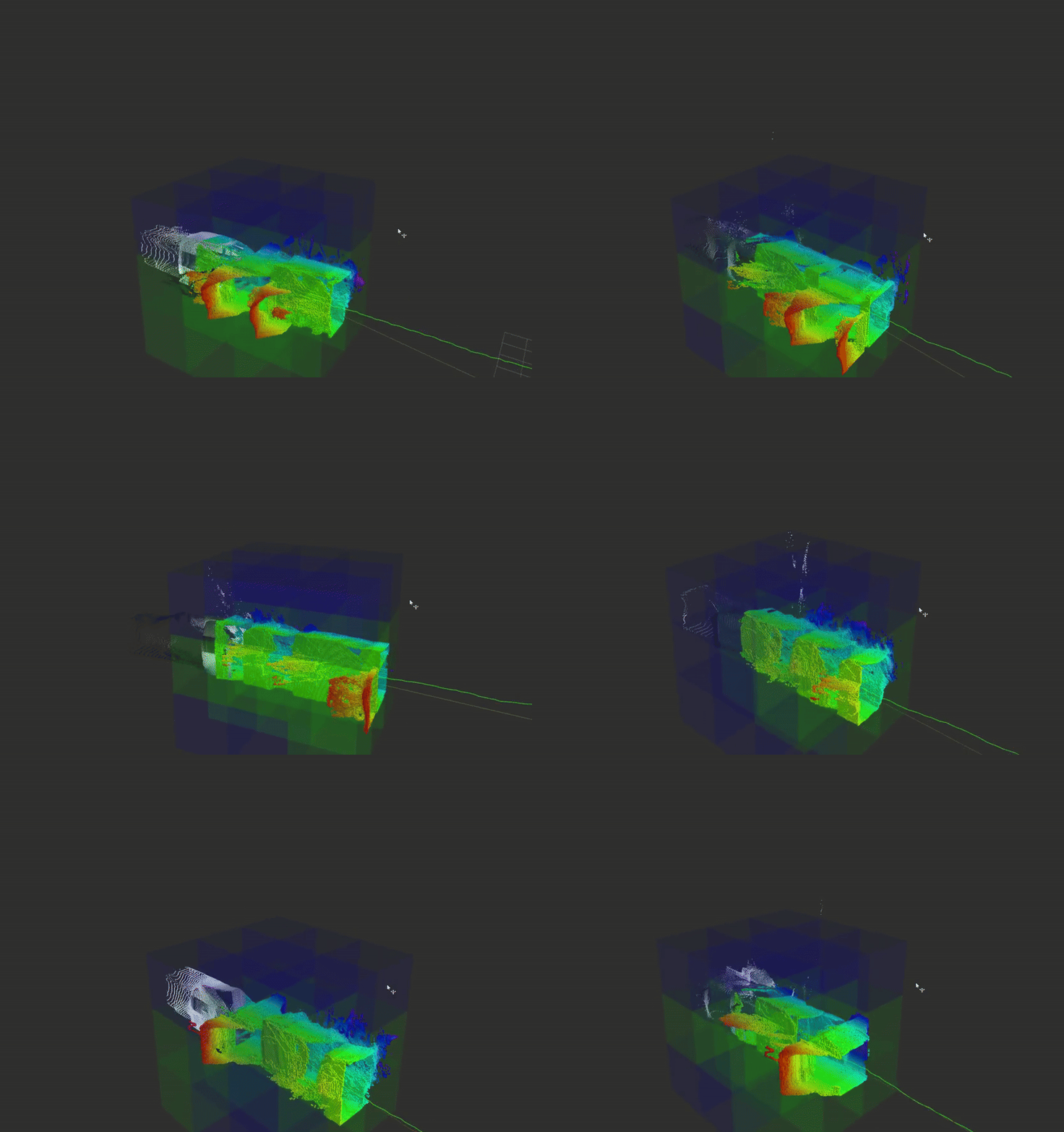
Full Video Here: https://youtu.be/gStI7W-x3mM
Green and Blue semi-transparent cubes are "Dirty" and "Clean" chunks. Dirty chunks are those that have been updated since the last time it was loaded into memory, while clean ones have not. Chunks that contain voxels are dirty. As the sensor moves, chunks are evicted based on some policy. In this case, it is a position based policy, where chunks that are not one of the 26 neibors of the current chunk are evicted from memory.
2. Position-based chunk loading from disc
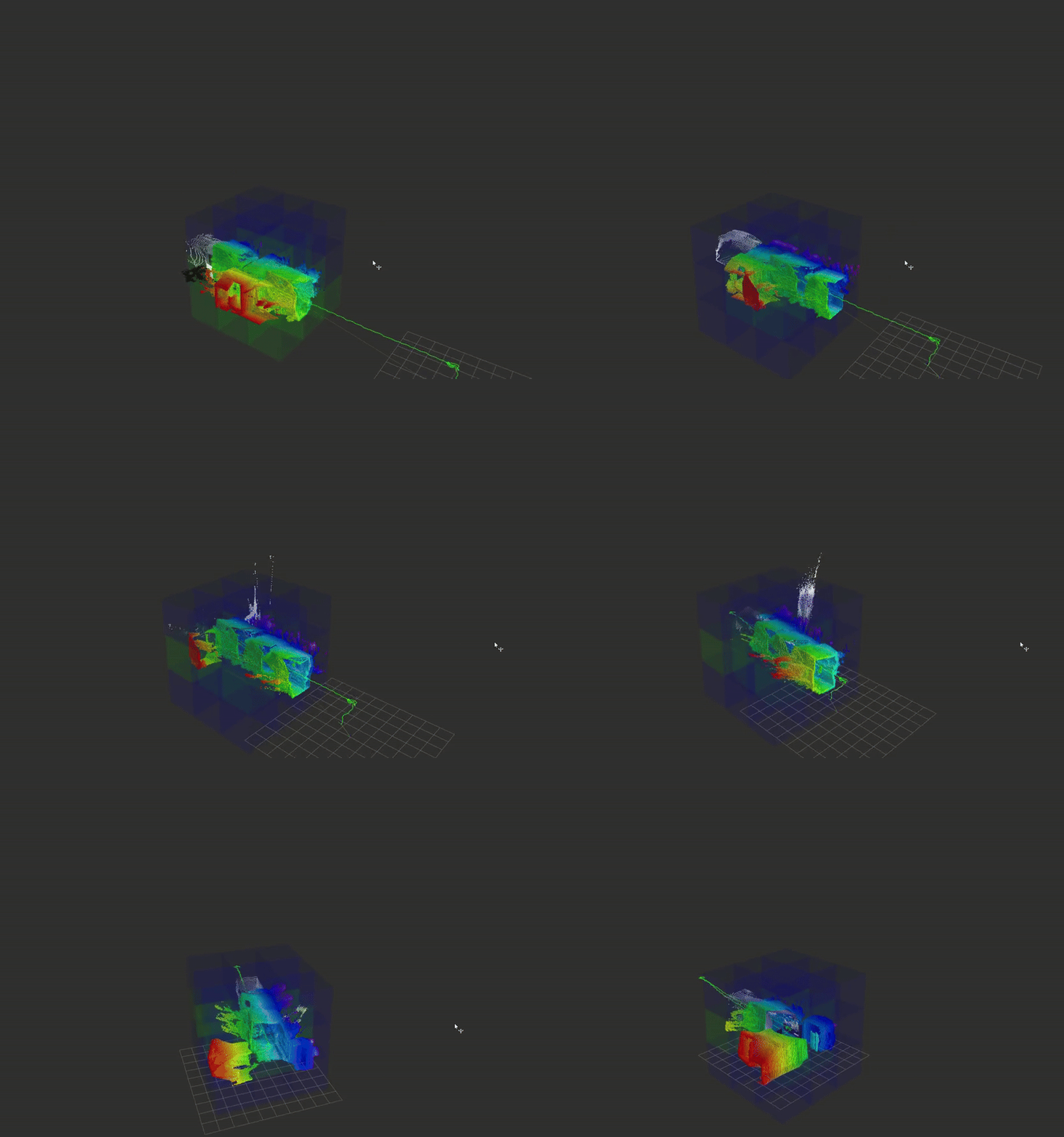
Full Video Here: https://youtu.be/h4DjMLnnrf4
Table of Contents
Prerequisites
Rolling Bonxai requires a point cloud source published as a sensor_msgs/PointCloud2 topic in the ROS 2 graph. This is typically provided by a depth camera (e.g., ZED2i) or a LiDAR sensor. You must configure topic_in to match the topic your sensor is publishing on, and ensure TF transforms are available from your sensor frame to the frame_id (map frame).
Required ROS 2 packages and dependencies:
bonxai_core,bonxai_map,rolling_bonxai,rolling_bonxai_msgsrclcpp,sensor_msgs,tf2_ros,pcl_conversionsyaml-cpp
Build your workspace with:
bashcolcon build --packages-select bonxai_core bonxai_map rolling_bonxai rolling_bonxai_msgs rolling_bonxai_ros source install/setup.bash
Launching Rolling Bonxai
Option 1: As a Composable Node (Recommended for Production)
The composable node option runs RollingBonxaiServer inside an rclcpp_components container, enabling zero-copy intra-process communication when combined with other composable nodes (e.g., the ZED camera wrapper).
bashros2 launch rolling_bonxai_ros rolling_bonxai_mapping.launch.py
You can override the container name and Foxglove visualization port:
bashros2 launch rolling_bonxai_ros rolling_bonxai_mapping.launch.py \ container_name:=my_container \ foxglove_port:=8765
The launch file will:
- Start an
rclcpp_componentscontainer - Load
RollingBonxai::RollingBonxaiServerinto that container - Start a Foxglove Bridge for visualization
Point cloud source: The node subscribes to the topic defined in
topic_in(default:/zed/zed_node/point_cloud/cloud_registered). Make sure your sensor driver is running and publishing to this topic before or alongside this launch file.
Option 2: As a Standalone Executable
For simpler setups or debugging, run the standalone binary directly:
bashros2 run rolling_bonxai_ros rolling_bonxai_server_node \ --ros-args --params-file /path/to/rolling_bonxai_params.yaml
Or pass parameters individually:
bashros2 run rolling_bonxai_ros rolling_bonxai_server_node \ --ros-args \ -p frame_id:=map \ -p topic_in:=/your/pointcloud/topic \ -p occupancy.resolution:=0.05
Option 3: Using a Params File
The recommended way to configure the node is to provide a YAML parameters file (see rolling_bonxai_ros/params/rolling_bonxai_params.yaml as a template):
bashros2 run rolling_bonxai_ros rolling_bonxai_server_node \ --ros-args --params-file rolling_bonxai_params.yaml
Parameter Reference
All parameters are scoped under rolling_bonxai_server_node/ros__parameters/. The YAML hierarchy below mirrors the parameter file structure.
Core Frame & Topic
| Parameter | Type | Default | Unit / Significance |
|---|---|---|---|
frame_id | string | "map" | The global fixed frame. All map data is stored in this frame. |
base_frame_id | string | "base_footprint" | The robot base frame used for TF lookups. |
topic_in | string | "/points" | The sensor_msgs/PointCloud2 topic to subscribe to. Must match your sensor's output topic. |
Occupancy Settings (occupancy.*)
| Parameter | Type | Default | Unit / Significance |
|---|---|---|---|
occupancy.resolution | double | 0.05 | Meters (m). Side length of each cubic voxel. Smaller = finer detail but higher memory usage. Typical range: 0.02–0.2 m. |
occupancy.occupancy_min_z | double | -100.0 | Meters (m). Points below this Z coordinate (in the map frame) are discarded before insertion. Useful to cut out the ground or underground clutter. |
occupancy.occupancy_max_z | double | 100.0 | Meters (m). Points above this Z coordinate are discarded. Useful to remove ceiling returns or high-altitude noise. |
occupancy.occupancy_threshold | double | 0.50 | Unitless probability [0, 1]. A voxel with log-odds corresponding to this probability is considered on the boundary between occupied and free. Voxels above this are occupied; below are free. The default of 0.5 means equal probability. |
Sensor Model (sensor_model.*)
These parameters control the Bayesian occupancy update. All probability values are converted internally to log-odds with a fixed-point scale of 1×10⁶.
| Parameter | Type | Default | Unit / Significance |
|---|---|---|---|
sensor_model.max_range | double | 30.0 | Meters (m). Points beyond this range are clipped to the maximum range and treated as free-space measurements rather than hits. |
sensor_model.hit | double | 0.7 | Unitless probability [0, 1]. Probability that a voxel is occupied given a sensor return. Higher values make the map respond faster to obstacles but may cause noise. |
sensor_model.miss | double | 0.4 | Unitless probability [0, 1]. Probability of occupancy given a ray passes through without a return. Lower values clear free space more aggressively. |
sensor_model.min | double | 0.12 | Unitless probability [0, 1]. Minimum clamping probability. Prevents a voxel from ever being considered more free than this. Stops the map from being over-confident about free space. |
sensor_model.max | double | 0.97 | Unitless probability [0, 1]. Maximum clamping probability. Prevents a voxel from becoming more occupied than this. Allows obstacles to eventually be cleared if the sensor reports free space there. |
Rolling / Coordinate System (rolling.coordinate_system.*)
| Parameter | Type | Default | Unit / Significance |
|---|---|---|---|
rolling.coordinate_system.chunk_size | double | 5.0 | Meters (m). The side length of each cubic chunk. Each chunk wraps one OccupancyMap. Larger chunks reduce I/O frequency but increase per-chunk memory. Typical range: 2–20 m. |
Rolling / Transition Manager (rolling.transition_manager.*)
| Parameter | Type | Default | Unit / Significance |
|---|---|---|---|
rolling.transition_manager.hysteresis_ratio | double | 0.2 | Unitless [0.01, 1.0]. Fraction of chunk_size that the robot must penetrate into a new chunk before a chunk transition is confirmed. For example, with chunk_size=5.0 and hysteresis_ratio=0.2, the robot must travel 1.0 m into the new chunk before any load/evict cycle fires. Higher values reduce I/O thrashing near boundaries at the cost of slightly delayed chunk loading. |
Rolling / Loading Policy (rolling.loading_policy.*)
| Parameter | Type | Default | Unit / Significance |
|---|---|---|---|
rolling.loading_policy.name | string | "neighbourhood" | Unitless string. Selects the chunk management strategy. Options: "neighbourhood", "planar", "temporal". |
Neighbourhood Policy (rolling.loading_policy.neighborhood.*):
| Parameter | Type | Default | Unit / Significance |
|---|---|---|---|
neighborhood.radius | int | 2 | Unitless (chunks). Chebyshev radius — loads all chunks within this many chunk-lengths in every direction. Radius 1 → 26 neighbours; radius 2 → 124 neighbours. Increase for faster robots. |
Planar Policy (rolling.loading_policy.planar.*):
| Parameter | Type | Default | Unit / Significance |
|---|---|---|---|
planar.radius | int | 1 | Unitless (chunks). Horizontal (XY-plane) Chebyshev radius. Same as neighbourhood radius but applied only on the ground plane. |
planar.z_min | int | 0 | Unitless (chunks). Under use_relative=false: minimum absolute Z chunk coordinate to keep loaded. Under use_relative=true: number of chunks below the ego to keep loaded (must be ≥ 0). |
planar.z_max | int | 2 | Unitless (chunks). Under use_relative=false: maximum absolute Z chunk coordinate. Under use_relative=true: number of chunks above the ego to keep loaded (must be ≥ 0). |
planar.use_relative | bool | false | Unitless boolean. If true, z_min and z_max are relative offsets from the robot's current Z chunk rather than absolute chunk coordinates. Recommended for ground robots that operate at varying elevations. |
Temporal Policy (rolling.loading_policy.temporal.*):
| Parameter | Type | Default | Unit / Significance |
|---|---|---|---|
temporal.radius | int | 2 | Unitless (chunks). Chebyshev radius, same as neighbourhood. |
temporal.age_weightage | double | 0.3 | Unitless [0.0, 1.0]. Blend factor between distance-based priority (0.0) and age-based priority (1.0). A value of 0.3 means 70% distance priority + 30% freshness priority when ordering load requests. |
temporal.max_age_s | int | 300 | Seconds (s). Chunks older than this are considered stale and excluded from loading. Useful in dynamic environments. |
Rolling / Storage (rolling.storage.*)
| Parameter | Type | Default | Unit / Significance |
|---|---|---|---|
rolling.storage.full_save_folder_path | string | "" | Unitless path string. Full filesystem path where chunk files (.chunk) and timestamp files (.timestamp) are saved to and loaded from. Must be readable and writable by the process. Example: "/home/robot/bonxai_chunks". |
Rolling / Async I/O (rolling.asyncio.*)
| Parameter | Type | Default | Unit / Significance |
|---|---|---|---|
rolling.asyncio.enable_io | bool | false | Unitless boolean. Master switch for disk I/O. When false, chunks are never saved or loaded from disk — the map is purely in-memory. Set to true for persistent, large-area mapping. |
rolling.asyncio.num_load_threads | int | 3 | Unitless (thread count). Number of dedicated worker threads for loading chunks from disk. Higher values allow more concurrent loads but consume more CPU. |
rolling.asyncio.num_save_threads | int | 1 | Unitless (thread count). Number of dedicated worker threads for saving chunks to disk. Saves are naturally serialised per-chunk (different files), so 1 is usually sufficient. |
Server (server.*)
| Parameter | Type | Default | Unit / Significance |
|---|---|---|---|
server.cleanup_interval_sec | double | 300.0 | Seconds (s). How often the /rolling_bonxai/clean_memory maintenance cycle should be offered. Note: cleanup is actually triggered via the /rolling_bonxai/clean_memory service call; this setting is retained for future automatic scheduling. |
Stats / Visualization (stats.*)
| Parameter | Type | Default | Unit / Significance |
|---|---|---|---|
stats.enable_stats | bool | true | Unitless boolean. Enables statistics publishers and the occupied-voxel point cloud publisher. Disable to reduce CPU overhead in production. |
stats.quick_stats | bool | true | Unitless boolean. If true, only fast O(1) statistics are published (cell counts, memory). If false, full per-cell iteration is run (bounding box, probability distributions) — expensive at high map sizes. |
stats.publish_occupied_voxels | bool | true | Unitless boolean. Publishes a sensor_msgs/PointCloud2 of all currently occupied voxels on /rolling_bonxai/occupied_voxels. Disable if bandwidth is a concern. |
stats.publish_rate | double | 3.0 | Hertz (Hz). Rate at which statistics and the occupied-voxel cloud are published. |
Architecture Overview
Rolling Bonxai is organized into a layered package hierarchy. bonxai_core (external, by Davide Faconti) provides the fundamental sparse voxel grid data structure — refer to the Bonxai repository for its internals. The packages described here build on top of it.
bonxai_map — Probabilistic Occupancy Map
bonxai_map wraps a Bonxai::VoxelGrid<CellOcc> to implement a probabilistic 3D occupancy map using log-odds representation. Each voxel stores an integer log-odds value (scaled by 1×10⁶ for fixed-point arithmetic) and an update_id that prevents multiple updates to the same cell within a single sensor sweep. The OccupancyMap class exposes insertPointCloud() as the primary update interface: for each incoming point it classifies the endpoint as a hit or miss (based on max_range), records the endpoint in a staging buffer, then calls updateFreeCells() to ray-trace from the sensor origin through all buffered endpoints, marking intermediate voxels as free. An Accessor cache is maintained internally to amortize lookup costs across bulk insertions. The class is move-only; copying is disabled because of its potentially large memory footprint.
rolling_bonxai — The Rolling Engine
rolling_bonxai implements the chunking and rolling-window logic. It is composed of six collaborating subsystems:
ChunkCoordinateSystem defines a center-origin spatial grid where chunk (0,0,0) is centered at world-origin (0,0,0). It converts between world positions (meters), voxel coordinates (Bonxai::CoordT), and chunk coordinates (ChunkCoord), and provides neighbor enumeration and boundary-distance queries used by the other subsystems.
TransitionManager runs a 5-state machine (UNINITIALIZED → STABLE_SOURCE → HYSTERESIS_SOURCE → HYSTERESIS_NEXT → STABLE_NEXT) that prevents thrashing at chunk boundaries. A chunk transition is only confirmed — and a load/evict cycle only triggered — when the robot has penetrated hysteresis_ratio × chunk_size meters into the geometrically new chunk. Large position jumps (>1 chunk) bypass hysteresis to handle localization resets.
ChunkLoadingPolicy is a pure-virtual interface with three built-in implementations: NeighborhoodPolicy (3D Chebyshev ball), PlanarNeighborhoodPolicy (horizontal ball + vertical Z range, for ground robots), and TemporalNeighborhoodPolicy (neighborhood filtered by chunk age). Policies answer two questions per candidate chunk: should it be loaded? and what priority should it have in the load queue?
ManagedChunk owns a unique_ptr<OccupancyMap> for one spatial chunk and tracks a thread-safe is_dirty_ flag. Accessing the map via getMutableMap() automatically marks it dirty. When a chunk is evicted, transferMapOwnership() extracts the underlying VoxelGrid for serialization without an extra copy.
FileStorageBackend handles on-disk persistence. Each chunk occupies its own subdirectory (<base_dir>/<x>_<y>_<z>/) containing a binary .chunk file (Bonxai serialization format) and a YAML .timestamp file recording creation, modification, and access times plus access count. The backend is designed to be called from worker threads — since each chunk maps to a different file, concurrent access to different chunks is safe.
AsyncChunkManager owns the FileStorageBackend and two thread pools: a priority queue of load workers (higher-priority chunks load first) and a FIFO queue of save workers. Load requests return std::future<unique_ptr<OccupancyMap>>; the main thread polls futures non-blockingly each update cycle via pollPendingLoads(). Duplicate load requests are rejected at two layers: the caller checks active_chunks_ and pending_loads_, and the manager checks its internal pending_loads_ map.
RollingOccupancyMap is the main orchestrator. Each call to insertPointCloud() performs two phases. In the occupancy update phase, it converts all points to Eigen::Vector3d, classifies each as hit or miss, dispatches endpoints to the correct active chunk, and ray-traces each ray across chunk boundaries using a boundary-check optimization (6 integer comparisons per voxel, chunk recomputed only on crossing). In the rolling update phase, it polls pending load futures, evaluates the TransitionManager, and — if a transition is triggered — calls performTransition() to issue async loads for desired chunks and async saves for evicted dirty chunks.
Data Flow Diagram
The diagram below traces data from the incoming point cloud all the way to disk. Each node states the method and source file where that step lives.
mermaidflowchart TD A["📡 PointCloud2 subscriber<br/>/your/pointcloud/topic<br/>rolling_bonxai_server.cpp · pointcloudCallback()"]:::ros subgraph ROS["rolling_bonxai_ros · RollingBonxaiServer"] A --> B["TF lookup<br/>lookupTransform: sensor frame → map frame<br/>rolling_bonxai_server.cpp · pointcloudCallback()"]:::ros B --> C["PCL decode + Z-filter<br/>pcl::fromROSMsg → filter by occupancy_min/max_z<br/>rolling_bonxai_server.cpp · pointcloudCallback()"]:::ros C --> D["Transform points to map frame<br/>Eigen::Quaterniond rotation + translation<br/>rolling_bonxai_server.cpp · pointcloudCallback()"]:::ros end D -->|"std::vector<Eigen::Vector3d> + origin"| E subgraph ENGINE["rolling_bonxai · RollingOccupancyMap"] direction TB E["insertPointCloud()<br/>rolling_occupancy_map.cpp"]:::core E --> OCC["updateOccupancy()<br/>rolling_occupancy_map.cpp"]:::core E --> ROLL["updateRolling()<br/>rolling_occupancy_map.cpp"]:::core subgraph OCCBLOCK["Occupancy update — per point"] OCC --> CLS["Classify: hit or miss<br/>dist² ≥ max_range² → clip to max_range<br/>rolling_occupancy_map.cpp"]:::detail CLS --> DISP["Dispatch endpoint to active chunk<br/>active_chunks_.find(chunk_coord)<br/>rolling_occupancy_map.cpp"]:::detail DISP --> RAY["RayIterator: walk voxels source→endpoint<br/>Boundary-check: 6 int comparisons per voxel<br/>occupancy_map.hpp · RayIterator()"]:::detail RAY --> MISS["addMissPoint() on each intermediate voxel<br/>occupancy_map.cpp · addMissPoint()"]:::detail MISS --> FIN["updateFreeCellsPreRayTrace()<br/>per touched chunk after all points<br/>occupancy_map.cpp"]:::detail end subgraph ROLLBLOCK["Rolling update — per frame"] ROLL --> POLL["pollPendingLoads()<br/>Check futures → promote ready chunks<br/>rolling_occupancy_map.cpp"]:::detail POLL --> TM["TransitionManager::shouldTriggerTransition()<br/>5-state hysteresis machine<br/>transition_manager.cpp"]:::detail TM -->|"transition triggered"| PERF["performTransition()<br/>rolling_occupancy_map.cpp"]:::detail TM -->|"no transition"| NOOP["No I/O — update metadata only<br/>rolling_occupancy_map.cpp"]:::skip PERF --> BUILD["Build PolicyContext<br/>robot pos, current chunk, metadata<br/>chunk_loading_policy_interface.hpp"]:::detail BUILD --> LOAD["ChunkLoadingPolicy::shouldLoad()<br/>NeighborhoodPolicy / PlanarNeighborhoodPolicy<br/>/ TemporalNeighborhoodPolicy<br/>chunk_loading_policies.cpp"]:::detail LOAD --> ASYNC["AsyncChunkManager::loadAsync()<br/>Enqueue to priority load queue<br/>async_chunk_manager.cpp"]:::detail PERF --> EVICT["ChunkLoadingPolicy::shouldEvict()<br/>chunk_loading_policies.cpp"]:::detail EVICT -->|"dirty chunk"| SAVE["AsyncChunkManager::saveAsync()<br/>Move VoxelGrid → FIFO save queue<br/>async_chunk_manager.cpp"]:::detail EVICT -->|"clean chunk"| DROP["Lazy drop — erase from active_chunks_<br/>rolling_occupancy_map.cpp"]:::skip end end subgraph IO["AsyncChunkManager · worker threads<br/>async_chunk_manager.cpp"] ASYNC -->|"priority queue"| LW["loadWorkerLoop() × N threads<br/>FileStorageBackend::load()<br/>Deserialize .chunk → OccupancyMap<br/>async_chunk_manager.cpp"]:::io SAVE -->|"FIFO queue"| SW["saveWorkerLoop() × M threads<br/>Bonxai::Serialize() → .chunk file<br/>YAML → .timestamp file<br/>async_chunk_manager.cpp"]:::io LW -->|"std::future resolved"| POLL end subgraph DISK["FileStorageBackend · disk<br/>file_storage_backend.cpp"] SW --> DF["<base_dir>/x_y_z/<br/> x_y_z.chunk (binary)<br/> x_y_z.timestamp (YAML)"]:::disk DF -->|"on load request"| LW end subgraph ACTIVE["Active chunks in memory<br/>chunk_storage.cpp / common.cpp"] DISP --> MC["ManagedChunk<br/>addHitPoint() / addMissPoint()<br/>markDirty() on first write<br/>common.cpp / occupancy_map.cpp"]:::chunk end subgraph PUB["Stats timer · rolling_bonxai_server.cpp · publishStats()"] MC -->|"stats_timer_ fires"| V1["/rolling_bonxai/occupied_voxels<br/>sensor_msgs/PointCloud2"]:::pub MC -->|"stats_timer_ fires"| V2["/rolling_bonxai/chunk_stats<br/>rolling_bonxai_msgs/ChunkStats"]:::pub MC -->|"stats_timer_ fires"| V3["/rolling_bonxai/quick_occupancy_stats<br/>rolling_bonxai_msgs/QuickOccupancyStats"]:::pub MC -->|"chunk_vis_timer_ fires"| V4["/rolling_bonxai/chunk_markers<br/>visualization_msgs/MarkerArray"]:::pub end classDef ros fill:#E6F1FB,stroke:#185FA5,color:#0C447C classDef core fill:#EAF3DE,stroke:#3B6D11,color:#27500A classDef detail fill:#F1EFE8,stroke:#5F5E5A,color:#2C2C2A classDef io fill:#FAEEDA,stroke:#854F0B,color:#633806 classDef disk fill:#EEEDFE,stroke:#534AB7,color:#26215C classDef chunk fill:#E1F5EE,stroke:#0F6E56,color:#04342C classDef pub fill:#FAECE7,stroke:#993C1D,color:#4A1B0C classDef skip fill:#F1EFE8,stroke:#B4B2A9,color:#5F5E5A
Node colour key
| Colour | Layer |
|---|---|
| Blue | rolling_bonxai_ros — ROS 2 entry point |
| Green | RollingOccupancyMap — core orchestrator |
| Gray | Per-step detail inside update phases |
| Amber | AsyncChunkManager — I/O worker threads |
| Purple | FileStorageBackend — disk storage |
| Teal | ManagedChunk — active in-memory chunks |
| Coral | Published ROS 2 topics |
Source file quick-reference
| Method(s) in diagram | File |
|---|---|
pointcloudCallback() | rolling_bonxai_ros/src/rolling_bonxai_server.cpp |
insertPointCloud(), updateOccupancy(), updateRolling(), pollPendingLoads(), performTransition() | rolling_bonxai/src/rolling_occupancy_map.cpp |
RayIterator() | rolling_bonxai/include/rolling_bonxai/occupancy_map.hpp |
addHitPoint(), addMissPoint(), updateFreeCellsPreRayTrace() | rolling_bonxai/src/occupancy_map.cpp |
TransitionManager::shouldTriggerTransition() | rolling_bonxai/src/transition_manager.cpp |
ChunkLoadingPolicy::shouldLoad(), shouldEvict() | rolling_bonxai/src/chunk_loading_policies.cpp |
PolicyContext definition | rolling_bonxai/include/rolling_bonxai/chunk_loading_policy_interface.hpp |
AsyncChunkManager::loadAsync(), saveAsync(), loadWorkerLoop(), saveWorkerLoop() | rolling_bonxai/src/async_chunk_manager.cpp |
FileStorageBackend::load(), save() | rolling_bonxai/src/file_storage_backend.cpp |
ManagedChunk dirty tracking | rolling_bonxai/src/common.cpp |
publishStats(), publishChunkVisualization() | rolling_bonxai_ros/src/rolling_bonxai_server.cpp |
Policy Selection Quick Reference
| Robot Type | Recommended Policy | Suggested Parameters |
|---|---|---|
| Aerial drone (any environment) | neighbourhood | radius=1 or 2 |
| Ground robot (flat indoor) | planar | radius=1, z_min=0, z_max=2, use_relative=true |
| Ground robot (variable elevation) | planar | radius=2, z_min=2, z_max=3, use_relative=true |
| Fast robot (>3 m/s) | neighbourhood | radius=2 or 3 |
| Dynamic outdoor environment | temporal | radius=2, max_age_s=300, age_weightage=0.3 |
Radius sizing formula:
radius = ceil(max_velocity_m_s × reaction_time_s / chunk_size_m)
For example: 4 m/s robot, 1.5 s reaction, 5 m chunks → ceil(4 × 1.5 / 5) = ceil(1.2) = 2.
Contributors
Showing top 1 contributor by commit count.

Related Repositories

TixiaoShan/LIO-SAM
LIO-SAM: Tightly-coupled Lidar Inertial Odometry via Smoothing and Mapping

hku-mars/r3live
A Robust, Real-time, RGB-colored, LiDAR-Inertial-Visual tightly-coupled state Estimation and mapping package

PRBonn/kiss-icp
A LiDAR odometry pipeline that just works

vectr-ucla/direct_lidar_odometry
[IEEE RA-L & ICRA'22] A lightweight and computationally-efficient frontend LiDAR odometry solution with consistent and accurate localization.
vectr-ucla/direct_lidar_inertial_odometry
[IEEE ICRA'23] A new lightweight LiDAR-inertial odometry algorithm with a novel coarse-to-fine approach in constructing continuous-time trajectories for precise motion correction.

MIT-SPARK/KISS-Matcher
KISS-Matcher: Fast, Robust, and Scalable Registration + ROS2 SLAM examples